AQA · A-Level · Geography
Course version: 7037 · Version from Sept 2018
The causes of aridity: atmospheric processes relating to pressure, winds,…
Full specification wording
Deserts as natural systems: The causes of aridity: atmospheric processes relating to pressure, winds, continentality, relief and cold ocean currents.
Aridity, defined as a permanent moisture deficit (typically under 250 mm annual precipitation), is driven by five key factors.
Checked against the AQA 7037 specification (opens in a new tab) on .
- Point 4 of 4
- 4 key terms
Study notes
From the checked teaching notes for this specification point.
The idea
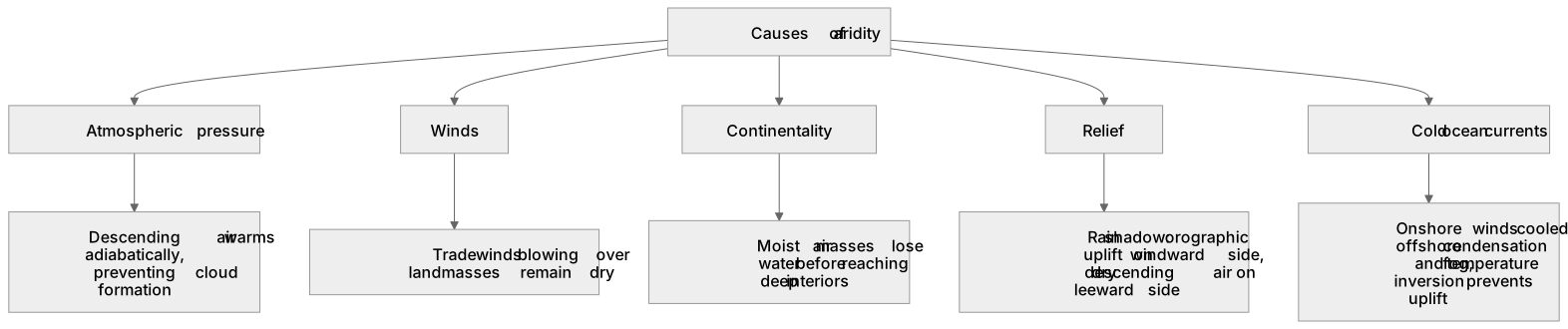
Aridity, defined as a permanent moisture deficit (typically under 250 mm annual precipitation), is driven by five key factors. Global atmospheric circulation creates high-pressure zones around 30° N/S (the Hadley cell descending limb), where sinking air warms adiabatically, preventing cloud formation. Trade winds blowing over landmasses remain dry, exacerbating this. Continentality causes aridity in deep interiors, like the Gobi, as moist air masses lose water before reaching them. Relief creates rain shadows; for example, the Andes block moisture, leaving the Atacama dry. Finally, cold ocean currents (like the Benguela current) cool onshore winds, causing offshore condensation and fog, but preventing rain from reaching the adjacent Namib desert.
What earns the marks
- Explain how descending air in the Hadley cell creates stable, high-pressure conditions that inhibit condensation and precipitation.
- Describe the rain shadow effect where orographic uplift causes precipitation on the windward side, leaving descending, warming air dry on the leeward side.
- Detail how distance from the sea (continentality) depletes the moisture content of prevailing winds before they reach inland areas.
- Explain the role of cold ocean currents in chilling lower air masses, creating temperature inversions that prevent the uplift necessary for rain formation.
Common mistakes and how to put them right
Confusing high and low pressure systems.
Put it right: High pressure involves descending air which warms and prevents cloud formation, whereas low pressure involves rising air and rain.
Stating that cold ocean currents cause dry air because cold water evaporates less.
Put it right: Explain that cold currents cool the air above them, causing offshore fog and a temperature inversion that prevents convective uplift over land.
Describing the rain shadow effect backwards.
Put it right: Ensure you state that the leeward (sheltered) side experiences aridity due to descending air, not the windward side.
Exam tips
- Use specific named examples for each cause of aridity, such as the Atacama for cold ocean currents and relief, or the Sahara for high pressure.
- When discussing atmospheric pressure, explicitly mention adiabatic warming of descending air to demonstrate a higher-level understanding of physical processes.
- Link multiple causes together if evaluating a specific desert, as many deserts (like the Atacama) are formed by a combination of relief, pressure, and ocean currents.
Try the lesson
The start of the Deserts as natural systems: The causes of aridity: atmospheric processes relating to pressure, winds, continentality, relief and cold ocean currents. lesson, made from checked teaching notes for this specification point.
Have a go first
How do cold ocean currents contribute to the formation of coastal deserts?
Listen
Aridity, defined as a permanent moisture deficit (typically under 250 mm annual precipitation), is driven by five key factors. Global atmospheric circulation creates high-pressure zones around 30° N/S (the Hadley cell descending limb), where sinking air warms adiabatically, preventing cloud formation. Trade winds blowing over landmasses remain dry, exacerbating this. Continentality causes aridity in deep interiors, like the Gobi, as moist air masses lose water before reaching them. Relief creates rain shadows; for example, the Andes block moisture, leaving the Atacama dry. Finally, cold ocean currents (like the Benguela current) cool onshore winds, causing offshore condensation and fog, but preventing rain from reaching the adjacent Namib desert. A strong answer earns marks for these points. Explain how descending air in the Hadley cell creates stable, high-pressure conditions that inhibit condensation and precipitation. Describe the rain shadow effect where orographic uplift causes precipitation on the windward side, leaving descending, warming air dry on the leeward side. Detail how distance from the sea (continentality) depletes the moisture content of prevailing winds before they reach inland areas. Explain the role of cold ocean currents in chilling lower air masses, creating temperature inversions that prevent the uplift necessary for rain formation. A common slip: Confusing high and low pressure systems. Instead, high pressure involves descending air which warms and prevents cloud formation, whereas low pressure involves rising air and rain. Exam tip: Use specific named examples for each cause of aridity, such as the Atacama for cold ocean currents and relief, or the Sahara for high pressure.
See it
Key words
Say what each word means before you turn the card.
Atmospheric circulation
Try answering aloud or in your head before turning the card.
Ocean-atmosphere interactions
Try answering aloud or in your head before turning the card.
Topographic influences
Try answering aloud or in your head before turning the card.
Spatial distribution of biomes
Try answering aloud or in your head before turning the card.
See every definition
- Atmospheric circulation
- Global circulation creates high-pressure zones around 30° N/S, where sinking air warms adiabatically and prevents cloud formation.
- Ocean-atmosphere interactions
- Cold ocean currents cool onshore winds, causing offshore condensation and fog but preventing rain from reaching the adjacent desert.
- Topographic influences
- Relief creates rain shadows, where orographic uplift causes precipitation on the windward side and descending, warming air leaves the leeward side dry.
- Spatial distribution of biomes
- Global atmospheric pressure belts determine where hot deserts are distributed, as high-pressure zones inhibit condensation and precipitation.
Label the diagram
Some boxes have lost their names. Pick the right name for each number.
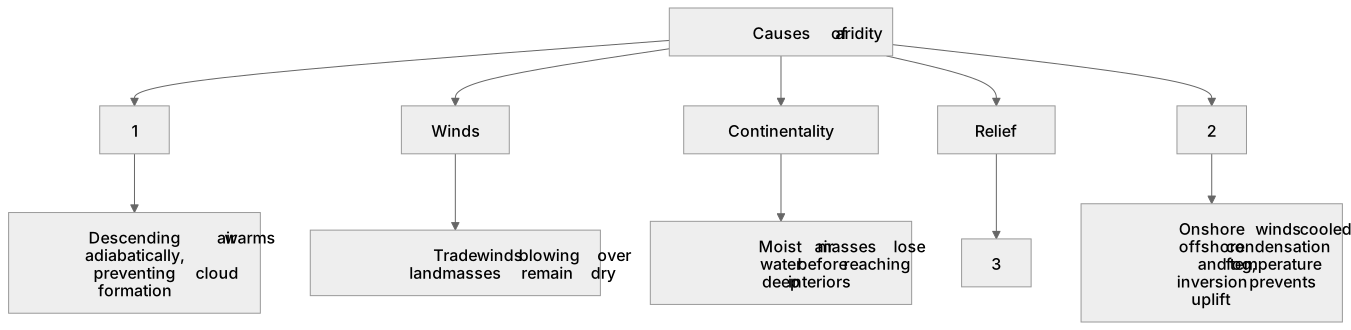
1Box 1
2Box 2
3Box 3
There is more to this lesson
The full lesson goes on to check your understanding and help you earn the marks. Create a free account to carry on, with your progress saved.
A week of Premium from your first lesson · Then the free plan continues · No card, no charge
Test your understanding of Deserts as natural systems: The causes of aridity: atmospheric processes relating to pressure, winds, continentality, relief and cold ocean currents.
Active recall beats re-reading. Take an instant quiz now to test what you’ve learned and lock it into long-term memory.
A week of Premium from your first lesson · Then the free plan continues · No card, no charge