AQA · A-Level · Geography
Course version: 7037 · Version from Sept 2018
Application of systems concepts to ecosystems – inputs, outputs, stores…
Full specification wording
Ecosystems and processes: Application of systems concepts to ecosystems – inputs, outputs, stores and transfers of energy and materials. Concepts of biomass and net primary production.
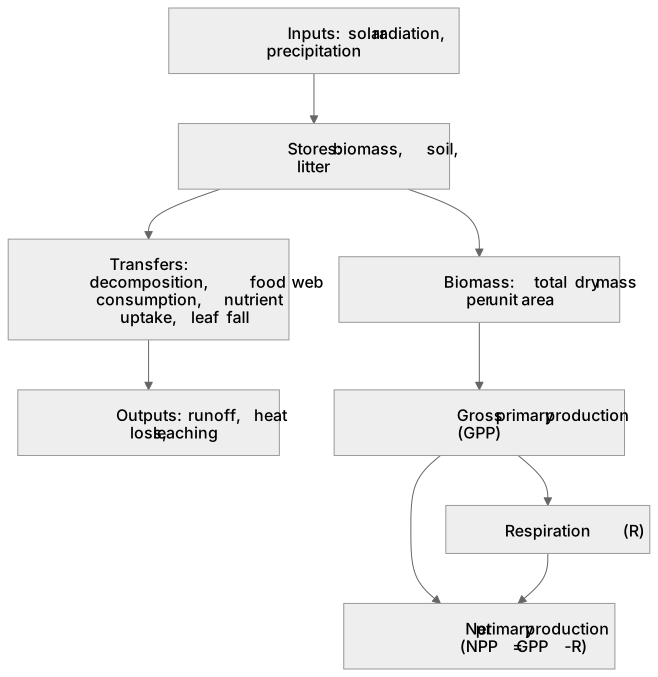
Ecosystems function as open systems with distinct inputs (solar radiation, precipitation), outputs (runoff, heat loss), stores (biomass, soil, litter), and transfers (decomposition, food web…
Checked against the AQA 7037 specification (opens in a new tab) on .
- Point 2 of 4
- 4 key terms
Study notes
From the checked teaching notes for this specification point.
The idea
Ecosystems function as open systems with distinct inputs (solar radiation, precipitation), outputs (runoff, heat loss), stores (biomass, soil, litter), and transfers (decomposition, food web consumption) of both energy and materials. Energy flows linearly and is ultimately lost as heat, whereas materials like carbon and nitrogen cycle continuously. Biomass represents the total dry mass of living organisms per unit area, typically measured in g m⁻². Net primary production (NPP) is the rate at which plants accumulate energy or biomass, calculated as gross primary production minus respiratory losses (NPP = GPP - R). It is usually expressed in g m⁻² yr⁻¹ or kJ m⁻² yr⁻¹, indicating the energy available to higher trophic levels.
What earns the marks
- Define ecosystems as open systems exchanging both energy and matter with their surrounding environment.
- Identify specific stores (e.g., biomass, dead organic matter, soil) and transfers (e.g., nutrient uptake, leaf fall, consumption).
- Distinguish between the one-way flow of energy (ultimately lost as heat) and the cyclical transfer of materials (nutrients).
- Define biomass as the total dry mass of living matter within a specific area, noting its role as a major energy store.
- Explain Net Primary Production (NPP) as the energy remaining after autotrophic respiration (R) is subtracted from Gross Primary Production (GPP).
Common mistakes and how to put them right
Confusing energy flow with material cycling.
Put it right: Energy flows linearly and is lost as heat, whereas materials cycle continuously through the system.
Using wet mass instead of dry mass to define biomass.
Put it right: Biomass must be measured as dry mass to eliminate variations caused by fluctuating water content.
Equating Gross Primary Production (GPP) with Net Primary Production (NPP).
Put it right: NPP is GPP minus the energy used by plants for respiration.
Exam tips
- Use specific examples of inputs (e.g., solar energy) and outputs (e.g., leaching) when describing an ecosystem as an open system.
- Always include appropriate units when discussing NPP, such as g m⁻² yr⁻¹ or kJ m⁻² yr⁻¹, to demonstrate mathematical understanding.
- When evaluating ecosystem productivity, explicitly state the formula NPP = GPP - R to structure your explanation.
Try the lesson
The start of the Ecosystems and processes: Application of systems concepts to ecosystems – inputs, outputs, stores and transfers of energy and materials. Concepts of biomass and net primary production. lesson, made from checked teaching notes for this specification point.
Have a go first
What is the definition of Net Primary Production (NPP) within the context of an ecosystem?
Listen
Ecosystems function as open systems with distinct inputs (solar radiation, precipitation), outputs (runoff, heat loss), stores (biomass, soil, litter), and transfers (decomposition, food web consumption) of both energy and materials. Energy flows linearly and is ultimately lost as heat, whereas materials like carbon and nitrogen cycle continuously. Biomass represents the total dry mass of living organisms per unit area, typically measured in g m⁻². Net primary production (NPP) is the rate at which plants accumulate energy or biomass, calculated as gross primary production minus respiratory losses (NPP = GPP - R). It is usually expressed in g m⁻² yr⁻¹ or kJ m⁻² yr⁻¹, indicating the energy available to higher trophic levels. A strong answer earns marks for these points. Define ecosystems as open systems exchanging both energy and matter with their surrounding environment. Identify specific stores (e.g., biomass, dead organic matter, soil) and transfers (e.g., nutrient uptake, leaf fall, consumption). Distinguish between the one-way flow of energy (ultimately lost as heat) and the cyclical transfer of materials (nutrients). Define biomass as the total dry mass of living matter within a specific area, noting its role as a major energy store. Exam tip: Use specific examples of inputs (e.g., solar energy) and outputs (e.g., leaching) when describing an ecosystem as an open system.
See it
Key words
Say what each word means before you turn the card.
Systems theory
Try answering aloud or in your head before turning the card.
Energy flow
Try answering aloud or in your head before turning the card.
Nutrient cycling
Try answering aloud or in your head before turning the card.
Ecosystem productivity
Try answering aloud or in your head before turning the card.
See every definition
- Systems theory
- Application of systems concepts to ecosystems, involving inputs, outputs, stores and transfers of energy and materials.
- Energy flow
- Movement of energy that is linear and ultimately lost as heat.
- Nutrient cycling
- Continuous cycling of materials such as carbon and nitrogen through the system.
- Ecosystem productivity
- Net primary production is the rate at which plants accumulate energy or biomass, calculated as gross primary production minus respiratory losses.
Label the diagram
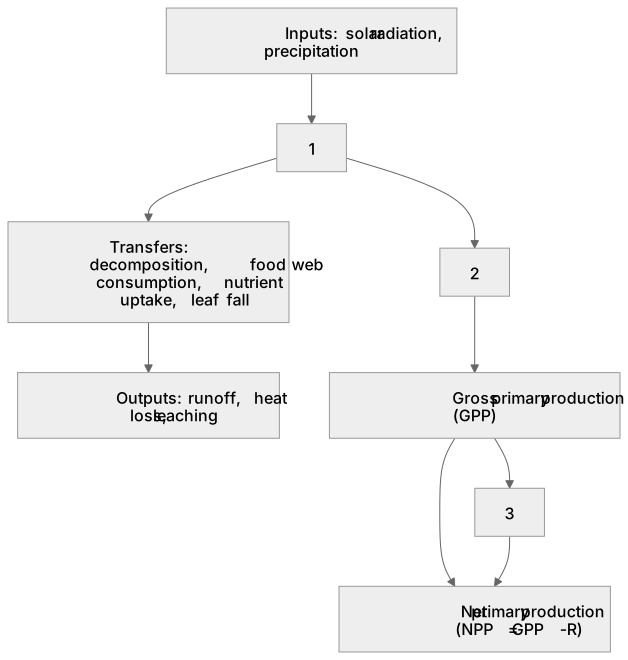
Some boxes have lost their names. Pick the right name for each number.
1Box 1
2Box 2
3Box 3
There is more to this lesson
The full lesson goes on to check your understanding and help you earn the marks. Create a free account to carry on, with your progress saved.
A week of Premium from your first lesson · Then the free plan continues · No card, no charge
Test your understanding of Ecosystems and processes: Application of systems concepts to ecosystems – inputs, outputs, stores and transfers of energy and materials. Concepts of biomass and net primary production.
Active recall beats re-reading. Take an instant quiz now to test what you’ve learned and lock it into long-term memory.
A week of Premium from your first lesson · Then the free plan continues · No card, no charge