AQA · A-Level · Geography
Course version: 7037 · Version from Sept 2018
Nature of ecosystems – their structure, energy flows, trophic levels, food…
Full specification wording
Ecosystems and processes: Nature of ecosystems – their structure, energy flows, trophic levels, food chains and food webs.
An ecosystem's structure comprises interacting biotic communities and abiotic factors.
Checked against the AQA 7037 specification (opens in a new tab) on .
- Point 1 of 4
- 3 key terms
Study notes
From the checked teaching notes for this specification point.
The idea
An ecosystem's structure comprises interacting biotic communities and abiotic factors. Energy flows through this system unidirectionally, entering primarily via solar radiation captured by autotrophs (producers) during photosynthesis. This energy is transferred through distinct trophic levels, from primary consumers (herbivores) to apex predators. A food chain illustrates a single, linear pathway of this energy transfer, whereas a food web provides a more realistic, complex network of interconnected food chains within the ecosystem. Because energy is lost at each trophic level through respiration and heat (following the 10% rule), food chains rarely exceed four or five levels, fundamentally shaping the ecosystem's carrying capacity and overall biomass distribution.
What earns the marks
- Define ecosystem structure as the dynamic interaction between biotic (living) and abiotic (non-living) components.
- Explain that energy flows unidirectionally through an ecosystem, unlike nutrients which are continuously cycled.
- Describe the function of trophic levels, identifying producers, primary, secondary, and tertiary consumers.
- Distinguish between a food chain (linear energy transfer) and a food web (complex, interconnected feeding relationships).
- Apply the concept of energy loss between trophic levels (approximately 90% lost as heat and respiration) to explain limits on food chain length.
Common mistakes and how to put them right
Stating that energy cycles through an ecosystem.
Put it right: Specify that energy flows unidirectionally and is eventually lost as heat, whereas nutrients cycle.
Drawing food chain arrows pointing towards the organism being eaten.
Put it right: Ensure arrows point in the direction of energy flow, from the prey to the predator.
Confusing food chains with food webs.
Put it right: Define a food chain as a single linear pathway and a food web as a complex network of multiple interconnected chains.
Exam tips
- Always draw arrows in food webs pointing in the direction of energy transfer, representing the flow of biomass.
- Use specific examples of organisms for each trophic level when describing a local or global ecosystem.
- Reference the second law of thermodynamics when explaining why biomass and energy decrease at higher trophic levels.
Try the lesson
The start of the Ecosystems and processes: Nature of ecosystems – their structure, energy flows, trophic levels, food chains and food webs. lesson, made from checked teaching notes for this specification point.
Have a go first
In a typical ecosystem, what happens to the majority of energy as it flows from one trophic level to the next?
Listen
An ecosystem's structure comprises interacting biotic communities and abiotic factors. Energy flows through this system unidirectionally, entering primarily via solar radiation captured by autotrophs (producers) during photosynthesis. This energy is transferred through distinct trophic levels, from primary consumers (herbivores) to apex predators. A food chain illustrates a single, linear pathway of this energy transfer, whereas a food web provides a more realistic, complex network of interconnected food chains within the ecosystem. Because energy is lost at each trophic level through respiration and heat (following the 10% rule), food chains rarely exceed four or five levels, fundamentally shaping the ecosystem's carrying capacity and overall biomass distribution. A strong answer earns marks for these points. Define ecosystem structure as the dynamic interaction between biotic (living) and abiotic (non-living) components. Explain that energy flows unidirectionally through an ecosystem, unlike nutrients which are continuously cycled. Describe the function of trophic levels, identifying producers, primary, secondary, and tertiary consumers. Distinguish between a food chain (linear energy transfer) and a food web (complex, interconnected feeding relationships). A common slip: Stating that energy cycles through an ecosystem. Instead, specify that energy flows unidirectionally and is eventually lost as heat, whereas nutrients cycle. Exam tip: Always draw arrows in food webs pointing in the direction of energy transfer, representing the flow of biomass.
See it
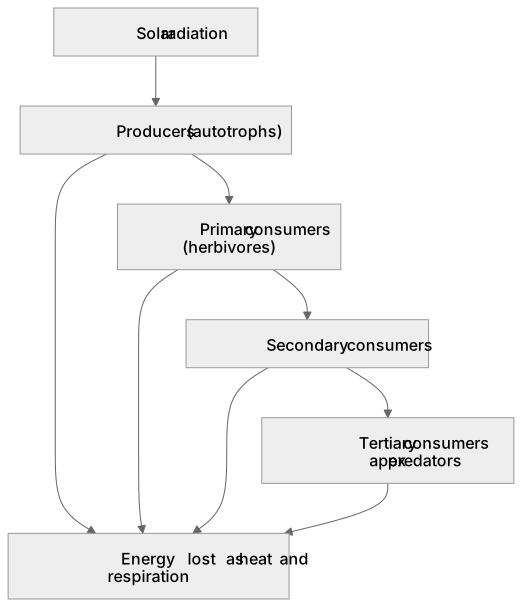
Key words
Say what each word means before you turn the card.
Energy dynamics
Try answering aloud or in your head before turning the card.
System structure
Try answering aloud or in your head before turning the card.
Ecological efficiency
Try answering aloud or in your head before turning the card.
See every definition
- Energy dynamics
- Energy flows unidirectionally through an ecosystem, entering primarily via solar radiation captured by autotrophs during photosynthesis and eventually lost as heat.
- System structure
- The arrangement comprises interacting biotic communities and abiotic factors, with energy transferred through distinct trophic levels from primary consumers to apex predators.
- Ecological efficiency
- Energy is lost at each trophic level through respiration and heat following the 10% rule, so food chains rarely exceed four or five levels.
Label the diagram
Some boxes have lost their names. Pick the right name for each number.
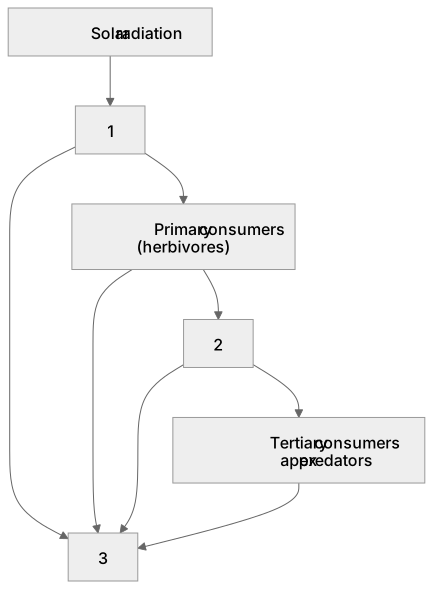
1Box 1
2Box 2
3Box 3
There is more to this lesson
The full lesson goes on to check your understanding and help you earn the marks. Create a free account to carry on, with your progress saved.
A week of Premium from your first lesson · Then the free plan continues · No card, no charge
Test your understanding of Ecosystems and processes: Nature of ecosystems – their structure, energy flows, trophic levels, food chains and food webs.
Active recall beats re-reading. Take an instant quiz now to test what you’ve learned and lock it into long-term memory.
A week of Premium from your first lesson · Then the free plan continues · No card, no charge