AQA · A-Level · Geography
Course version: 7037 · Version from Sept 2018
Sources of energy, both primary and secondary. Components of demand and…
Full specification wording
Energy security: Sources of energy, both primary and secondary. Components of demand and energy mixes in contrasting settings.
Primary energy sources are extracted directly from nature, such as raw coal or wind.
Checked against the AQA 7037 specification (opens in a new tab) on .
- Point 1 of 7
- 4 key terms
Study notes
From the checked teaching notes for this specification point.
The idea
Primary energy sources are extracted directly from nature, such as raw coal or wind. Secondary sources are derived from transforming primary sources, with electricity and refined petrol being prime examples. Energy demand comprises distinct components: industrial manufacturing, domestic heating, transport networks, and agriculture. A country's energy mix represents the proportion of different primary sources it consumes. Contrasting settings reveal stark differences; for instance, Norway's mix is dominated by renewable hydroelectricity due to its topography, whereas India relies heavily on coal to fuel rapid industrialisation. Understanding these variations requires analysing how economic development and sectoral demand shape national energy profiles.
What earns the marks
- Define primary energy as unconverted natural resources and secondary energy as manufactured or converted forms like electricity.
- Identify and evaluate the main components of energy demand: transport, domestic, industrial, and commercial sectors.
- Compare the energy mixes of at least two contrasting countries, highlighting the dominance of specific fuels.
- Explain how the level of economic development influences the components of demand, such as higher industrial demand in emerging economies.
Common mistakes and how to put them right
Confusing primary and secondary energy.
Put it right: State that coal is primary, but the electricity generated from burning it is secondary.
Treating 'energy mix' and 'electricity mix' as the same thing.
Put it right: Ensure the energy mix includes all energy used for transport and heating, not just electrical power generation.
Failing to specify components of demand.
Put it right: Explicitly break down national demand into transport, domestic, and industrial sectors rather than just discussing total volume.
Exam tips
- Learn specific percentage figures for the energy mix of two contrasting countries to support comparative essays.
- When discussing demand, link the dominant component to the country's development stage, such as transport in post-industrial societies.
- Use the terms 'primary' and 'secondary' accurately when describing energy pathways from extraction to consumption.
Try the lesson
The start of the Energy security: Sources of energy, both primary and secondary. Components of demand and energy mixes in contrasting settings. lesson, made from checked teaching notes for this specification point.
Have a go first
Which of the following correctly identifies a secondary source of energy?
Listen
Primary energy sources are extracted directly from nature, such as raw coal or wind. Secondary sources are derived from transforming primary sources, with electricity and refined petrol being prime examples. Energy demand comprises distinct components: industrial manufacturing, domestic heating, transport networks, and agriculture. A country's energy mix represents the proportion of different primary sources it consumes. Contrasting settings reveal stark differences; for instance, Norway's mix is dominated by renewable hydroelectricity due to its topography, whereas India relies heavily on coal to fuel rapid industrialisation. Understanding these variations requires analysing how economic development and sectoral demand shape national energy profiles. A strong answer earns marks for these points. Define primary energy as unconverted natural resources and secondary energy as manufactured or converted forms like electricity. Identify and evaluate the main components of energy demand: transport, domestic, industrial, and commercial sectors. Compare the energy mixes of at least two contrasting countries, highlighting the dominance of specific fuels. Explain how the level of economic development influences the components of demand, such as higher industrial demand in emerging economies. A common slip: Confusing primary and secondary energy. Instead, state that coal is primary, but the electricity generated from burning it is secondary. Exam tip: Learn specific percentage figures for the energy mix of two contrasting countries to support comparative essays.
See it

Key words
Say what each word means before you turn the card.
Primary energy
Try answering aloud or in your head before turning the card.
Secondary energy
Try answering aloud or in your head before turning the card.
Energy mix
Try answering aloud or in your head before turning the card.
Components of demand
Try answering aloud or in your head before turning the card.
See every definition
- Primary energy
- Energy sources extracted directly from nature, such as raw coal or wind.
- Secondary energy
- Energy derived from transforming primary sources, with electricity and refined petrol being prime examples.
- Energy mix
- The proportion of different primary sources a country consumes.
- Components of demand
- Industrial manufacturing, domestic heating, transport networks and agriculture.
Label the diagram
Some boxes have lost their names. Pick the right name for each number.
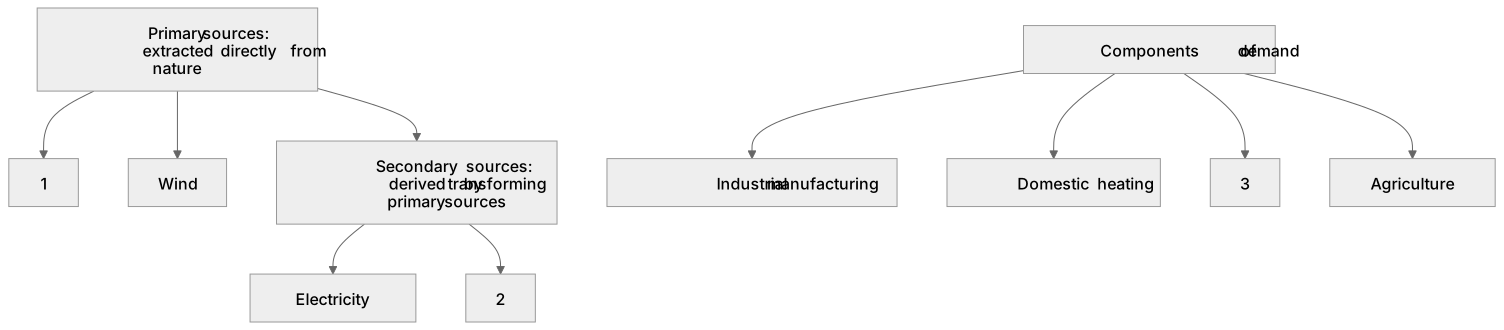
1Box 1
2Box 2
3Box 3
There is more to this lesson
The full lesson goes on to check your understanding and help you earn the marks. Create a free account to carry on, with your progress saved.
A week of Premium from your first lesson · Then the free plan continues · No card, no charge
Test your understanding of Energy security: Sources of energy, both primary and secondary. Components of demand and energy mixes in contrasting settings.
Active recall beats re-reading. Take an instant quiz now to test what you’ve learned and lock it into long-term memory.
A week of Premium from your first lesson · Then the free plan continues · No card, no charge