AQA · A-Level · Geography
Course version: 7037 · Version from Sept 2018
Global patterns of health, mortality and morbidity. Economic and social…
Full specification wording
Environment, health and well-being: Global patterns of health, mortality and morbidity. Economic and social development and the epidemiological transition.
Global health patterns show stark contrasts, measured by mortality (death rates) and morbidity (illness prevalence).
Checked against the AQA 7037 specification (opens in a new tab) on .
- Point 1 of 5
- 4 key terms
Study notes
From the checked teaching notes for this specification point.
The idea
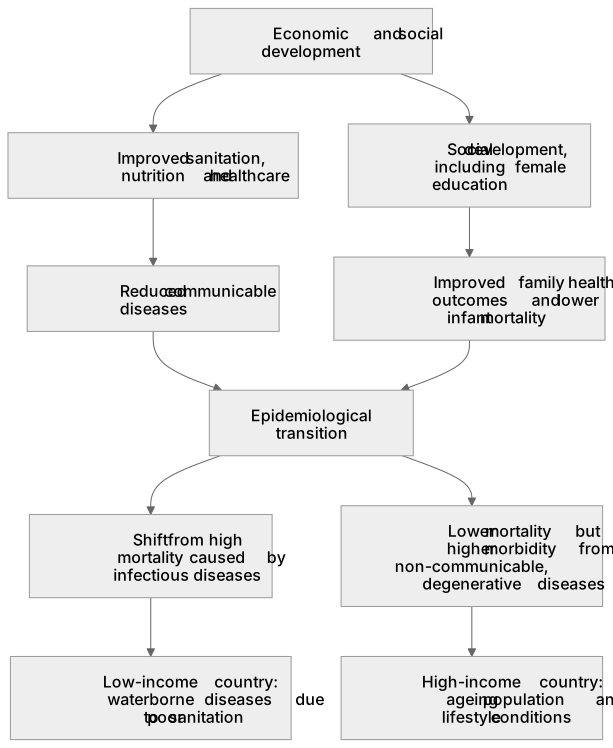
Global health patterns show stark contrasts, measured by mortality (death rates) and morbidity (illness prevalence). These patterns are driven by economic and social development. As nations develop, they undergo the epidemiological transition. This model describes a shift from high mortality caused by infectious diseases (like malaria) to lower mortality but higher morbidity from non-communicable, degenerative diseases (like heart disease). For example, a low-income country may struggle with waterborne diseases due to poor sanitation, while a high-income country faces healthcare challenges from an ageing population and lifestyle conditions. This transition explains how the global disease burden shifts alongside economic progress.
What earns the marks
- Define mortality as the incidence of death and morbidity as the incidence of disease or illness within a population.
- Explain the stages of Omran's epidemiological transition model, linking them to demographic changes and development.
- Analyse how economic development improves sanitation, nutrition, and healthcare, reducing communicable diseases.
- Evaluate how social development, particularly female education, correlates with improved family health outcomes and lower infant mortality.
- Discuss the rise of diseases of affluence (non-communicable diseases) in advanced stages of the epidemiological transition.
Common mistakes and how to put them right
Confusing mortality and morbidity.
Put it right: Mortality refers to death rates, whereas morbidity refers to the prevalence of illness or disease.
Assuming the epidemiological transition only applies to economic changes.
Put it right: It must also be linked to social development such as education and healthcare access.
Stating that infectious diseases are entirely eradicated in high-income countries.
Put it right: They are reduced but can still cause significant morbidity, especially novel viruses.
Exam tips
- Use specific country examples to contrast different stages of the epidemiological transition model.
- When discussing development, explicitly separate economic factors (like GDP per capita) from social factors (like literacy rates).
- Link changes in morbidity and mortality to the Demographic Transition Model to show synoptic understanding of population dynamics.
Try the lesson
The start of the Environment, health and well-being: Global patterns of health, mortality and morbidity. Economic and social development and the epidemiological transition. lesson, made from checked teaching notes for this specification point.
Have a go first
According to the epidemiological transition model, what is the defining characteristic of the 'Age of Degenerative and Man-Made Diseases'?
Listen
Global health patterns show stark contrasts, measured by mortality (death rates) and morbidity (illness prevalence). These patterns are driven by economic and social development. As nations develop, they undergo the epidemiological transition. This model describes a shift from high mortality caused by infectious diseases (like malaria) to lower mortality but higher morbidity from non-communicable, degenerative diseases (like heart disease). For example, a low-income country may struggle with waterborne diseases due to poor sanitation, while a high-income country faces healthcare challenges from an ageing population and lifestyle conditions. This transition explains how the global disease burden shifts alongside economic progress. A strong answer earns marks for these points. Define mortality as the incidence of death and morbidity as the incidence of disease or illness within a population. Explain the stages of Omran's epidemiological transition model, linking them to demographic changes and development. Analyse how economic development improves sanitation, nutrition, and healthcare, reducing communicable diseases. Evaluate how social development, particularly female education, correlates with improved family health outcomes and lower infant mortality. Exam tip: Use specific country examples to contrast different stages of the epidemiological transition model.
See it
Key words
Say what each word means before you turn the card.
Mortality
Try answering aloud or in your head before turning the card.
Morbidity
Try answering aloud or in your head before turning the card.
Epidemiological transition
Try answering aloud or in your head before turning the card.
Development
Try answering aloud or in your head before turning the card.
See every definition
- Mortality
- The incidence of death within a population, measured by death rates.
- Morbidity
- The incidence of disease or illness within a population, or the prevalence of illness.
- Epidemiological transition
- A model describing a shift from high mortality caused by infectious diseases to lower mortality but higher morbidity from non-communicable, degenerative diseases as nations develop.
- Development
- Economic and social progress, including improved sanitation, nutrition, healthcare, education and healthcare access, which drives changes in health patterns.
Label the diagram
Some boxes have lost their names. Pick the right name for each number.
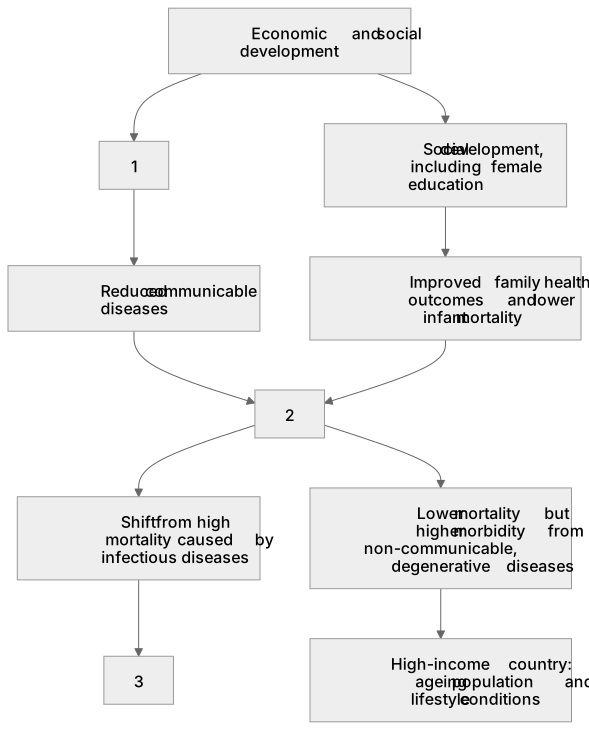
1Box 1
2Box 2
3Box 3
There is more to this lesson
The full lesson goes on to check your understanding and help you earn the marks. Create a free account to carry on, with your progress saved.
A week of Premium from your first lesson · Then the free plan continues · No card, no charge
Test your understanding of Environment, health and well-being: Global patterns of health, mortality and morbidity. Economic and social development and the epidemiological transition.
Active recall beats re-reading. Take an instant quiz now to test what you’ve learned and lock it into long-term memory.
A week of Premium from your first lesson · Then the free plan continues · No card, no charge