AQA · A-Level · Geography
Course version: 7037 · Version from Sept 2018
The relationship between environment variables eg climate, topography…
Full specification wording
Environment, health and well-being: The relationship between environment variables eg climate, topography (drainage) and incidence of disease. Air quality and health. Water quality and health.
Environmental variables strongly influence disease incidence.
Checked against the AQA 7037 specification (opens in a new tab) on .
- Point 2 of 5
- 4 key terms
Study notes
From the checked teaching notes for this specification point.
The idea
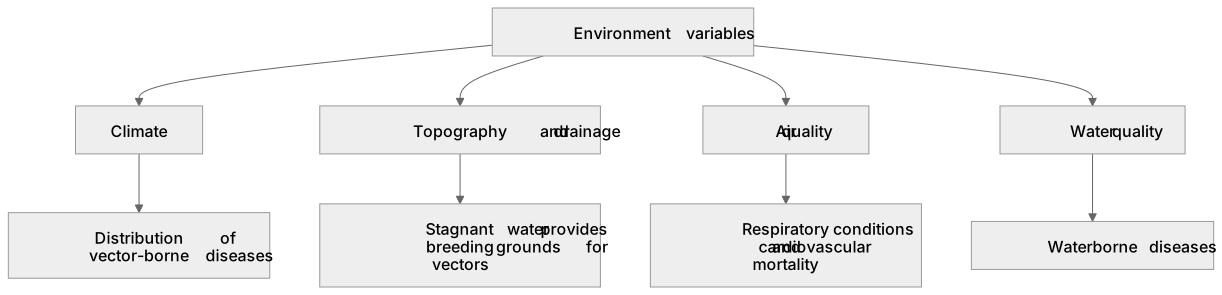
Environmental variables strongly influence disease incidence. Climate dictates the distribution of vector-borne diseases; malaria thrives in tropics where high temperatures support mosquitoes. Topography and drainage are critical, as stagnant water in poorly drained areas provides breeding grounds for vectors. Environmental quality also impacts health. Poor air quality, measured by particulate matter (PM2.5 in µg/m³), exacerbates respiratory conditions like asthma and increases cardiovascular mortality. Similarly, poor water quality, contaminated by runoff or inadequate sanitation, leads to outbreaks of waterborne diseases such as cholera. This highlights the vital link between physical environments, pollution, and global health outcomes.
What earns the marks
- Explain how climatic factors (temperature, precipitation, humidity) control the geographical range and seasonal incidence of vector-borne diseases.
- Analyse the role of topography and drainage in creating micro-environments for disease vectors, such as stagnant water for mosquitoes.
- Evaluate the health impacts of poor air quality, specifically linking particulate matter and nitrogen dioxide to respiratory and cardiovascular diseases.
- Discuss how water quality affects health, focusing on the transmission of waterborne diseases through contaminated drinking water and poor sanitation.
- Assess how human modification of the environment (e.g., urbanisation, deforestation) alters these environmental variables and subsequently changes disease incidence.
Common mistakes and how to put them right
Failing to distinguish between waterborne diseases (caused by ingesting contaminated water) and water-bred/vector-borne diseases (where the vector breeds in water).
Using incorrect units for air pollution.
Put it right: Particulate matter should be expressed as a concentration, such as µg/m³, rather than a percentage.
Exam tips
- Use specific examples of diseases (e.g., malaria for climate/drainage, cholera for water quality, asthma for air quality) to anchor your explanations.
- When discussing topography, link it explicitly to drainage patterns and how water accumulates in the landscape.
- Consider spatial variations in air and water quality, contrasting urban and rural environments or high-income and low-income countries.
Try the lesson
The start of the Environment, health and well-being: The relationship between environment variables eg climate, topography (drainage) and incidence of disease. Air quality and health. Water quality and health. lesson, made from checked teaching notes for this specification point.
Have a go first
Which environmental variable is most directly responsible for the high incidence of water-borne diseases such as cholera in certain regions?
Listen
Environmental variables strongly influence disease incidence. Climate dictates the distribution of vector-borne diseases; malaria thrives in tropics where high temperatures support mosquitoes. Topography and drainage are critical, as stagnant water in poorly drained areas provides breeding grounds for vectors. Environmental quality also impacts health. Poor air quality, measured by particulate matter (PM2.5 in µg/m³), exacerbates respiratory conditions like asthma and increases cardiovascular mortality. Similarly, poor water quality, contaminated by runoff or inadequate sanitation, leads to outbreaks of waterborne diseases such as cholera. This highlights the vital link between physical environments, pollution, and global health outcomes. A strong answer earns marks for these points. Explain how climatic factors (temperature, precipitation, humidity) control the geographical range and seasonal incidence of vector-borne diseases. Analyse the role of topography and drainage in creating micro-environments for disease vectors, such as stagnant water for mosquitoes. Evaluate the health impacts of poor air quality, specifically linking particulate matter and nitrogen dioxide to respiratory and cardiovascular diseases. Discuss how water quality affects health, focusing on the transmission of waterborne diseases through contaminated drinking water and poor sanitation. Exam tip: Use specific examples of diseases (e.g., malaria for climate/drainage, cholera for water quality, asthma for air quality) to anchor your explanations.
See it
Key words
Say what each word means before you turn the card.
Physical systems
Try answering aloud or in your head before turning the card.
Human-environment interaction
Try answering aloud or in your head before turning the card.
Health and well-being
Try answering aloud or in your head before turning the card.
Spatial distribution
Try answering aloud or in your head before turning the card.
See every definition
- Physical systems
- Environmental variables such as climate and topography, including drainage, which influence the incidence of disease.
- Human-environment interaction
- Human modification of the environment, such as urbanisation and deforestation, which alters environmental variables and subsequently changes disease incidence.
- Health and well-being
- Affected by environmental quality, including air quality and water quality, which influence respiratory, cardiovascular and waterborne diseases.
- Spatial distribution
- The geographical range and seasonal incidence of vector-borne diseases, controlled by climatic factors such as temperature, precipitation and humidity.
Label the diagram
Some boxes have lost their names. Pick the right name for each number.
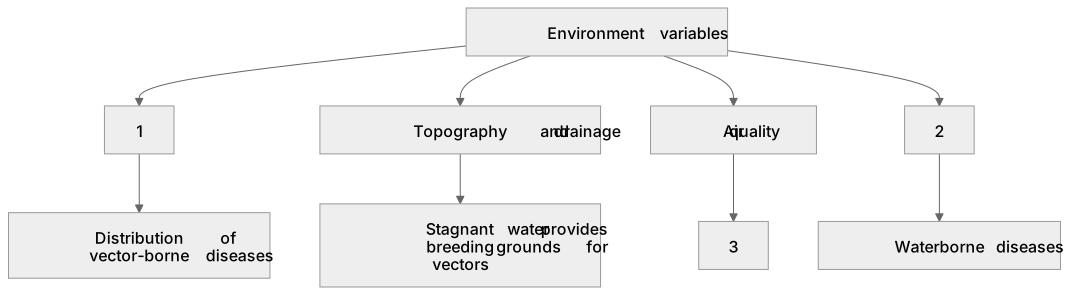
1Box 1
2Box 2
3Box 3
There is more to this lesson
The full lesson goes on to check your understanding and help you earn the marks. Create a free account to carry on, with your progress saved.
A week of Premium from your first lesson · Then the free plan continues · No card, no charge
Test your understanding of Environment, health and well-being: The relationship between environment variables eg climate, topography (drainage) and incidence of disease. Air quality and health. Water quality and health.
Active recall beats re-reading. Take an instant quiz now to test what you’ve learned and lock it into long-term memory.
A week of Premium from your first lesson · Then the free plan continues · No card, no charge