AQA · A-Level · Geography
Course version: 7037 · Version from Sept 2018
The global prevalence, distribution, seasonal incidence of one specified…
Full specification wording
Environment, health and well-being: The global prevalence, distribution, seasonal incidence of one specified biologically transmitted disease, eg malaria; its links to physical and socio-economic environments including impacts of environmental variables on transmission vectors. Impact on health and well-being. Management and mitigation strategies.
Malaria is a biologically transmitted disease with high global prevalence, primarily distributed across tropical regions like Sub-Saharan Africa.
Checked against the AQA 7037 specification (opens in a new tab) on .
- Point 3 of 5
- 4 key terms
Study notes
From the checked teaching notes for this specification point.
The idea
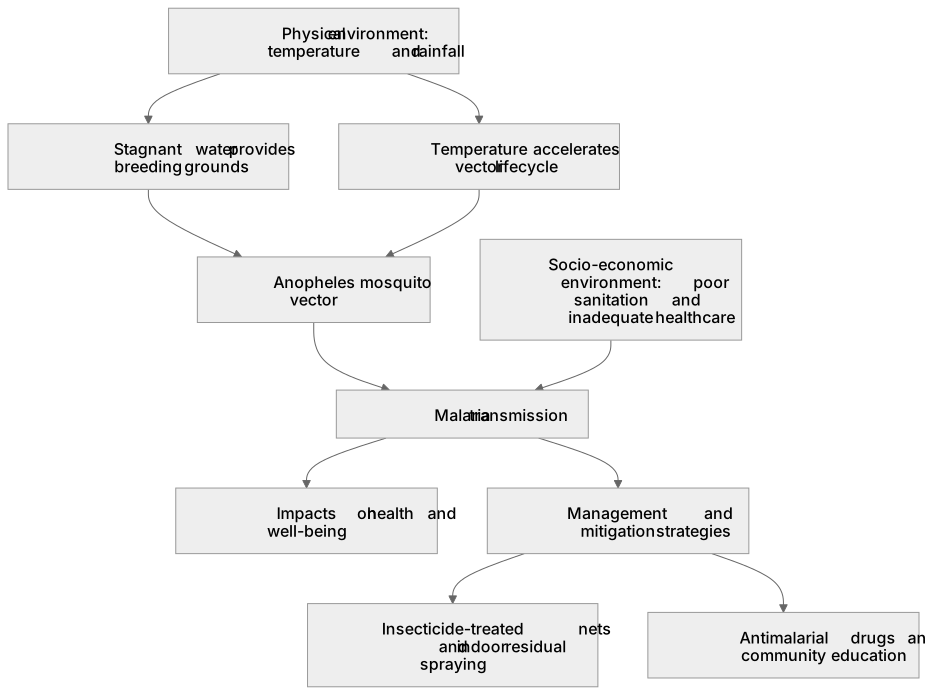
Malaria is a biologically transmitted disease with high global prevalence, primarily distributed across tropical regions like Sub-Saharan Africa. Its seasonal incidence peaks during rainy seasons when stagnant water provides breeding grounds for the Anopheles mosquito vector. Physical environmental variables, such as temperatures between 15°C and 32°C, accelerate vector lifecycles. Socio-economic links include poor sanitation and inadequate healthcare exacerbating transmission. Impacts on health and well-being include severe anaemia, high infant mortality, and reduced economic productivity. Management and mitigation strategies range from distributing insecticide-treated nets and indoor residual spraying to antimalarial drugs and community education.
What earns the marks
- Accurate description of the global distribution and prevalence of the chosen biologically transmitted disease.
- Explanation of how physical factors influence the lifecycle and spread of the transmission vector.
- Analysis of how socio-economic factors, such as poverty and healthcare access, increase vulnerability to the disease.
- Evaluation of the effectiveness of different management and mitigation strategies at local, national or global scales.
Common mistakes and how to put them right
Confusing the pathogen with the vector.
Put it right: Clearly distinguish between the organism causing the disease (e.g., Plasmodium parasite) and the organism transmitting it (e.g., Anopheles mosquito).
Stating that malaria is only found in Africa.
Put it right: Note that while most prevalent in Sub-Saharan Africa, it is also distributed across parts of Asia and the Americas.
Failing to link seasonal incidence to specific environmental variables.
Put it right: Explicitly connect peak transmission times to seasonal rainfall and temperature changes that favour vector breeding.
Exam tips
- Use specific data to illustrate the prevalence and distribution of your chosen disease.
- When discussing impacts on well-being, include both direct health consequences and indirect socio-economic effects like lost income.
- Assess the sustainability and limitations of mitigation strategies, such as mosquito resistance to insecticides.
Try the lesson
The start of the Environment, health and well-being: The global prevalence, distribution, seasonal incidence of one specified biologically transmitted disease, eg malaria; its links to physical and socio-economic environments including impacts of environmental variables on transmission vectors. Impact on health and well-being. Management and mitigation strategies. lesson, made from checked teaching notes for this specification point.
Have a go first
Which physical environmental condition is most essential for the survival and breeding of the Anopheles mosquito, the primary vector for malaria?
Listen
Malaria is a biologically transmitted disease with high global prevalence, primarily distributed across tropical regions like Sub-Saharan Africa. Its seasonal incidence peaks during rainy seasons when stagnant water provides breeding grounds for the Anopheles mosquito vector. Physical environmental variables, such as temperatures between 15°C and 32°C, accelerate vector lifecycles. Socio-economic links include poor sanitation and inadequate healthcare exacerbating transmission. Impacts on health and well-being include severe anaemia, high infant mortality, and reduced economic productivity. Management and mitigation strategies range from distributing insecticide-treated nets and indoor residual spraying to antimalarial drugs and community education. A strong answer earns marks for these points. Accurate description of the global distribution and prevalence of the chosen biologically transmitted disease. Explanation of how physical factors influence the lifecycle and spread of the transmission vector. Analysis of how socio-economic factors, such as poverty and healthcare access, increase vulnerability to the disease. Evaluation of the effectiveness of different management and mitigation strategies at local, national or global scales. A common slip: Confusing the pathogen with the vector. Instead, Clearly distinguish between the organism causing the disease (e.g., Plasmodium parasite) and the organism transmitting it (e.g., Anopheles mosquito). Exam tip: Use specific data to illustrate the prevalence and distribution of your chosen disease.
See it
Key words
Say what each word means before you turn the card.
Vector ecology and climate
Try answering aloud or in your head before turning the card.
Socio-economic inequalities in health
Try answering aloud or in your head before turning the card.
Global health management
Try answering aloud or in your head before turning the card.
Environmental determinism and disease
Try answering aloud or in your head before turning the card.
See every definition
- Vector ecology and climate
- Physical environmental variables, such as temperatures between 15°C and 32°C, accelerate vector lifecycles, and seasonal rainfall provides breeding grounds for the vector.
- Socio-economic inequalities in health
- Poor sanitation and inadequate healthcare exacerbate transmission of the disease.
- Global health management
- Management and mitigation strategies range from distributing insecticide-treated nets and indoor residual spraying to antimalarial drugs and community education.
- Environmental determinism and disease
- Links to physical and socio-economic environments include impacts of environmental variables on transmission vectors.
Label the diagram
Some boxes have lost their names. Pick the right name for each number.
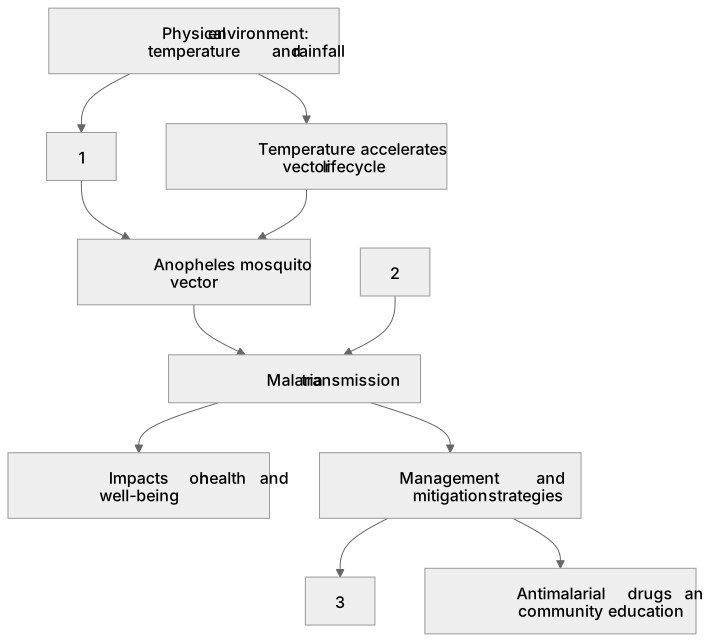
1Box 1
2Box 2
3Box 3
There is more to this lesson
The full lesson goes on to check your understanding and help you earn the marks. Create a free account to carry on, with your progress saved.
A week of Premium from your first lesson · Then the free plan continues · No card, no charge
Test your understanding of Environment, health and well-being: The global prevalence, distribution, seasonal incidence of one specified biologically transmitted disease, eg malaria; its links to physical and socio-economic environments including impacts of environmental variables on transmission vectors. Impact on health and well-being. Management and mitigation strategies.
Active recall beats re-reading. Take an instant quiz now to test what you’ve learned and lock it into long-term memory.
A week of Premium from your first lesson · Then the free plan continues · No card, no charge