AQA · A-Level · Geography
Course version: 7037 · Version from Sept 2018
Erosional and depositional landforms: corries, arêtes, glacial troughs,…
Full specification wording
Glaciated landscape development: Erosional and depositional landforms: corries, arêtes, glacial troughs, hanging valleys, truncated spurs, roches moutonnées. Characteristic glaciated landscapes.
Glaciated landscapes feature distinct erosional and depositional landforms.
Checked against the AQA 7037 specification (opens in a new tab) on .
- Point 1 of 4
- 4 key terms
Study notes
From the checked teaching notes for this specification point.
The idea
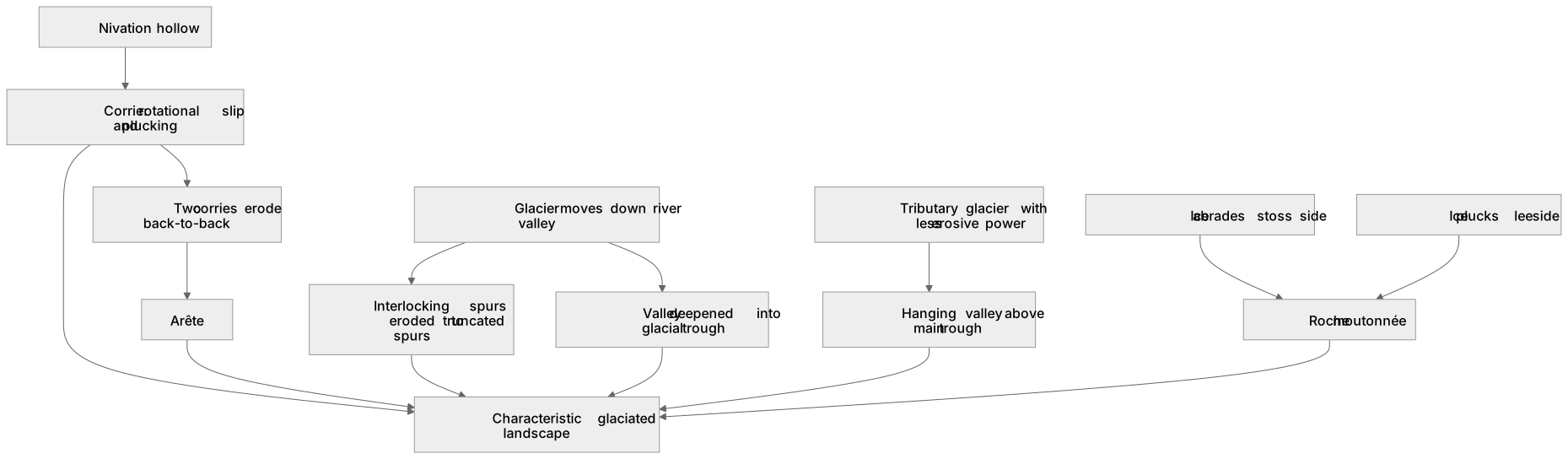
Glaciated landscapes feature distinct erosional and depositional landforms. Corries form as nivation hollows enlarge through rotational slip and plucking. When two corries erode back-to-back, a knife-edged arête is created. Glaciers moving down river valleys erode interlocking spurs to form truncated spurs and deepen the valley into a steep-sided glacial trough. Tributary glaciers leave hanging valleys suspended above the main trough. Roches moutonnées develop as ice abrades the stoss side and plucks the lee side of resistant rock. While these are erosional, depositional features like moraines also shape the terrain. Together, these landforms combine to create characteristic glaciated landscapes, such as the Snowdonia massif.
What earns the marks
- Explain the formation of corries through nivation, rotational slip, abrasion, and plucking.
- Describe the spatial relationship between corries and the formation of arêtes and pyramidal peaks.
- Detail the transformation of V-shaped river valleys into U-shaped glacial troughs, including the creation of truncated spurs and hanging valleys.
- Explain the micro-scale erosional processes of abrasion and plucking responsible for shaping roches moutonnées.
- Analyse how individual erosional and depositional landforms assemble to form a characteristic glaciated landscape system.
Common mistakes and how to put them right
Stating that glaciers create valleys from scratch.
Put it right: Explain that glaciers modify pre-existing fluvial V-shaped valleys into U-shaped troughs.
Confusing the stoss and lee sides of a roche moutonnée.
Put it right: The stoss side is smoothed by abrasion facing up-glacier and the lee side is steepened by plucking facing down-glacier.
Describing hanging valleys as being formed by waterfalls.
Put it right: Explain that hanging valleys are formed by tributary glaciers with less erosive power than the main glacier, with waterfalls being a post-glacial feature.
Exam tips
- Use annotated diagrams to illustrate the formation of complex landforms like corries and roches moutonnées, ensuring processes like plucking and abrasion are clearly labelled.
- When discussing characteristic landscapes, refer to a specific named example, such as the Lake District or Snowdonia, to ground your explanation.
- Always link the specific glacial process, such as rotational slip, to the resulting morphological feature, such as the over-deepened corrie basin.
Try the lesson
The start of the Glaciated landscape development: Erosional and depositional landforms: corries, arêtes, glacial troughs, hanging valleys, truncated spurs, roches moutonnées. Characteristic glaciated landscapes. lesson, made from checked teaching notes for this specification point.
Have a go first
Which erosional landform is characterised by an asymmetrical profile featuring a smooth, gently sloping stoss side and a steep, jagged lee side?
Listen
Glaciated landscapes feature distinct erosional and depositional landforms. Corries form as nivation hollows enlarge through rotational slip and plucking. When two corries erode back-to-back, a knife-edged arête is created. Glaciers moving down river valleys erode interlocking spurs to form truncated spurs and deepen the valley into a steep-sided glacial trough. Tributary glaciers leave hanging valleys suspended above the main trough. Roches moutonnées develop as ice abrades the stoss side and plucks the lee side of resistant rock. While these are erosional, depositional features like moraines also shape the terrain. Together, these landforms combine to create characteristic glaciated landscapes, such as the Snowdonia massif. A strong answer earns marks for these points. Explain the formation of corries through nivation, rotational slip, abrasion, and plucking. Describe the spatial relationship between corries and the formation of arêtes and pyramidal peaks. Detail the transformation of V-shaped river valleys into U-shaped glacial troughs, including the creation of truncated spurs and hanging valleys. Explain the micro-scale erosional processes of abrasion and plucking responsible for shaping roches moutonnées. A common slip: Stating that glaciers create valleys from scratch. Instead, explain that glaciers modify pre-existing fluvial V-shaped valleys into U-shaped troughs. Exam tip: Use annotated diagrams to illustrate the formation of complex landforms like corries and roches moutonnées, ensuring processes like plucking and abrasion are clearly labelled.
See it
Key words
Say what each word means before you turn the card.
Corries
Try answering aloud or in your head before turning the card.
Arête
Try answering aloud or in your head before turning the card.
Glacial trough
Try answering aloud or in your head before turning the card.
Roches moutonnées
Try answering aloud or in your head before turning the card.
See every definition
- Corries
- Hollows that enlarge through rotational slip and plucking as nivation hollows.
- Arête
- A knife-edged ridge created when two corries erode back-to-back.
- Glacial trough
- A steep-sided valley formed when a glacier moving down a river valley deepens it.
- Roches moutonnées
- Features that develop as ice abrades the stoss side and plucks the lee side of resistant rock.
Label the diagram
Some boxes have lost their names. Pick the right name for each number.
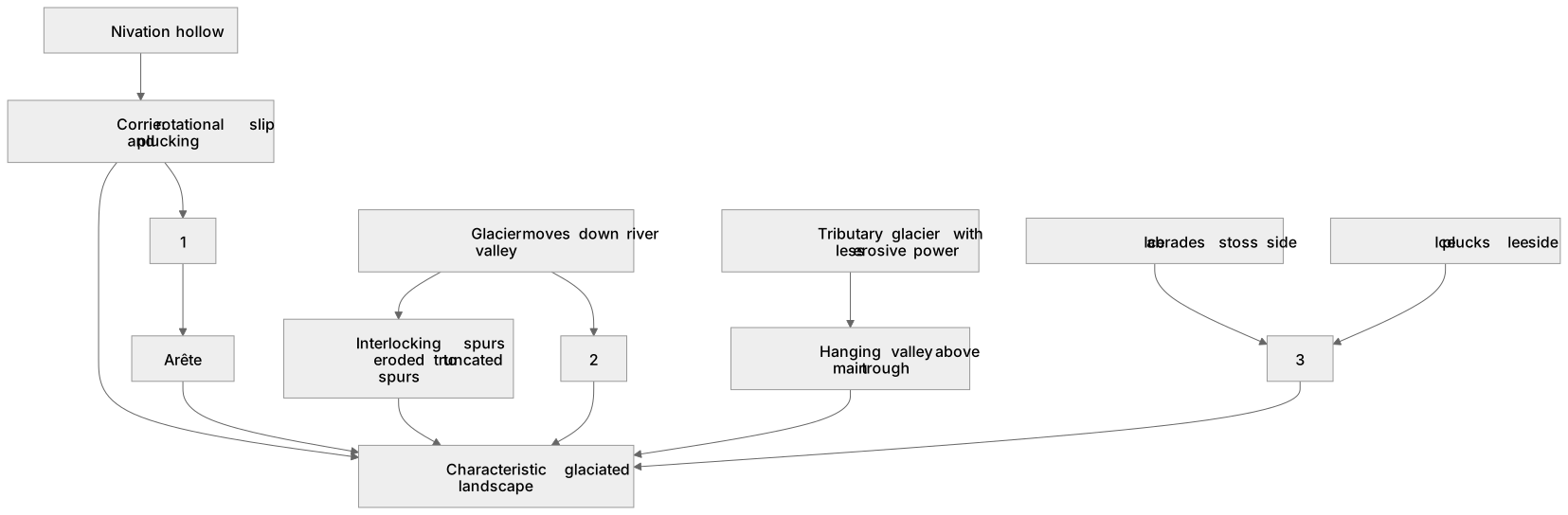
1Box 1
2Box 2
3Box 3
There is more to this lesson
The full lesson goes on to check your understanding and help you earn the marks. Create a free account to carry on, with your progress saved.
A week of Premium from your first lesson · Then the free plan continues · No card, no charge
Test your understanding of Glaciated landscape development: Erosional and depositional landforms: corries, arêtes, glacial troughs, hanging valleys, truncated spurs, roches moutonnées. Characteristic glaciated landscapes.
Active recall beats re-reading. Take an instant quiz now to test what you’ve learned and lock it into long-term memory.
A week of Premium from your first lesson · Then the free plan continues · No card, no charge