AQA · A-Level · Geography
Course version: 7037 · Version from Sept 2018
Issues associated with attempts at global governance, including how:…
Full specification wording
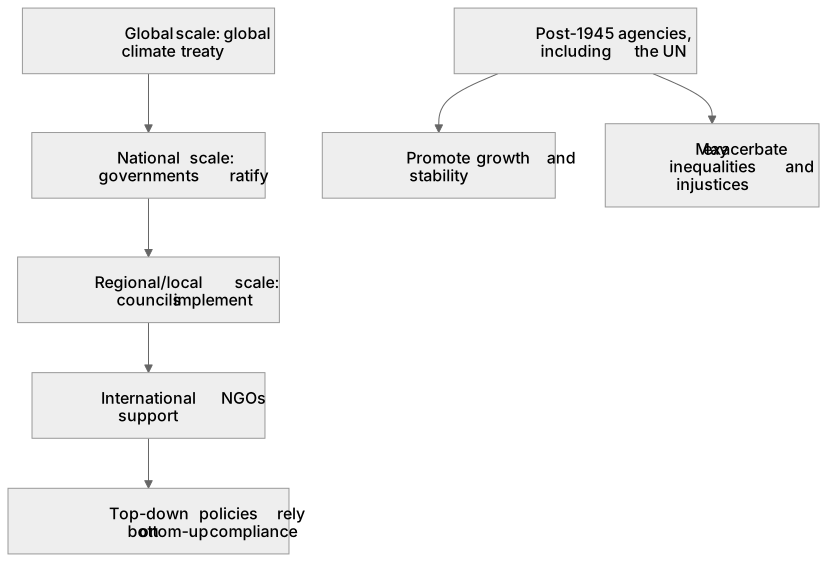
Global governance: Issues associated with attempts at global governance, including how: agencies, including the UN in the post-1945 era, can work to promote growth and stability but may also exacerbate inequalities and injustices; interactions between the local, regional, national, international and global scales are fundamental to understanding global governance.
Global governance involves complex rule-making to manage global affairs, but it faces significant issues.
Checked against the AQA 7037 specification (opens in a new tab) on .
- Point 2 of 2
- 4 key terms
Study notes
From the checked teaching notes for this specification point.
The idea
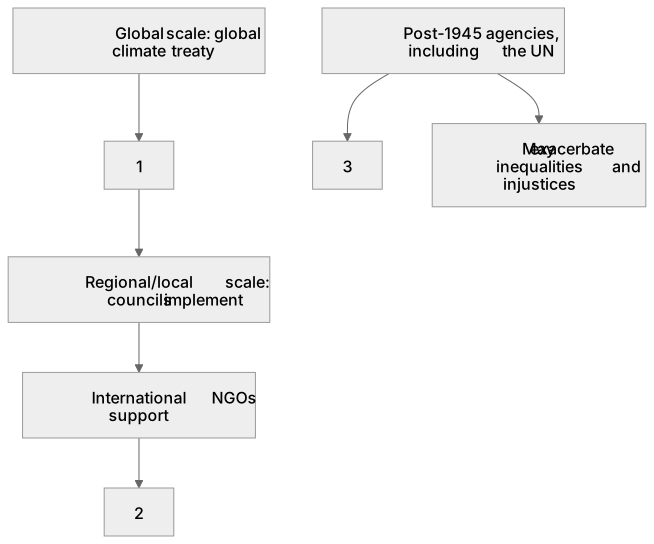
Global governance involves complex rule-making to manage global affairs, but it faces significant issues. Post-1945 agencies like the United Nations (UN) aim to promote economic growth and geopolitical stability through peacekeeping and development goals. However, these institutions can inadvertently exacerbate inequalities and injustices. For example, structural adjustment programmes by global financial institutions often disproportionately harm the poorest citizens in developing nations. Understanding global governance requires analysing interactions across all scales. A global climate treaty (global scale) must be ratified by governments (national), implemented by councils (regional/local), and supported by international NGOs, showing how top-down policies rely on bottom-up compliance.
What earns the marks
- Explain the role of the UN and other post-1945 agencies in maintaining geopolitical stability and fostering economic growth.
- Evaluate how global governance policies can create or worsen inequalities, such as unequal voting power in the IMF or UN Security Council vetoes.
- Analyse the concept of injustice in global governance, where developing nations may bear the brunt of environmental or economic policies dictated by wealthier states.
- Demonstrate how global governance operates across multiple scales, linking global agreements to national legislation and local implementation.
Common mistakes and how to put them right
Assuming global governance only occurs at the international level.
Put it right: Recognise that global governance requires interaction across local, regional, national, and global scales.
Viewing the UN solely as a positive force for growth.
Put it right: Critically evaluate how UN structures, like the Security Council veto, can perpetuate geopolitical inequalities.
Confusing global governance with a 'world government'.
Put it right: Define global governance as a complex framework of agreements, norms, and institutions, not a single sovereign authority.
Exam tips
- Use specific examples of UN interventions, such as peacekeeping missions or the Sustainable Development Goals, to illustrate attempts at promoting stability.
- When discussing inequalities, reference the structural power imbalances within global institutions like the IMF, World Bank, or WTO.
- Always link global policies to their local impacts to demonstrate an understanding of multi-scalar interactions in global governance.
Try the lesson
The start of the Global governance: Issues associated with attempts at global governance, including how: agencies, including the UN in the post-1945 era, can work to promote growth and stability but may also exacerbate inequalities and injustices; interactions between the local, regional, national, international and global scales are fundamental to understanding global governance. lesson, made from checked teaching notes for this specification point.
Have a go first
Which of the following best describes a structural feature of the United Nations that has been criticised for exacerbating global inequalities?
Listen
Global governance involves complex rule-making to manage global affairs, but it faces significant issues. Post-1945 agencies like the United Nations (UN) aim to promote economic growth and geopolitical stability through peacekeeping and development goals. However, these institutions can inadvertently exacerbate inequalities and injustices. For example, structural adjustment programmes by global financial institutions often disproportionately harm the poorest citizens in developing nations. Understanding global governance requires analysing interactions across all scales. A global climate treaty (global scale) must be ratified by governments (national), implemented by councils (regional/local), and supported by international NGOs, showing how top-down policies rely on bottom-up compliance. A strong answer earns marks for these points. Explain the role of the UN and other post-1945 agencies in maintaining geopolitical stability and fostering economic growth. Evaluate how global governance policies can create or worsen inequalities, such as unequal voting power in the IMF or UN Security Council vetoes. Analyse the concept of injustice in global governance, where developing nations may bear the brunt of environmental or economic policies dictated by wealthier states. Demonstrate how global governance operates across multiple scales, linking global agreements to national legislation and local implementation. A common slip: Assuming global governance only occurs at the international level. Instead, recognise that global governance requires interaction across local, regional, national, and global scales. Exam tip: Use specific examples of UN interventions, such as peacekeeping missions or the Sustainable Development Goals, to illustrate attempts at promoting stability.
See it
Key words
Say what each word means before you turn the card.
Global governance and institutions
Try answering aloud or in your head before turning the card.
Inequality and social justice
Try answering aloud or in your head before turning the card.
Scale and spatial interactions
Try answering aloud or in your head before turning the card.
Geopolitics and power dynamics
Try answering aloud or in your head before turning the card.
See every definition
- Global governance and institutions
- Complex rule-making to manage global affairs, involving agreements, norms and institutions rather than a single sovereign authority.
- Inequality and social justice
- Institutions can inadvertently exacerbate inequalities and injustices, with policies such as structural adjustment programmes disproportionately harming the poorest citizens in developing nations.
- Scale and spatial interactions
- Interactions between the local, regional, national, international and global scales are fundamental to understanding global governance, as top-down policies rely on bottom-up compliance.
- Geopolitics and power dynamics
- Post-1945 agencies such as the UN aim to promote economic growth and geopolitical stability, yet structures like the Security Council veto can perpetuate geopolitical inequalities.
Label the diagram
Some boxes have lost their names. Pick the right name for each number.
1Box 1
2Box 2
3Box 3
There is more to this lesson
The full lesson goes on to check your understanding and help you earn the marks. Create a free account to carry on, with your progress saved.
A week of Premium from your first lesson · Then the free plan continues · No card, no charge
Test your understanding of Global governance: Issues associated with attempts at global governance, including how: agencies, including the UN in the post-1945 era, can work to promote growth and stability but may also exacerbate inequalities and injustices; interactions between the local, regional, national, international and global scales are fundamental to understanding global governance.
Active recall beats re-reading. Take an instant quiz now to test what you’ve learned and lock it into long-term memory.
A week of Premium from your first lesson · Then the free plan continues · No card, no charge