AQA · A-Level · Geography
Course version: 7037 · Version from Sept 2018
The emergence and developing role of norms, laws and institutions in…
Full specification wording
Global governance: The emergence and developing role of norms, laws and institutions in regulating and reproducing global systems.
Global governance relies on the emergence and developing role of norms, laws, and institutions to regulate and reproduce global systems.
Checked against the AQA 7037 specification (opens in a new tab) on .
- Point 1 of 2
- 4 key terms
Study notes
From the checked teaching notes for this specification point.
The idea
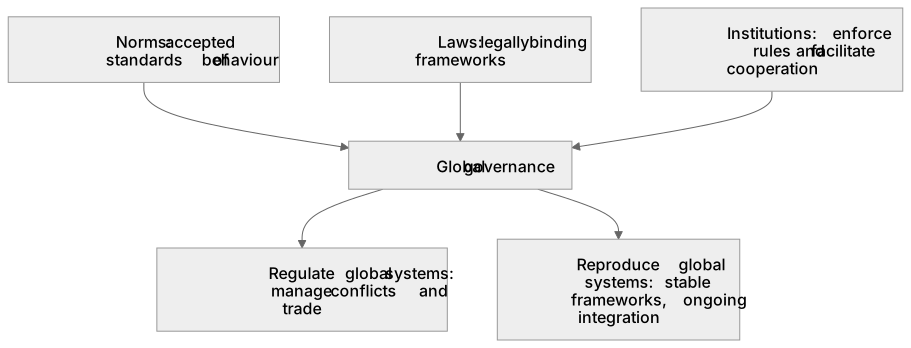
Global governance relies on the emergence and developing role of norms, laws, and institutions to regulate and reproduce global systems. Norms are accepted standards of behaviour, such as the expectation of human rights protection. Laws provide legally binding frameworks, like the UN Convention on the Law of the Sea (UNCLOS), which regulates maritime activities. Institutions, such as the World Trade Organization (WTO) or the United Nations, enforce these rules and facilitate cooperation. Together, they regulate global systems by managing conflicts and trade, while reproducing them by establishing continuous, stable frameworks that encourage ongoing international integration and standardise global interactions over time.
What earns the marks
- Define and distinguish between norms (accepted behaviours), laws (binding agreements), and institutions (organisations).
- Explain how institutions like the UN or WTO have emerged and developed to manage complex global interactions.
- Analyse the role of international laws, such as UNCLOS, in regulating shared global spaces and systems.
- Evaluate how these governance mechanisms reproduce global systems by maintaining stability and promoting continuous integration.
Common mistakes and how to put them right
Confusing norms with laws.
Put it right: Clearly distinguish norms as customary, expected behaviours and laws as formal, legally binding agreements.
Ignoring the 'reproducing' aspect of the statement.
Put it right: Explain how institutions not only control (regulate) but also sustain and expand (reproduce) global systems over time.
Providing generic descriptions of institutions.
Put it right: Use specific examples of how an institution's role has developed, such as the WTO's evolving mechanisms for dispute resolution.
Exam tips
- Memorise specific examples for each category: a norm (e.g., sustainability), a law (e.g., UNCLOS), and an institution (e.g., the IMF).
- Discuss the 'developing role' by highlighting how institutions adapt to new global challenges like climate change or cyber security.
- Critically evaluate the effectiveness of these mechanisms, noting where institutions may fail to enforce laws or where norms are ignored.
Try the lesson
The start of the Global governance: The emergence and developing role of norms, laws and institutions in regulating and reproducing global systems. lesson, made from checked teaching notes for this specification point.
Have a go first
In the context of global governance, which of the following best defines a 'norm'?
Listen
Global governance relies on the emergence and developing role of norms, laws, and institutions to regulate and reproduce global systems. Norms are accepted standards of behaviour, such as the expectation of human rights protection. Laws provide legally binding frameworks, like the UN Convention on the Law of the Sea (UNCLOS), which regulates maritime activities. Institutions, such as the World Trade Organization (WTO) or the United Nations, enforce these rules and facilitate cooperation. Together, they regulate global systems by managing conflicts and trade, while reproducing them by establishing continuous, stable frameworks that encourage ongoing international integration and standardise global interactions over time. A strong answer earns marks for these points. Define and distinguish between norms (accepted behaviours), laws (binding agreements), and institutions (organisations). Explain how institutions like the UN or WTO have emerged and developed to manage complex global interactions. Analyse the role of international laws, such as UNCLOS, in regulating shared global spaces and systems. Evaluate how these governance mechanisms reproduce global systems by maintaining stability and promoting continuous integration. A common slip: Confusing norms with laws. Instead, clearly distinguish norms as customary, expected behaviours and laws as formal, legally binding agreements. Exam tip: Memorise specific examples for each category: a norm (e.g., sustainability), a law (e.g., UNCLOS), and an institution (e.g., the IMF).
See it
Key words
Say what each word means before you turn the card.
Global governance
Try answering aloud or in your head before turning the card.
Norms
Try answering aloud or in your head before turning the card.
Laws
Try answering aloud or in your head before turning the card.
Institutions
Try answering aloud or in your head before turning the card.
See every definition
- Global governance
- The emergence and developing role of norms, laws and institutions in regulating and reproducing global systems.
- Norms
- Accepted standards of behaviour, such as the expectation of human rights protection.
- Laws
- Legally binding frameworks, like the UN Convention on the Law of the Sea (UNCLOS), which regulates maritime activities.
- Institutions
- Organisations such as the World Trade Organization (WTO) or the United Nations that enforce these rules and facilitate cooperation.
Label the diagram
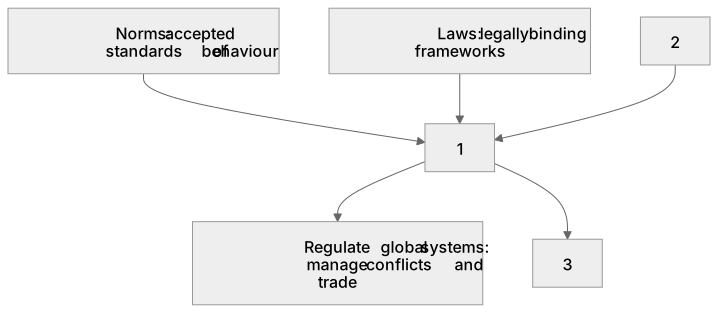
Some boxes have lost their names. Pick the right name for each number.
1Box 1
2Box 2
3Box 3
There is more to this lesson
The full lesson goes on to check your understanding and help you earn the marks. Create a free account to carry on, with your progress saved.
A week of Premium from your first lesson · Then the free plan continues · No card, no charge
Test your understanding of Global governance: The emergence and developing role of norms, laws and institutions in regulating and reproducing global systems.
Active recall beats re-reading. Take an instant quiz now to test what you’ve learned and lock it into long-term memory.
A week of Premium from your first lesson · Then the free plan continues · No card, no charge