AQA · A-Level · Geography
Course version: 7037 · Version from Sept 2018
Prospects for the global population. Projected distributions. Critical…
Full specification wording
Global population futures: Prospects for the global population. Projected distributions. Critical appraisal of future population-environment relationships.
Global population prospects suggest a peak of around 10.4 billion by the 2080s, though UN projections vary based on fertility rate assumptions.
Checked against the AQA 7037 specification (opens in a new tab) on .
- Point 2 of 2
- 4 key terms
Study notes
From the checked teaching notes for this specification point.
The idea
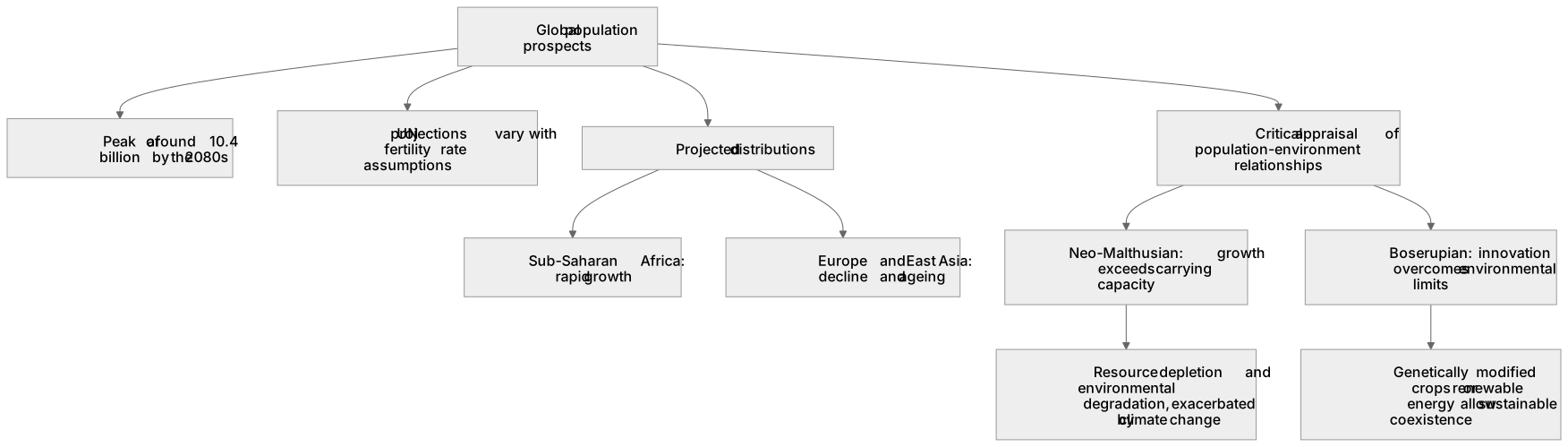
Global population prospects suggest a peak of around 10.4 billion by the 2080s, though UN projections vary based on fertility rate assumptions. Projected distributions show stark regional contrasts: sub-Saharan Africa will experience rapid growth, while Europe and East Asia face population decline and ageing. A critical appraisal of future population-environment relationships requires evaluating competing theories. Neo-Malthusian perspectives argue that unchecked growth will exceed Earth's carrying capacity, leading to resource depletion and environmental degradation, exacerbated by climate change. Conversely, Boserupian views suggest human innovation, such as genetically modified crops or renewable energy, will overcome environmental limits, allowing sustainable coexistence.
What earns the marks
- Identify and explain UN population projections (high, medium, and low variants) and the factors influencing these trajectories.
- Describe the projected spatial distribution of future populations, highlighting the shift in demographic weight towards Africa and Asia.
- Critically evaluate neo-Malthusian theories regarding carrying capacity, resource scarcity, and ecological overshoot in the context of future growth.
- Assess Boserupian and cornucopian perspectives that emphasise technological innovation and adaptation in mitigating environmental limits.
- Analyse the complex feedback loops between population growth, climate change, and environmental degradation.
Common mistakes and how to put them right
Assuming global population will grow indefinitely.
Put it right: Acknowledge that growth rates are slowing and population is projected to peak before 2100.
Treating population growth as uniform globally.
Put it right: Specify regional variations, noting rapid growth in Africa versus decline in parts of Europe and Asia.
Presenting Malthusian theory as an absolute fact.
Put it right: Critically appraise it by contrasting it with Boserupian innovation and acknowledging technological advancements.
Exam tips
- Use specific UN projection data (e.g., 10.4 billion peak) to support arguments about future global population prospects.
- When critically appraising population-environment relationships, explicitly contrast pessimistic (Malthusian) and optimistic (Boserupian) viewpoints.
- Link projected demographic distributions to specific environmental pressures, such as water scarcity in rapidly growing sub-Saharan regions.
Try the lesson
The start of the Global population futures: Prospects for the global population. Projected distributions. Critical appraisal of future population-environment relationships. lesson, made from checked teaching notes for this specification point.
Have a go first
Which region is projected by the United Nations to experience the largest absolute increase in population over the course of the 21st century?
Listen
Global population prospects suggest a peak of around 10.4 billion by the 2080s, though UN projections vary based on fertility rate assumptions. Projected distributions show stark regional contrasts: sub-Saharan Africa will experience rapid growth, while Europe and East Asia face population decline and ageing. A critical appraisal of future population-environment relationships requires evaluating competing theories. Neo-Malthusian perspectives argue that unchecked growth will exceed Earth's carrying capacity, leading to resource depletion and environmental degradation, exacerbated by climate change. Conversely, Boserupian views suggest human innovation, such as genetically modified crops or renewable energy, will overcome environmental limits, allowing sustainable coexistence. A strong answer earns marks for these points. Identify and explain UN population projections (high, medium, and low variants) and the factors influencing these trajectories. Describe the projected spatial distribution of future populations, highlighting the shift in demographic weight towards Africa and Asia. Critically evaluate neo-Malthusian theories regarding carrying capacity, resource scarcity, and ecological overshoot in the context of future growth. Assess Boserupian and cornucopian perspectives that emphasise technological innovation and adaptation in mitigating environmental limits. A common slip: Assuming global population will grow indefinitely. Instead, acknowledge that growth rates are slowing and population is projected to peak before 2100. Exam tip: Use specific UN projection data (e.g., 10.4 billion peak) to support arguments about future global population prospects.
See it
Key words
Say what each word means before you turn the card.
Carrying capacity
Try answering aloud or in your head before turning the card.
Technological innovation
Try answering aloud or in your head before turning the card.
Neo-Malthusian perspectives
Try answering aloud or in your head before turning the card.
Boserupian views
Try answering aloud or in your head before turning the card.
See every definition
- Carrying capacity
- The limit of Earth's resources that neo-Malthusian perspectives argue unchecked growth will exceed, leading to resource depletion and environmental degradation.
- Technological innovation
- Human innovation, such as genetically modified crops or renewable energy, which Boserupian views suggest will overcome environmental limits and allow sustainable coexistence.
- Neo-Malthusian perspectives
- Views arguing that unchecked growth will exceed Earth's carrying capacity, leading to resource depletion and environmental degradation, exacerbated by climate change.
- Boserupian views
- Perspectives suggesting human innovation will overcome environmental limits, allowing sustainable coexistence.
Label the diagram
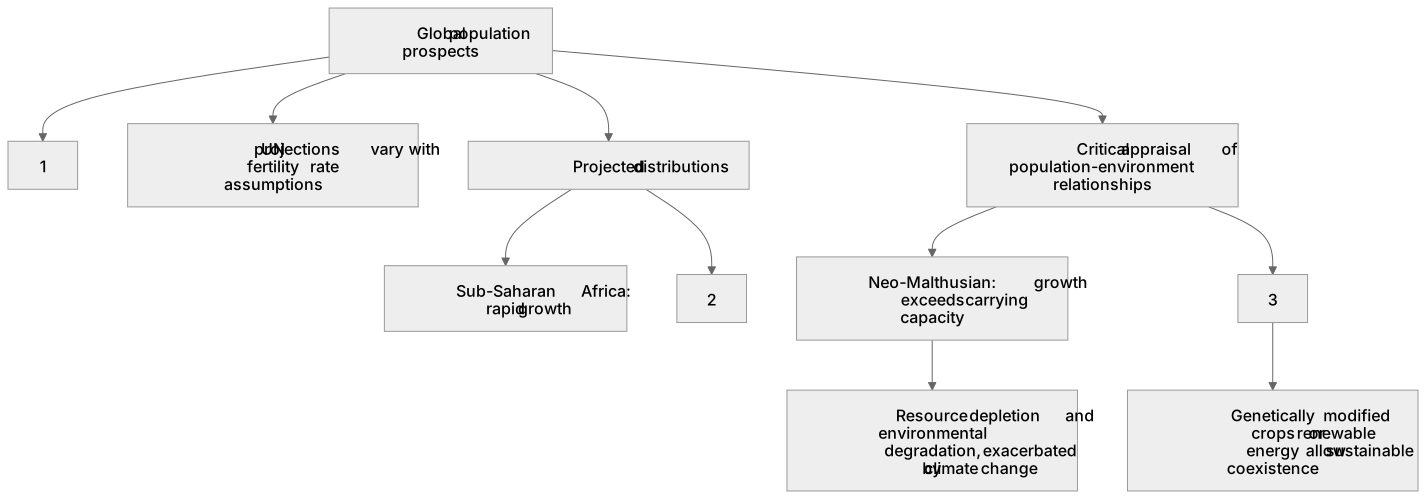
Some boxes have lost their names. Pick the right name for each number.
1Box 1
2Box 2
3Box 3
There is more to this lesson
The full lesson goes on to check your understanding and help you earn the marks. Create a free account to carry on, with your progress saved.
A week of Premium from your first lesson · Then the free plan continues · No card, no charge
Test your understanding of Global population futures: Prospects for the global population. Projected distributions. Critical appraisal of future population-environment relationships.
Active recall beats re-reading. Take an instant quiz now to test what you’ve learned and lock it into long-term memory.
A week of Premium from your first lesson · Then the free plan continues · No card, no charge