AQA · A-Level · Geography
Course version: 7037 · Version from Sept 2018
Sources of energy in hot desert environments: insolation, winds, runoff.
Full specification wording
Hot desert systems and landscapes - 3.1.2.2 Systems and processes: Sources of energy in hot desert environments: insolation, winds, runoff.
Hot desert systems are driven by three primary energy sources: insolation, winds, and runoff.
Checked against the AQA 7037 specification (opens in a new tab) on .
- Point 1 of 6
- 2 key terms
Study notes
From the checked teaching notes for this specification point.
The idea
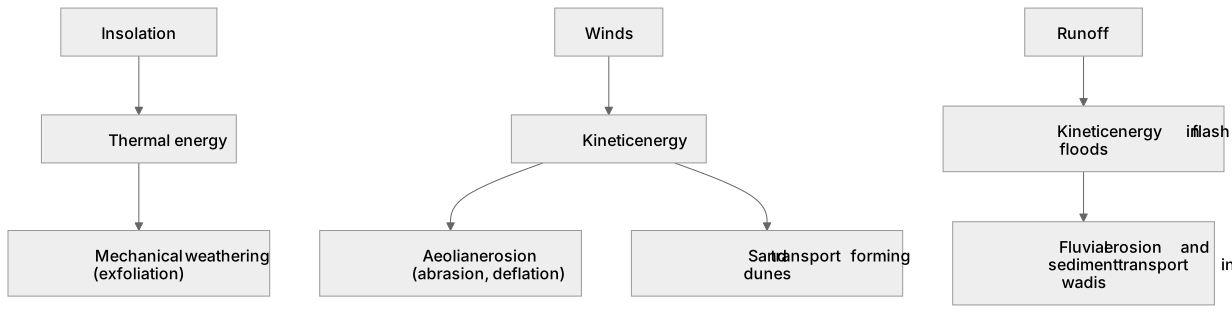
Hot desert systems are driven by three primary energy sources: insolation, winds, and runoff. Insolation (incoming solar radiation) is intense due to the lack of cloud cover, providing thermal energy that drives extreme diurnal temperature ranges. This thermal energy fuels mechanical weathering processes like exfoliation. Winds, generated by steep pressure gradients, provide kinetic energy essential for aeolian erosion (abrasion and deflation) and the transportation of sand to form dunes. Runoff, though infrequent, supplies immense kinetic energy during episodic flash floods. Because desert surfaces lack vegetation and have baked, impermeable soils, overland flow rapidly channels into wadis, causing severe fluvial erosion and sediment transport.
What earns the marks
- Identify insolation as the primary source of thermal energy, driving high evaporation rates and mechanical weathering through extreme temperature fluctuations.
- Explain how wind provides kinetic energy for aeolian processes, enabling deflation, abrasion, and the transport of sediment over vast distances.
- Describe how episodic rainfall generates surface runoff, providing concentrated kinetic energy for rapid fluvial erosion and transportation in wadis.
- Link the lack of vegetation and soil moisture to the amplified effects of these energy sources, such as increased surface albedo and rapid overland flow.
Common mistakes and how to put them right
Assuming runoff is insignificant in deserts due to low rainfall.
Put it right: Emphasise that while infrequent, episodic flash floods possess immense kinetic energy and are major geomorphic agents.
Treating insolation merely as 'heat'.
Put it right: Define insolation as incoming solar radiation that provides thermal energy for specific physical processes like insolation weathering and convection.
Failing to connect wind energy to atmospheric pressure.
Put it right: Explain that wind energy is derived from pressure gradients, often exacerbated by intense local insolation.
Exam tips
- Always link the source of energy directly to the geomorphic process it drives, such as wind energy driving aeolian abrasion.
- Use the systems approach terminology in your answers, referring to insolation, wind, and runoff as 'inputs' of energy into the desert landscape system.
- Highlight the episodic nature of runoff compared to the continuous or diurnal nature of insolation and wind energy.
Try the lesson
The start of the Hot desert systems and landscapes - 3.1.2.2 Systems and processes: Sources of energy in hot desert environments: insolation, winds, runoff. lesson, made from checked teaching notes for this specification point.
Have a go first
Which of the following are the primary sources of energy that drive geomorphic processes in hot desert environments?
Listen
Hot desert systems are driven by three primary energy sources: insolation, winds, and runoff. Insolation (incoming solar radiation) is intense due to the lack of cloud cover, providing thermal energy that drives extreme diurnal temperature ranges. This thermal energy fuels mechanical weathering processes like exfoliation. Winds, generated by steep pressure gradients, provide kinetic energy essential for aeolian erosion (abrasion and deflation) and the transportation of sand to form dunes. Runoff, though infrequent, supplies immense kinetic energy during episodic flash floods. Because desert surfaces lack vegetation and have baked, impermeable soils, overland flow rapidly channels into wadis, causing severe fluvial erosion and sediment transport. A strong answer earns marks for these points. Identify insolation as the primary source of thermal energy, driving high evaporation rates and mechanical weathering through extreme temperature fluctuations. Explain how wind provides kinetic energy for aeolian processes, enabling deflation, abrasion, and the transport of sediment over vast distances. Describe how episodic rainfall generates surface runoff, providing concentrated kinetic energy for rapid fluvial erosion and transportation in wadis. Link the lack of vegetation and soil moisture to the amplified effects of these energy sources, such as increased surface albedo and rapid overland flow. A common slip: Assuming runoff is insignificant in deserts due to low rainfall. Instead, emphasise that while infrequent, episodic flash floods possess immense kinetic energy and are major geomorphic agents. Exam tip: Always link the source of energy directly to the geomorphic process it drives, such as wind energy driving aeolian abrasion.
See it
Key words
Say what each word means before you turn the card.
Insolation
Try answering aloud or in your head before turning the card.
Runoff
Try answering aloud or in your head before turning the card.
See every definition
- Insolation
- Incoming solar radiation that is intense due to the lack of cloud cover, providing thermal energy that drives extreme diurnal temperature ranges.
- Runoff
- Infrequent overland flow that supplies immense kinetic energy during episodic flash floods, rapidly channelling into wadis.
Label the diagram
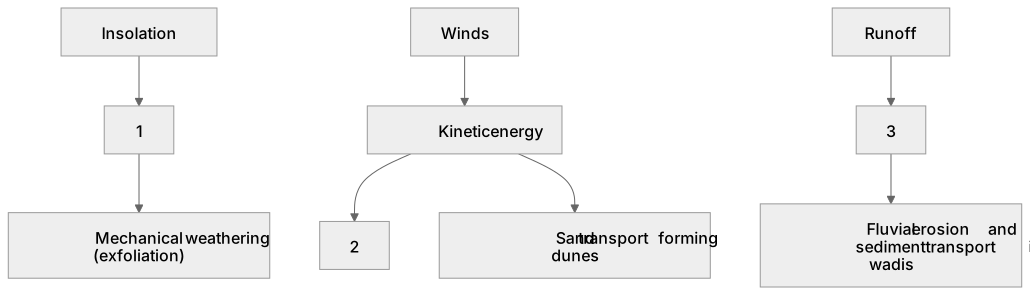
Some boxes have lost their names. Pick the right name for each number.
1Box 1
2Box 2
3Box 3
There is more to this lesson
The full lesson goes on to check your understanding and help you earn the marks. Create a free account to carry on, with your progress saved.
A week of Premium from your first lesson · Then the free plan continues · No card, no charge
Test your understanding of Hot desert systems and landscapes - 3.1.2.2 Systems and processes: Sources of energy in hot desert environments: insolation, winds, runoff.
Active recall beats re-reading. Take an instant quiz now to test what you’ve learned and lock it into long-term memory.
A week of Premium from your first lesson · Then the free plan continues · No card, no charge