AQA · A-Level · Geography
Course version: 7037 · Version from Sept 2018
Sediment sources, cells and budgets.
Full specification wording
Hot desert systems and landscapes - 3.1.2.2 Systems and processes: Sediment sources, cells and budgets.
In hot desert systems, sediment sources include the mechanical weathering of bedrock, fluvial inputs from episodic flash floods in wadis, and aeolian (wind-blown) material.
Checked against the AQA 7037 specification (opens in a new tab) on .
- Point 2 of 6
- 4 key terms
Study notes
From the checked teaching notes for this specification point.
The idea
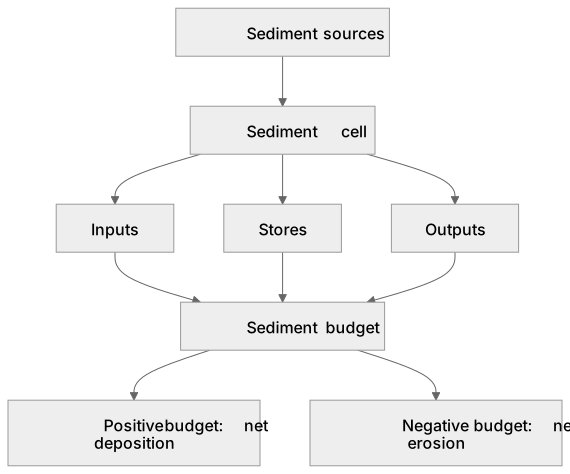
In hot desert systems, sediment sources include the mechanical weathering of bedrock, fluvial inputs from episodic flash floods in wadis, and aeolian (wind-blown) material. A sediment cell represents a largely self-contained system where sediment is cycled, often bounded by topographic features like mountain ranges enclosing a desert basin (bolson). The sediment budget is the balance between sediment inputs (addition), stores (such as sand dunes or alluvial fans), and outputs (removal, like dust storms exporting material). If inputs exceed outputs, a positive budget occurs, leading to net deposition and the growth of landforms like ergs. Conversely, a negative budget results in net erosion, exposing deflation hollows or desert pavements.
What earns the marks
- Identify primary sediment sources in deserts, including insolation weathering, fluvial transport from wadis, and aeolian deposition.
- Define a sediment cell as a functional system with defined boundaries, typically topographically closed basins in desert environments.
- Explain the components of a sediment budget using the systems approach: inputs, transfers, stores, and outputs.
- Relate a positive sediment budget to the formation of depositional landforms (e.g., barchan dunes) and a negative budget to erosional features (e.g., deflation hollows).
Common mistakes and how to put them right
Confusing sediment cells with atmospheric circulation cells (like the Hadley cell).
Put it right: Clearly define sediment cells as terrestrial systems bounded by topography where sediment is sourced, transferred, and stored.
Assuming desert sediment is exclusively sourced by wind.
Put it right: Acknowledge that fluvial processes (flash floods) and in situ weathering are major, often dominant, sediment sources.
Stating that a sediment budget is always in equilibrium.
Put it right: Explain that budgets can be positive (net deposition) or negative (net erosion) depending on environmental changes.
Exam tips
- Use the systems framework (inputs, outputs, stores, transfers) to structure answers about sediment budgets.
- Provide a specific example of a desert sediment sink, such as an erg (sand sea) or a playa lake, when discussing positive budgets.
- Link changes in the sediment budget to long-term climate shifts, such as transitions from pluvial to arid periods.
Try the lesson
The start of the Hot desert systems and landscapes - 3.1.2.2 Systems and processes: Sediment sources, cells and budgets. lesson, made from checked teaching notes for this specification point.
Have a go first
Which of the following best describes a positive sediment budget in a hot desert system?
Listen
In hot desert systems, sediment sources include the mechanical weathering of bedrock, fluvial inputs from episodic flash floods in wadis, and aeolian (wind-blown) material. A sediment cell represents a largely self-contained system where sediment is cycled, often bounded by topographic features like mountain ranges enclosing a desert basin (bolson). The sediment budget is the balance between sediment inputs (addition), stores (such as sand dunes or alluvial fans), and outputs (removal, like dust storms exporting material). If inputs exceed outputs, a positive budget occurs, leading to net deposition and the growth of landforms like ergs. Conversely, a negative budget results in net erosion, exposing deflation hollows or desert pavements. A strong answer earns marks for these points. Identify primary sediment sources in deserts, including insolation weathering, fluvial transport from wadis, and aeolian deposition. Define a sediment cell as a functional system with defined boundaries, typically topographically closed basins in desert environments. Explain the components of a sediment budget using the systems approach: inputs, transfers, stores, and outputs. Relate a positive sediment budget to the formation of depositional landforms (e.g., barchan dunes) and a negative budget to erosional features (e.g., deflation hollows). A common slip: Confusing sediment cells with atmospheric circulation cells (like the Hadley cell). Instead, Clearly define sediment cells as terrestrial systems bounded by topography where sediment is sourced, transferred, and stored. Exam tip: Use the systems framework (inputs, outputs, stores, transfers) to structure answers about sediment budgets.
See it
Key words
Say what each word means before you turn the card.
Sediment cell
Try answering aloud or in your head before turning the card.
Sediment budget
Try answering aloud or in your head before turning the card.
Positive budget
Try answering aloud or in your head before turning the card.
Negative budget
Try answering aloud or in your head before turning the card.
See every definition
- Sediment cell
- A largely self-contained system where sediment is cycled, often bounded by topographic features like mountain ranges enclosing a desert basin.
- Sediment budget
- The balance between sediment inputs, stores such as sand dunes or alluvial fans, and outputs such as dust storms exporting material.
- Positive budget
- Occurs when inputs exceed outputs, leading to net deposition and the growth of landforms like ergs.
- Negative budget
- Results in net erosion, exposing deflation hollows or desert pavements.
Label the diagram
Some boxes have lost their names. Pick the right name for each number.
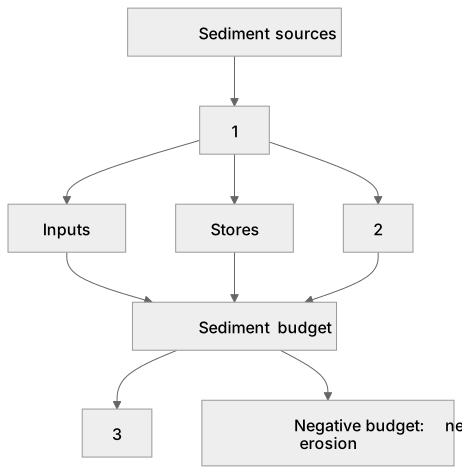
1Box 1
2Box 2
3Box 3
There is more to this lesson
The full lesson goes on to check your understanding and help you earn the marks. Create a free account to carry on, with your progress saved.
A week of Premium from your first lesson · Then the free plan continues · No card, no charge
Test your understanding of Hot desert systems and landscapes - 3.1.2.2 Systems and processes: Sediment sources, cells and budgets.
Active recall beats re-reading. Take an instant quiz now to test what you’ve learned and lock it into long-term memory.
A week of Premium from your first lesson · Then the free plan continues · No card, no charge