AQA · A-Level · Geography
Course version: 7037 · Version from Sept 2018
Sources of water: exogenous, endoreic and ephemeral; the episodic role of…
Full specification wording
Hot desert systems and landscapes - 3.1.2.2 Systems and processes: Sources of water: exogenous, endoreic and ephemeral; the episodic role of water; sheet flooding, channel flash flooding.
Water in hot deserts originates from three main sources.
Checked against the AQA 7037 specification (opens in a new tab) on .
- Point 6 of 6
- 4 key terms
Study notes
From the checked teaching notes for this specification point.
The idea
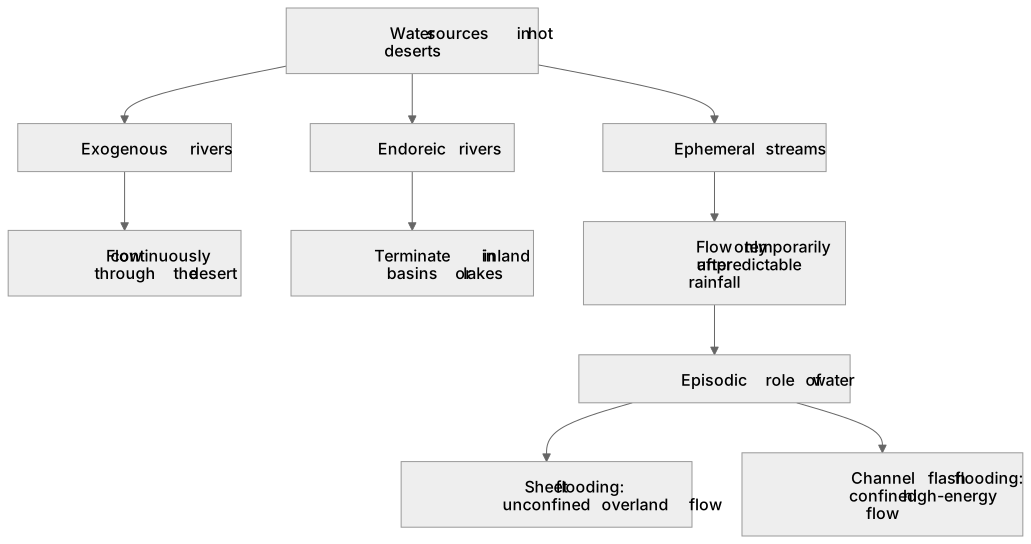
Water in hot deserts originates from three main sources. Exogenous rivers, like the Colorado River, originate in wetter adjacent regions and flow continuously through the arid landscape. Endoreic rivers flow into inland basins or lakes, such as Lake Chad, never reaching the ocean. Ephemeral streams flow only temporarily following unpredictable rainfall. Because rainfall is rare, water plays an episodic role, meaning geomorphic work occurs in short, intense bursts. When heavy rain falls on baked, impermeable surfaces, it creates sheet flooding—unconfined overland flow that strips topsoil and deposits sediment across broad areas. Alternatively, water concentrates into steep-sided gullies, causing channel flash flooding. These high-energy, confined flows transport massive sediment loads, rapidly eroding wadis before quickly dissipating.
What earns the marks
- Define exogenous rivers as those with source regions outside the desert environment, maintaining year-round flow.
- Explain endoreic drainage as closed systems where water terminates in inland basins, often forming salt lakes or playas.
- Describe ephemeral streams as temporary watercourses that only flow following rare, intense precipitation events.
- Evaluate the episodic role of water, noting that despite its rarity, high-magnitude flash floods perform more geomorphic work than continuous wind action.
- Distinguish between unconfined sheet flooding, which causes widespread surface wash, and confined channel flash flooding, which deeply incises wadis.
Common mistakes and how to put them right
Confusing exogenous and endoreic rivers.
Put it right: Exogenous rivers flow through the desert to the sea, whereas endoreic rivers terminate in inland basins.
Assuming water is geomorphologically insignificant in deserts.
Put it right: Water is actually the dominant agent of erosion, albeit operating episodically.
Using 'ephemeral' and 'episodic' interchangeably.
Put it right: Ephemeral refers to the temporary nature of the water source, while episodic refers to the irregular timing of geomorphic events.
Exam tips
- Use specific examples like the River Nile (exogenous) or the Okavango (endoreic) to illustrate water sources.
- When discussing landscape development, emphasise how the baked, impermeable desert crust promotes rapid surface runoff and flash flooding.
- Contrast the spatial impacts of sheet flooding (broad, shallow erosion) with channel flash flooding (deep, localised incision).
Try the lesson
The start of the Hot desert systems and landscapes - 3.1.2.2 Systems and processes: Sources of water: exogenous, endoreic and ephemeral; the episodic role of water; sheet flooding, channel flash flooding. lesson, made from checked teaching notes for this specification point.
Have a go first
Which of the following best describes an exogenous river in a hot desert environment?
Listen
Water in hot deserts originates from three main sources. Exogenous rivers, like the Colorado River, originate in wetter adjacent regions and flow continuously through the arid landscape. Endoreic rivers flow into inland basins or lakes, such as Lake Chad, never reaching the ocean. Ephemeral streams flow only temporarily following unpredictable rainfall. Because rainfall is rare, water plays an episodic role, meaning geomorphic work occurs in short, intense bursts. When heavy rain falls on baked, impermeable surfaces, it creates sheet flooding—unconfined overland flow that strips topsoil and deposits sediment across broad areas. Alternatively, water concentrates into steep-sided gullies, causing channel flash flooding. These high-energy, confined flows transport massive sediment loads, rapidly eroding wadis before quickly dissipating. A strong answer earns marks for these points. Define exogenous rivers as those with source regions outside the desert environment, maintaining year-round flow. Explain endoreic drainage as closed systems where water terminates in inland basins, often forming salt lakes or playas. Describe ephemeral streams as temporary watercourses that only flow following rare, intense precipitation events. Evaluate the episodic role of water, noting that despite its rarity, high-magnitude flash floods perform more geomorphic work than continuous wind action. Exam tip: Use specific examples like the River Nile (exogenous) or the Okavango (endoreic) to illustrate water sources.
See it
Key words
Say what each word means before you turn the card.
Exogenous rivers
Try answering aloud or in your head before turning the card.
Endoreic rivers
Try answering aloud or in your head before turning the card.
Ephemeral streams
Try answering aloud or in your head before turning the card.
Sheet flooding
Try answering aloud or in your head before turning the card.
See every definition
- Exogenous rivers
- Rivers that originate in wetter adjacent regions and flow continuously through the arid landscape.
- Endoreic rivers
- Rivers that flow into inland basins or lakes, never reaching the ocean.
- Ephemeral streams
- Streams that flow only temporarily following unpredictable rainfall.
- Sheet flooding
- Unconfined overland flow that strips topsoil and deposits sediment across broad areas when heavy rain falls on baked, impermeable surfaces.
Label the diagram
Some boxes have lost their names. Pick the right name for each number.
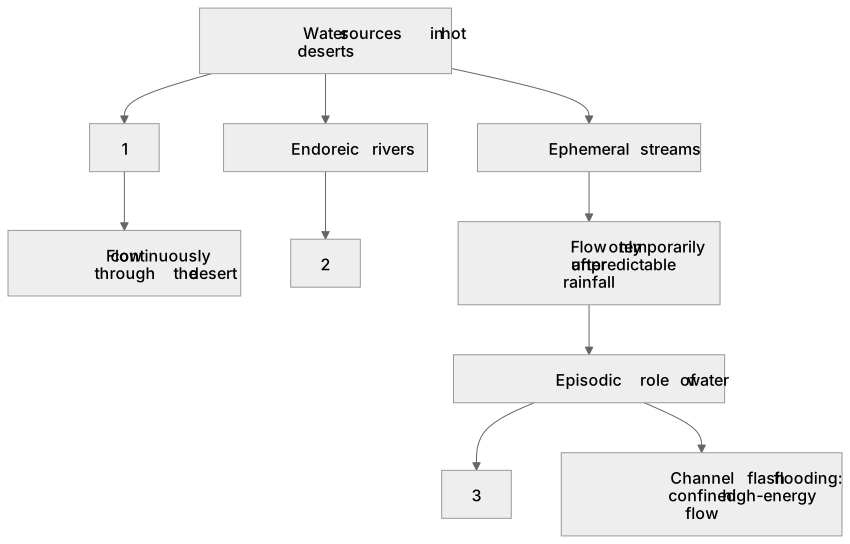
1Box 1
2Box 2
3Box 3
There is more to this lesson
The full lesson goes on to check your understanding and help you earn the marks. Create a free account to carry on, with your progress saved.
A week of Premium from your first lesson · Then the free plan continues · No card, no charge
Test your understanding of Hot desert systems and landscapes - 3.1.2.2 Systems and processes: Sources of water: exogenous, endoreic and ephemeral; the episodic role of water; sheet flooding, channel flash flooding.
Active recall beats re-reading. Take an instant quiz now to test what you’ve learned and lock it into long-term memory.
A week of Premium from your first lesson · Then the free plan continues · No card, no charge