AQA · A-Level · Geography
Course version: 7037 · Version from Sept 2018
The role of wind – erosion: deflation and abrasion; transportation;…
Full specification wording
Hot desert systems and landscapes - 3.1.2.2 Systems and processes: The role of wind – erosion: deflation and abrasion; transportation; suspension, saltation, surface creep, deposition.
Wind (aeolian) processes dominate hot deserts due to sparse vegetation and dry sediment.
Checked against the AQA 7037 specification (opens in a new tab) on .
- Point 5 of 6
- 4 key terms
Study notes
From the checked teaching notes for this specification point.
The idea
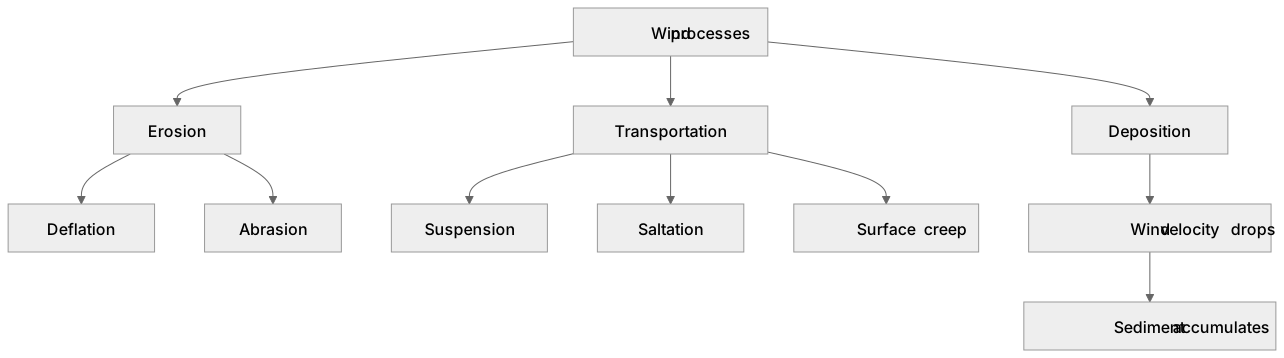
Wind (aeolian) processes dominate hot deserts due to sparse vegetation and dry sediment. Wind erosion occurs via deflation, where turbulent eddies remove fine particles to leave desert pavements, and abrasion, where wind-borne sand scours rock surfaces to form ventifacts. Transportation depends on wind velocity and particle size: fine dust is carried high in suspension; sand grains bounce along the surface via saltation; and larger pebbles are nudged forward by surface creep, driven by the impact of saltating grains. When wind velocity drops, deposition occurs, forming features like barchan dunes as the wind loses energy and drops its sediment load, reshaping the arid landscape.
What earns the marks
- Define deflation as the removal of loose, fine-grained material by the wind, often creating deflation hollows or desert pavements.
- Explain abrasion as the sandblasting effect of wind-blown particles against rock surfaces, typically concentrated within a metre of the ground.
- Differentiate the three modes of aeolian transportation based on particle size and wind energy: suspension (dust), saltation (sand), and surface creep (larger gravel).
- Describe deposition as the result of a reduction in wind velocity, leading to the accumulation of sediment to form various dune types.
Common mistakes and how to put them right
Confusing saltation with suspension.
Put it right: Clearly state that suspension carries fine dust high in the air over long distances, while saltation involves sand grains bouncing along the ground.
Assuming wind abrasion occurs high up on rock formations.
Put it right: Specify that wind abrasion is most effective within 1 to 1.5 metres of the ground because saltating sand grains cannot be lifted higher.
Describing surface creep as a direct result of wind pushing large rocks.
Put it right: Explain that surface creep is primarily driven by the kinetic energy transferred from the impact of saltating sand grains hitting larger pebbles.
Exam tips
- Use specific particle sizes to distinguish between transportation methods, noting that saltation is responsible for moving the majority of desert sand.
- Link the process of abrasion to the formation of specific landforms like yardangs, zeugen, and ventifacts.
- When explaining deposition, always mention the loss of wind energy or velocity as the primary trigger.
Try the lesson
The start of the Hot desert systems and landscapes - 3.1.2.2 Systems and processes: The role of wind – erosion: deflation and abrasion; transportation; suspension, saltation, surface creep, deposition. lesson, made from checked teaching notes for this specification point.
Have a go first
Which term describes the aeolian erosion process where wind removes loose, fine-grained material from the desert surface, often leaving behind a desert pavement?
Listen
Wind (aeolian) processes dominate hot deserts due to sparse vegetation and dry sediment. Wind erosion occurs via deflation, where turbulent eddies remove fine particles to leave desert pavements, and abrasion, where wind-borne sand scours rock surfaces to form ventifacts. Transportation depends on wind velocity and particle size: fine dust is carried high in suspension; sand grains bounce along the surface via saltation; and larger pebbles are nudged forward by surface creep, driven by the impact of saltating grains. When wind velocity drops, deposition occurs, forming features like barchan dunes as the wind loses energy and drops its sediment load, reshaping the arid landscape. A strong answer earns marks for these points. Define deflation as the removal of loose, fine-grained material by the wind, often creating deflation hollows or desert pavements. Explain abrasion as the sandblasting effect of wind-blown particles against rock surfaces, typically concentrated within a metre of the ground. Differentiate the three modes of aeolian transportation based on particle size and wind energy: suspension (dust), saltation (sand), and surface creep (larger gravel). Describe deposition as the result of a reduction in wind velocity, leading to the accumulation of sediment to form various dune types. A common slip: Confusing saltation with suspension. Instead, Clearly state that suspension carries fine dust high in the air over long distances, while saltation involves sand grains bouncing along the ground. Exam tip: Use specific particle sizes to distinguish between transportation methods, noting that saltation is responsible for moving the majority of desert sand.
See it
Key words
Say what each word means before you turn the card.
Deflation
Try answering aloud or in your head before turning the card.
Abrasion
Try answering aloud or in your head before turning the card.
Suspension
Try answering aloud or in your head before turning the card.
Saltation
Try answering aloud or in your head before turning the card.
See every definition
- Deflation
- The removal of loose, fine-grained material by the wind, often creating deflation hollows or desert pavements.
- Abrasion
- The sandblasting effect of wind-blown particles against rock surfaces, typically concentrated within a metre of the ground.
- Suspension
- A mode of aeolian transportation in which fine dust is carried high in the air over long distances.
- Saltation
- A mode of aeolian transportation in which sand grains bounce along the ground.
Label the diagram
Some boxes have lost their names. Pick the right name for each number.
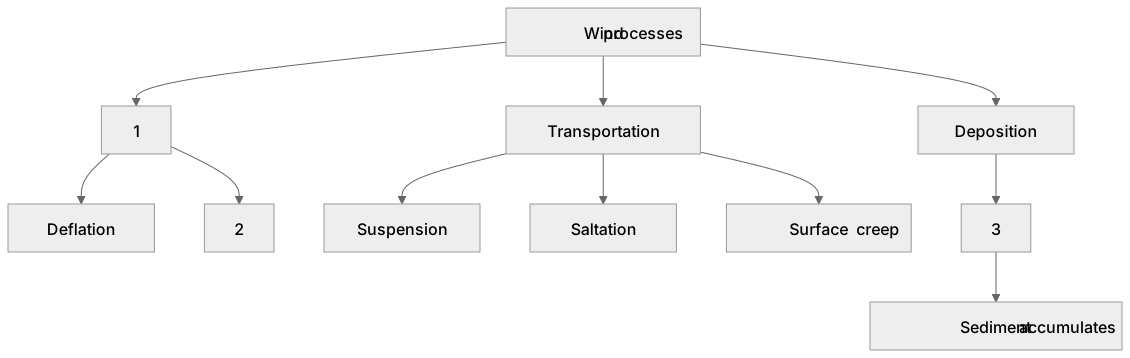
1Box 1
2Box 2
3Box 3
There is more to this lesson
The full lesson goes on to check your understanding and help you earn the marks. Create a free account to carry on, with your progress saved.
A week of Premium from your first lesson · Then the free plan continues · No card, no charge
Test your understanding of Hot desert systems and landscapes - 3.1.2.2 Systems and processes: The role of wind – erosion: deflation and abrasion; transportation; suspension, saltation, surface creep, deposition.
Active recall beats re-reading. Take an instant quiz now to test what you’ve learned and lock it into long-term memory.
A week of Premium from your first lesson · Then the free plan continues · No card, no charge