AQA · A-Level · Geography
Course version: 7037 · Version from Sept 2018
How both past and present processes of development can be seen to…
Full specification wording
Meaning and representation: How both past and present processes of development can be seen to influence the social and economic characteristics of places and so be implicit in present meanings.
Places are shaped by a continuum of past and present development processes that dictate their current social and economic characteristics, ultimately embedding themselves into the present meaning…
Checked against the AQA 7037 specification (opens in a new tab) on .
- Point 2 of 2
- 2 key terms
Study notes
From the checked teaching notes for this specification point.
The idea
Places are shaped by a continuum of past and present development processes that dictate their current social and economic characteristics, ultimately embedding themselves into the present meaning of the place. For example, a city's past as a Victorian industrial hub (past economic process) might leave a legacy of terraced housing and strong working-class community networks (social characteristics). Present processes, such as urban regeneration or gentrification, introduce new economic activities like digital industries and alter social demographics by attracting young professionals. These combined layers of development are implicit in how the place is currently perceived and experienced, meaning its contemporary identity is a direct product of its historical and ongoing economic and social evolution.
What earns the marks
- Identify specific historical development processes, such as industrialisation or deindustrialisation, that have shaped a place's demographic and built environment.
- Explain how contemporary processes, such as gentrification or foreign direct investment, alter current economic profiles and employment structures.
- Link physical changes in the built environment to shifts in social characteristics, such as community cohesion, inequality, or cultural diversity.
- Evaluate how the layered history of a place contributes to its present meaning, identity, and the lived experience of its residents.
Common mistakes and how to put them right
Focusing solely on historical events without linking them to present-day social or economic characteristics.
Put it right: Connect past processes to contemporary realities.
Treating 'meaning' as a purely abstract concept.
Put it right: Ensure you ground place meaning in tangible social and economic data, such as employment types or housing quality.
Ignoring present processes of development.
Put it right: Balance the analysis by discussing both historical legacies and current changes like urban regeneration.
Exam tips
- Use a specific case study of a local or distant place to illustrate the transition from past industrial functions to present-day service or knowledge economies.
- When discussing 'meaning', explicitly state whose meaning you are referring to, as different demographic groups will perceive the same development processes differently.
- Structure your answer chronologically but ensure every historical point explicitly answers how it influences the present-day characteristics of the place.
Try the lesson
The start of the Meaning and representation: How both past and present processes of development can be seen to influence the social and economic characteristics of places and so be implicit in present meanings. lesson, made from checked teaching notes for this specification point.
Have a go first
Which of the following best describes how past industrial development is most likely to influence the present meaning of a place?
Listen
Places are shaped by a continuum of past and present development processes that dictate their current social and economic characteristics, ultimately embedding themselves into the present meaning of the place. For example, a city's past as a Victorian industrial hub (past economic process) might leave a legacy of terraced housing and strong working-class community networks (social characteristics). Present processes, such as urban regeneration or gentrification, introduce new economic activities like digital industries and alter social demographics by attracting young professionals. These combined layers of development are implicit in how the place is currently perceived and experienced, meaning its contemporary identity is a direct product of its historical and ongoing economic and social evolution. A strong answer earns marks for these points. Identify specific historical development processes, such as industrialisation or deindustrialisation, that have shaped a place's demographic and built environment. Explain how contemporary processes, such as gentrification or foreign direct investment, alter current economic profiles and employment structures. Link physical changes in the built environment to shifts in social characteristics, such as community cohesion, inequality, or cultural diversity. Evaluate how the layered history of a place contributes to its present meaning, identity, and the lived experience of its residents. Exam tip: Use a specific case study of a local or distant place to illustrate the transition from past industrial functions to present-day service or knowledge economies.
See it
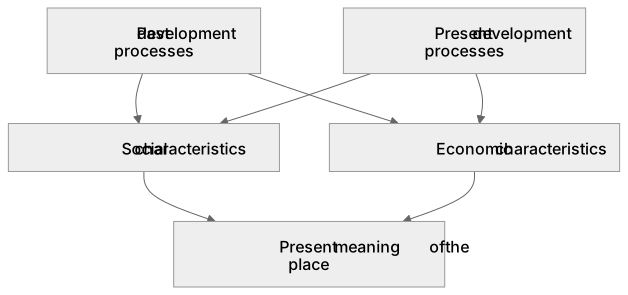
Key words
Say what each word means before you turn the card.
Place identity and meaning
Try answering aloud or in your head before turning the card.
Urban regeneration and gentrification
Try answering aloud or in your head before turning the card.
See every definition
- Place identity and meaning
- How a place is currently perceived and experienced, being a direct product of its historical and ongoing economic and social evolution.
- Urban regeneration and gentrification
- Present processes of development that introduce new economic activities and alter social demographics, adding to the combined layers of development in a place.
Label the diagram
Some boxes have lost their names. Pick the right name for each number.
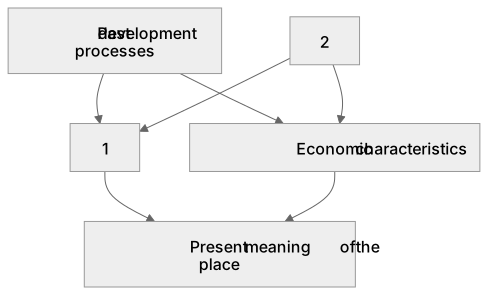
1Box 1
2Box 2
There is more to this lesson
The full lesson goes on to check your understanding and help you earn the marks. Create a free account to carry on, with your progress saved.
A week of Premium from your first lesson · Then the free plan continues · No card, no charge
Test your understanding of Meaning and representation: How both past and present processes of development can be seen to influence the social and economic characteristics of places and so be implicit in present meanings.
Active recall beats re-reading. Take an instant quiz now to test what you’ve learned and lock it into long-term memory.
A week of Premium from your first lesson · Then the free plan continues · No card, no charge