AQA · A-Level · Geography
Course version: 7037 · Version from Sept 2018
How places may be represented in a variety of different forms such as…
Full specification wording
Meaning and representation: How places may be represented in a variety of different forms such as advertising copy, tourist agency material, local art exhibitions in diverse media (eg film, photography, art, story, song etc) that often give contrasting images to that presented formally or statistically such as cartography and census data.
Places are represented through diverse media, creating subjective identities that often contrast with objective realities.
Checked against the AQA 7037 specification (opens in a new tab) on .
- Point 1 of 2
- 4 key terms
Study notes
From the checked teaching notes for this specification point.
The idea
Places are represented through diverse media, creating subjective identities that often contrast with objective realities. Advertising copy and tourist agency materials typically project sanitised images to attract visitors. Local art exhibitions, encompassing film, photography, art, stories, and songs, offer emotional perspectives capturing a community's authentic voice. These qualitative representations frequently contradict formal, statistical depictions. While census data might reveal high deprivation and cartography shows dense industrial zoning, a local song or story might celebrate the area's rich cultural vibrancy, highlighting the tension between lived experience and statistical fact.
What earns the marks
- Analyse how advertising copy and tourist agency materials construct specific, often positive, representations of place.
- Examine the role of diverse media, including film, photography, art, stories, and songs, in conveying lived experiences and local art exhibitions.
- Interpret formal and statistical representations of place, specifically using cartography and census data.
- Compare and contrast the subjective images created by media and art with the objective realities presented by formal statistical data.
Common mistakes and how to put them right
Treating all qualitative media as entirely factual.
Put it right: Recognise that films, songs, and tourist materials are subjective and often biased or curated for a specific purpose.
Overlooking the specific examples of media listed in the specification.
Put it right: Ensure you explicitly reference advertising, tourist materials, local art, film, photography, stories, and songs in your answers.
Assuming census data and cartography tell the complete story of a place.
Put it right: Acknowledge that while formal data provides statistical facts, it lacks the emotional and lived reality captured by diverse media.
Exam tips
- Select a specific place and gather contrasting representations, such as a tourist brochure versus local census data, to use as a direct comparison in an essay.
- Critically evaluate the purpose behind a representation; ask why a tourist agency or a local artist might want to portray a place in a certain way.
- Use cartography and census data to establish the demographic and spatial baseline of your chosen place before exploring its cultural representations.
Try the lesson
The start of the Meaning and representation: How places may be represented in a variety of different forms such as advertising copy, tourist agency material, local art exhibitions in diverse media (eg film, photography, art, story, song etc) that often give contrasting images to that presented formally or statistically such as cartography and census data. lesson, made from checked teaching notes for this specification point.
Have a go first
Which of the following is an example of a formal or statistical representation of a place?
Listen
Places are represented through diverse media, creating subjective identities that often contrast with objective realities. Advertising copy and tourist agency materials typically project sanitised images to attract visitors. Local art exhibitions, encompassing film, photography, art, stories, and songs, offer emotional perspectives capturing a community's authentic voice. These qualitative representations frequently contradict formal, statistical depictions. While census data might reveal high deprivation and cartography shows dense industrial zoning, a local song or story might celebrate the area's rich cultural vibrancy, highlighting the tension between lived experience and statistical fact. A strong answer earns marks for these points. Analyse how advertising copy and tourist agency materials construct specific, often positive, representations of place. Examine the role of diverse media, including film, photography, art, stories, and songs, in conveying lived experiences and local art exhibitions. Interpret formal and statistical representations of place, specifically using cartography and census data. Compare and contrast the subjective images created by media and art with the objective realities presented by formal statistical data. A common slip: Treating all qualitative media as entirely factual. Instead, Recognise that films, songs, and tourist materials are subjective and often biased or curated for a specific purpose. Exam tip: Select a specific place and gather contrasting representations, such as a tourist brochure versus local census data, to use as a direct comparison in an essay.
See it
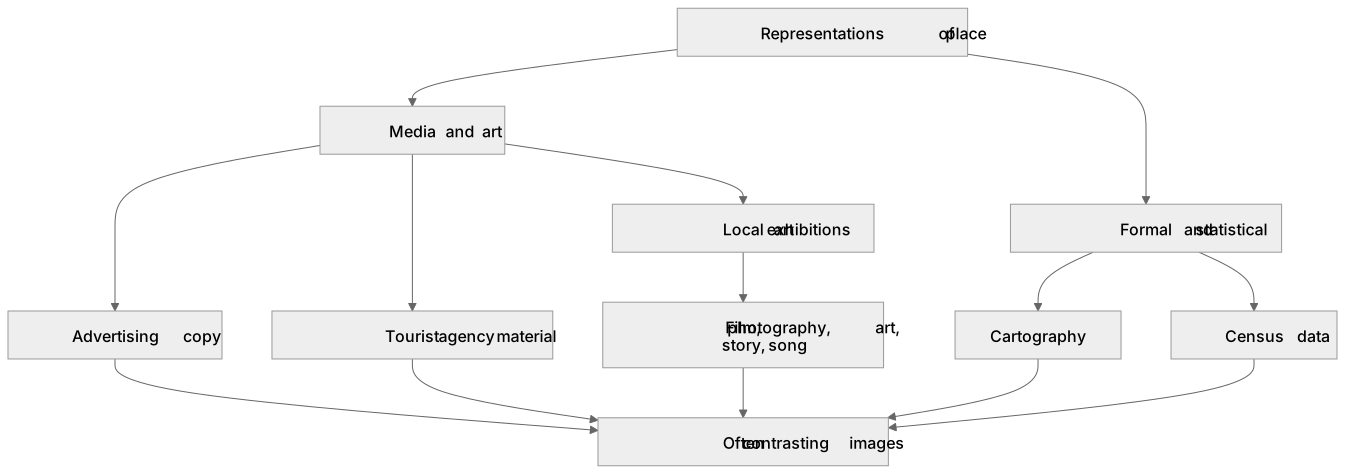
Key words
Say what each word means before you turn the card.
Representation
Try answering aloud or in your head before turning the card.
Subjectivity vs Objectivity
Try answering aloud or in your head before turning the card.
Qualitative vs Quantitative data
Try answering aloud or in your head before turning the card.
Lived experience
Try answering aloud or in your head before turning the card.
See every definition
- Representation
- How places may be represented in a variety of different forms, such as advertising copy, tourist agency material and local art exhibitions in diverse media.
- Subjectivity vs Objectivity
- The tension between subjective images created by media and art and the objective realities presented by formal statistical data.
- Qualitative vs Quantitative data
- Qualitative representations frequently contradict formal, statistical depictions, while census data provides statistical facts that lack the emotional and lived reality.
- Lived experience
- The emotional and lived reality captured by diverse media, highlighting the tension with statistical fact.
Label the diagram
Some boxes have lost their names. Pick the right name for each number.
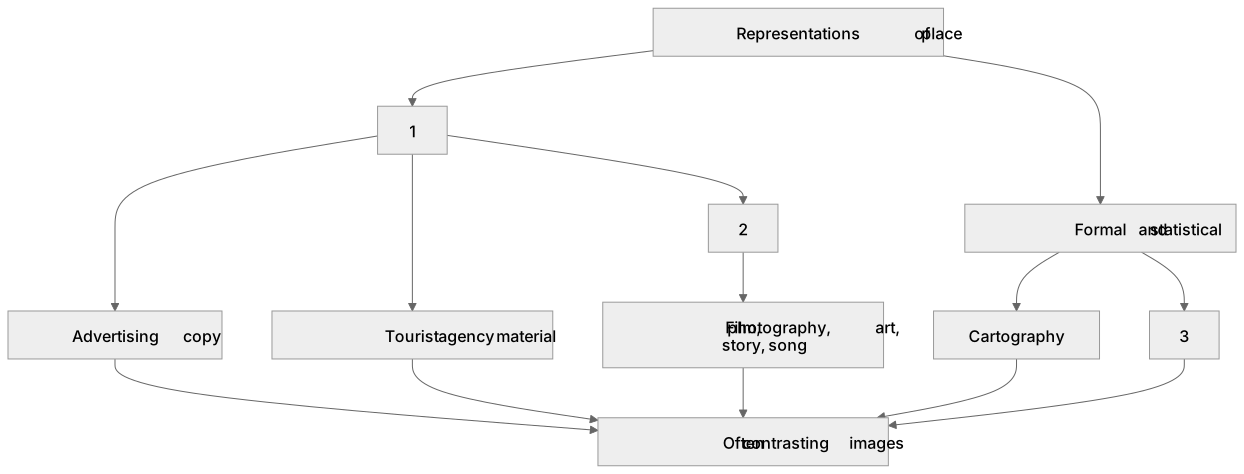
1Box 1
2Box 2
3Box 3
There is more to this lesson
The full lesson goes on to check your understanding and help you earn the marks. Create a free account to carry on, with your progress saved.
A week of Premium from your first lesson · Then the free plan continues · No card, no charge
Test your understanding of Meaning and representation: How places may be represented in a variety of different forms such as advertising copy, tourist agency material, local art exhibitions in diverse media (eg film, photography, art, story, song etc) that often give contrasting images to that presented formally or statistically such as cartography and census data.
Active recall beats re-reading. Take an instant quiz now to test what you’ve learned and lock it into long-term memory.
A week of Premium from your first lesson · Then the free plan continues · No card, no charge