AQA · A-Level · Geography
Course version: 7037 · Version from Sept 2018
Destructive, constructive and conservative plate margins. Characteristic…
Full specification wording
Plate tectonics: Destructive, constructive and conservative plate margins. Characteristic processes: seismicity and vulcanicity. Associated landforms: young fold mountains, rift valleys, ocean ridges, deep sea trenches and island arcs, volcanoes.
Plate margins are boundaries where tectonic plates interact, driving characteristic processes and creating distinct landforms.
Checked against the AQA 7037 specification (opens in a new tab) on .
- Point 2 of 3
- 4 key terms
Study notes
From the checked teaching notes for this specification point.
The idea
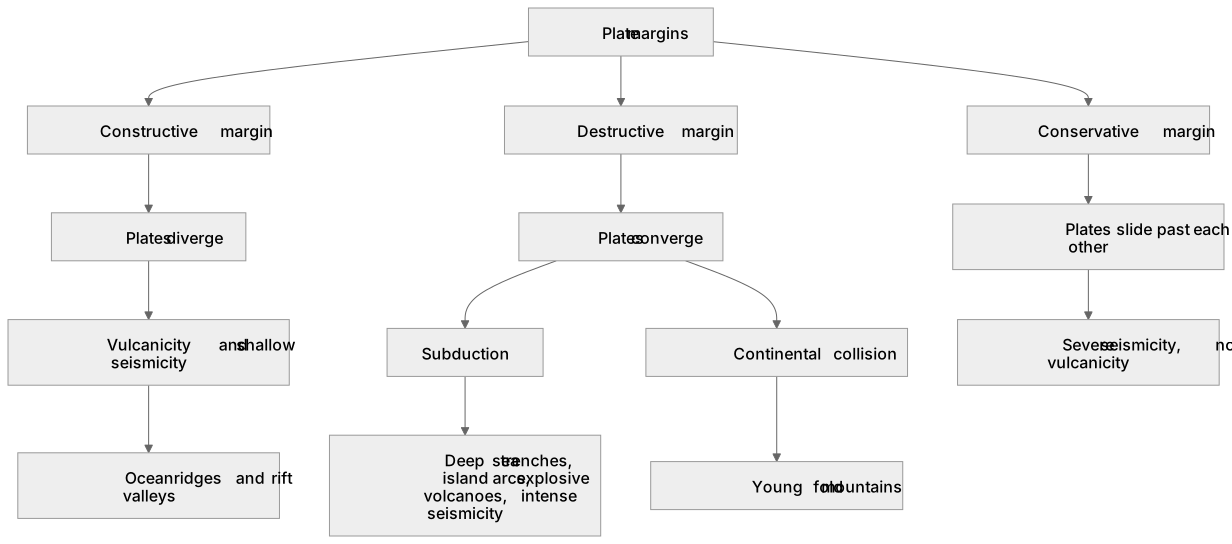
Plate margins are boundaries where tectonic plates interact, driving characteristic processes and creating distinct landforms. At constructive margins, plates diverge, causing vulcanicity and shallow seismicity, forming ocean ridges (Mid-Atlantic Ridge) and rift valleys (East African Rift). Destructive margins involve convergence; subduction generates deep sea trenches (Mariana Trench), island arcs, explosive volcanoes, and intense seismicity, while continental collisions form young fold mountains (Himalayas). Conservative margins feature plates sliding past each other (San Andreas Fault), producing severe seismicity but no vulcanicity, as no magma is generated or released.
What earns the marks
- Explain the mechanics of constructive margins, noting decompression melting that forms basaltic magma, ocean ridges, and rift valleys.
- Detail destructive margins where subduction of denser oceanic crust creates deep sea trenches, island arcs, and explosive stratovolcanoes.
- Describe the formation of young fold mountains at destructive margins where two continental plates collide and undergo orogenesis.
- Clarify that conservative margins experience significant seismicity due to friction and locked faults, but lack vulcanicity.
Common mistakes and how to put them right
Stating that magma is created by friction at destructive margins.
Put it right by explaining that flux melting occurs due to the release of volatiles from the subducting plate.
Confusing the types of volcanoes at different margins.
Put it right by associating shield volcanoes with constructive margins and composite volcanoes with destructive margins.
Claiming conservative margins have volcanoes.
Put it right by stating they only experience seismicity because there is no mechanism for magma generation or crustal destruction.
Exam tips
- Always link the specific landform (such as a deep sea trench) to the exact tectonic process (such as subduction and slab pull) operating at that margin.
- Use named, real-world examples for every landform discussed, such as the Andes for young fold mountains or the Mid-Atlantic Ridge for ocean ridges.
- When discussing seismicity, differentiate between the shallow focus earthquakes of constructive margins and the deep focus earthquakes of destructive margins.
Try the lesson
The start of the Plate tectonics: Destructive, constructive and conservative plate margins. Characteristic processes: seismicity and vulcanicity. Associated landforms: young fold mountains, rift valleys, ocean ridges, deep sea trenches and island arcs, volcanoes. lesson, made from checked teaching notes for this specification point.
Have a go first
Which of the following landforms is characteristically associated with a constructive plate margin?
Listen
Plate margins are boundaries where tectonic plates interact, driving characteristic processes and creating distinct landforms. At constructive margins, plates diverge, causing vulcanicity and shallow seismicity, forming ocean ridges (Mid-Atlantic Ridge) and rift valleys (East African Rift). Destructive margins involve convergence; subduction generates deep sea trenches (Mariana Trench), island arcs, explosive volcanoes, and intense seismicity, while continental collisions form young fold mountains (Himalayas). Conservative margins feature plates sliding past each other (San Andreas Fault), producing severe seismicity but no vulcanicity, as no magma is generated or released. A strong answer earns marks for these points. Explain the mechanics of constructive margins, noting decompression melting that forms basaltic magma, ocean ridges, and rift valleys. Detail destructive margins where subduction of denser oceanic crust creates deep sea trenches, island arcs, and explosive stratovolcanoes. Describe the formation of young fold mountains at destructive margins where two continental plates collide and undergo orogenesis. Clarify that conservative margins experience significant seismicity due to friction and locked faults, but lack vulcanicity. A common slip: Stating that magma is created by friction at destructive margins. Instead, explaining that flux melting occurs due to the release of volatiles from the subducting plate. Exam tip: Always link the specific landform (such as a deep sea trench) to the exact tectonic process (such as subduction and slab pull) operating at that margin.
See it
Key words
Say what each word means before you turn the card.
Constructive margins
Try answering aloud or in your head before turning the card.
Destructive margins
Try answering aloud or in your head before turning the card.
Conservative margins
Try answering aloud or in your head before turning the card.
Vulcanicity
Try answering aloud or in your head before turning the card.
See every definition
- Constructive margins
- Boundaries where plates diverge, causing vulcanicity and shallow seismicity, and forming ocean ridges and rift valleys.
- Destructive margins
- Boundaries involving convergence, where subduction generates deep sea trenches, island arcs, explosive volcanoes and intense seismicity, while continental collisions form young fold mountains.
- Conservative margins
- Boundaries where plates slide past each other, producing severe seismicity but no vulcanicity, as no magma is generated or released.
- Vulcanicity
- Characteristic process at constructive and destructive margins, absent at conservative margins because no magma is generated or released.
Label the diagram
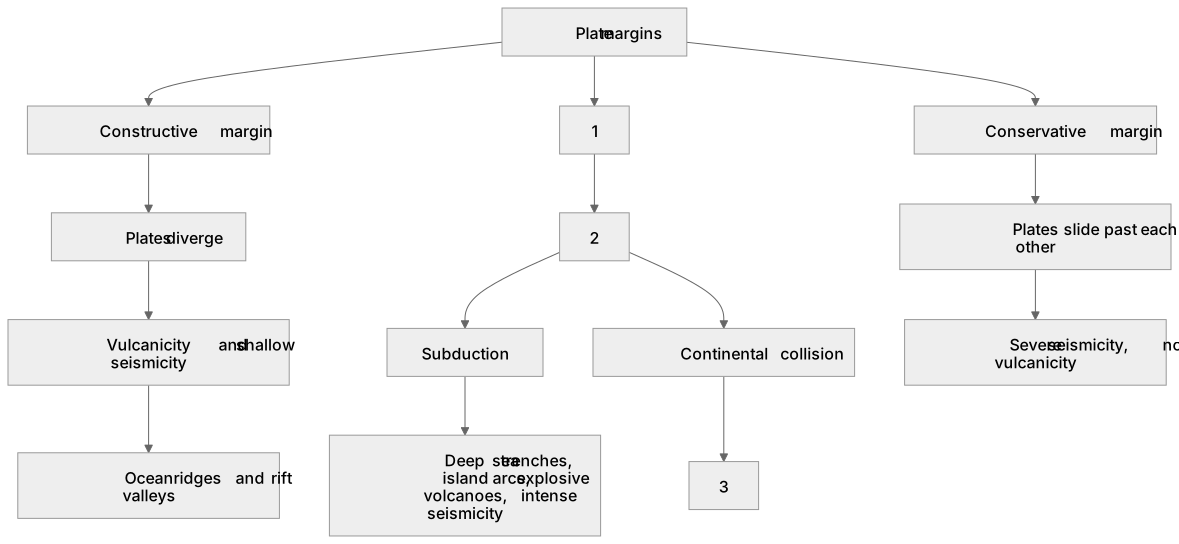
Some boxes have lost their names. Pick the right name for each number.
1Box 1
2Box 2
3Box 3
There is more to this lesson
The full lesson goes on to check your understanding and help you earn the marks. Create a free account to carry on, with your progress saved.
A week of Premium from your first lesson · Then the free plan continues · No card, no charge
Test your understanding of Plate tectonics: Destructive, constructive and conservative plate margins. Characteristic processes: seismicity and vulcanicity. Associated landforms: young fold mountains, rift valleys, ocean ridges, deep sea trenches and island arcs, volcanoes.
Active recall beats re-reading. Take an instant quiz now to test what you’ve learned and lock it into long-term memory.
A week of Premium from your first lesson · Then the free plan continues · No card, no charge