AQA · A-Level · Geography
Course version: 7037 · Version from Sept 2018
Earth structure and internal energy sources. Plate tectonic theory of…
Full specification wording
Plate tectonics: Earth structure and internal energy sources. Plate tectonic theory of crustal evolution: tectonic plates; plate movement; gravitational sliding; ridge push, slab pull; convection currents and sea-floor spreading.
The Earth's structure comprises the inner core, outer core, mantle, and crust.
Checked against the AQA 7037 specification (opens in a new tab) on .
- Point 1 of 3
- 4 key terms
Study notes
From the checked teaching notes for this specification point.
The idea
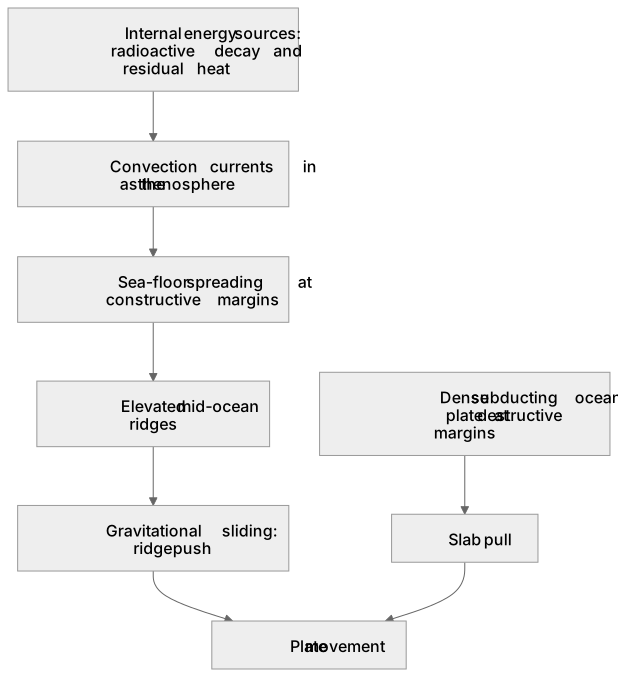
The Earth's structure comprises the inner core, outer core, mantle, and crust. Internal energy sources, primarily radioactive decay and residual heat, drive dynamic processes within the mantle. The plate tectonic theory of crustal evolution explains how the lithosphere is divided into tectonic plates that constantly move. This plate movement is driven by several mechanisms. Convection currents in the asthenosphere transfer heat, contributing to sea-floor spreading at constructive margins. Gravitational sliding occurs as lithosphere slides away from elevated mid-ocean ridges, known as ridge push. At destructive margins, the dense, subducting oceanic plate pulls the rest of the plate behind it, a dominant driving force termed slab pull.
What earns the marks
- Describe the Earth's internal structure, detailing the physical properties of the crust, mantle, and core.
- Explain the role of radioactive decay as the primary internal energy source driving mantle convection.
- Outline the process of sea-floor spreading and how it provides evidence for the plate tectonic theory of crustal evolution.
- Compare the relative importance of ridge push (gravitational sliding) and slab pull in driving plate movement.
Common mistakes and how to put them right
Stating that convection currents are the sole driver of plate movement.
Put it right: Explain that while convection currents are important, slab pull is now considered the dominant driving force for plate movement.
Confusing the lithosphere with the crust.
Put it right: Define the lithosphere as the crust and the uppermost solid part of the mantle, which together form the tectonic plates.
Describing ridge push as magma pushing the plates apart.
Put it right: Describe ridge push as gravitational sliding, where the elevated lithosphere at mid-ocean ridges slides downwards and outwards due to gravity.
Exam tips
- Ensure you can clearly distinguish between the mechanisms of ridge push and slab pull, using appropriate geographical terminology.
- When discussing internal energy sources, explicitly mention both primordial heat and radiogenic heat from radioactive decay.
- Use annotated diagrams to illustrate the processes of sea-floor spreading, convection currents, and subduction.
Try the lesson
The start of the Plate tectonics: Earth structure and internal energy sources. Plate tectonic theory of crustal evolution: tectonic plates; plate movement; gravitational sliding; ridge push, slab pull; convection currents and sea-floor spreading. lesson, made from checked teaching notes for this specification point.
Have a go first
Which process is considered the primary source of the Earth's internal heat energy that drives mantle convection?
Listen
The Earth's structure comprises the inner core, outer core, mantle, and crust. Internal energy sources, primarily radioactive decay and residual heat, drive dynamic processes within the mantle. The plate tectonic theory of crustal evolution explains how the lithosphere is divided into tectonic plates that constantly move. This plate movement is driven by several mechanisms. Convection currents in the asthenosphere transfer heat, contributing to sea-floor spreading at constructive margins. Gravitational sliding occurs as lithosphere slides away from elevated mid-ocean ridges, known as ridge push. At destructive margins, the dense, subducting oceanic plate pulls the rest of the plate behind it, a dominant driving force termed slab pull. A strong answer earns marks for these points. Describe the Earth's internal structure, detailing the physical properties of the crust, mantle, and core. Explain the role of radioactive decay as the primary internal energy source driving mantle convection. Outline the process of sea-floor spreading and how it provides evidence for the plate tectonic theory of crustal evolution. Compare the relative importance of ridge push (gravitational sliding) and slab pull in driving plate movement. A common slip: Stating that convection currents are the sole driver of plate movement. Instead, Explain that while convection currents are important, slab pull is now considered the dominant driving force for plate movement. Exam tip: Ensure you can clearly distinguish between the mechanisms of ridge push and slab pull, using appropriate geographical terminology.
See it
Key words
Say what each word means before you turn the card.
Plate tectonic theory
Try answering aloud or in your head before turning the card.
Convection currents
Try answering aloud or in your head before turning the card.
Ridge push
Try answering aloud or in your head before turning the card.
Slab pull
Try answering aloud or in your head before turning the card.
See every definition
- Plate tectonic theory
- Explains how the lithosphere is divided into tectonic plates that constantly move, driving crustal evolution.
- Convection currents
- Currents in the asthenosphere that transfer heat, contributing to sea-floor spreading at constructive margins.
- Ridge push
- Gravitational sliding as lithosphere slides away from elevated mid-ocean ridges.
- Slab pull
- At destructive margins, the dense, subducting oceanic plate pulls the rest of the plate behind it, a dominant driving force.
Label the diagram
Some boxes have lost their names. Pick the right name for each number.
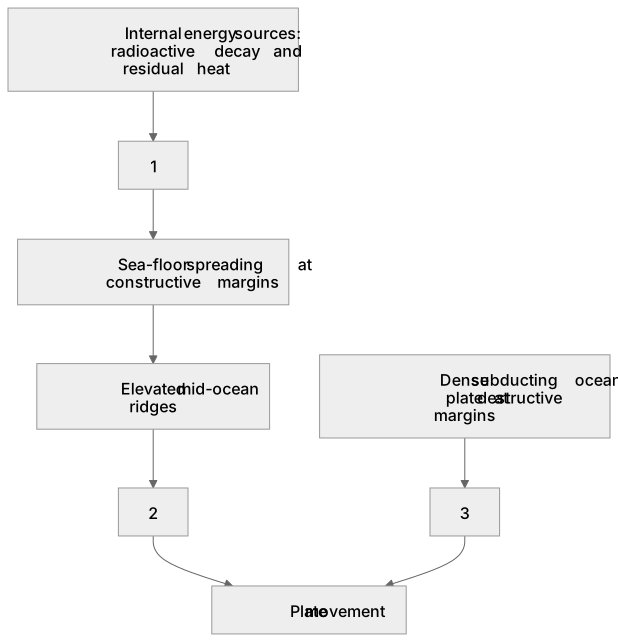
1Box 1
2Box 2
3Box 3
There is more to this lesson
The full lesson goes on to check your understanding and help you earn the marks. Create a free account to carry on, with your progress saved.
A week of Premium from your first lesson · Then the free plan continues · No card, no charge
Test your understanding of Plate tectonics: Earth structure and internal energy sources. Plate tectonic theory of crustal evolution: tectonic plates; plate movement; gravitational sliding; ridge push, slab pull; convection currents and sea-floor spreading.
Active recall beats re-reading. Take an instant quiz now to test what you’ve learned and lock it into long-term memory.
A week of Premium from your first lesson · Then the free plan continues · No card, no charge