AQA · A-Level · Geography
Course version: 7037 · Version from Sept 2018
Population growth dynamics. Concepts of overpopulation, underpopulation…
Full specification wording
Principles of population ecology and their application to human populations: Population growth dynamics. Concepts of overpopulation, underpopulation and optimum population. Implications of population size and structure for the balance between population and resources; the concepts of ‘carrying capacity’ and ‘ecological footprint’ and their implications.
Population growth dynamics explore how birth and death rates alter population size.
Checked against the AQA 7037 specification (opens in a new tab) on .
- Point 1 of 2
- 3 key terms
Study notes
From the checked teaching notes for this specification point.
The idea
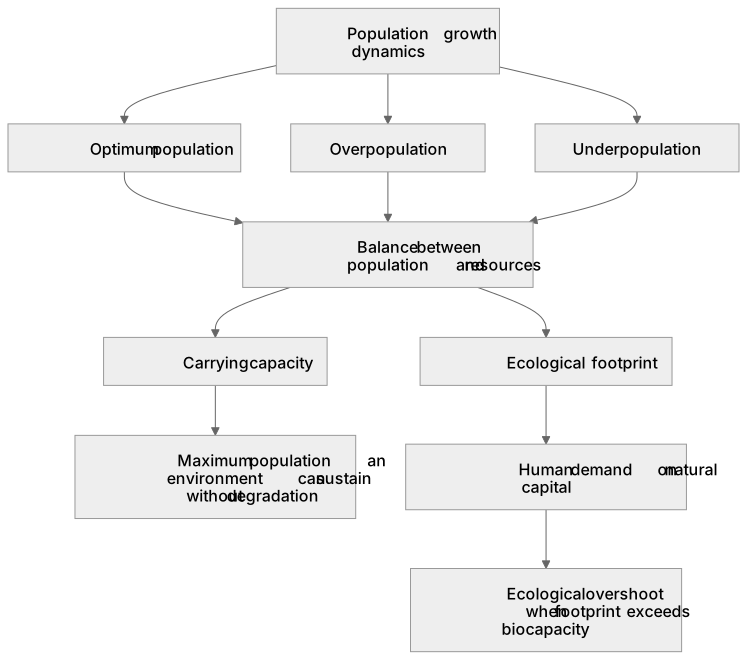
Population growth dynamics explore how birth and death rates alter population size. Optimum population occurs when the number of people yields the highest living standards given available resources. Overpopulation happens when numbers exceed resources, whereas underpopulation means insufficient people to fully exploit them. The balance between population size, age structure, and resources is critical. Carrying capacity defines the maximum population an environment can sustain without degradation. Ecological footprint measures human demand on natural capital. An ecological footprint larger than the available biocapacity indicates ecological overshoot. Carrying capacity is tested separately by asking whether an environment can sustain a given population and its consumption over time; technology, trade and changing consumption can alter that relationship.
What earns the marks
- Define optimum population as a dynamic state where population size and resources maximise per capita income and quality of life.
- Explain how population structure (e.g., an ageing population) affects resource consumption and economic productivity.
- Apply the concept of carrying capacity to human populations, noting how technology (e.g., agricultural advancements) can alter this limit.
- Use the ecological footprint to assess sustainability, comparing a population's resource demand against the Earth's biocapacity.
Common mistakes and how to put them right
Treating optimum population as a fixed number.
Put it right: Explain that it is dynamic and changes with technological advancements and resource discovery.
Confusing overpopulation with high population density.
Put it right: Clarify that overpopulation relates to the ratio of people to available resources, not just physical space.
Failing to link population structure to resources.
Put it right: Explicitly discuss how age structures (like high dependency ratios) impact resource allocation and economic output.
Exam tips
- Use the ecological footprint model to compare the resource demands of high-income and low-income countries in exam responses.
- Link carrying capacity to Malthusian and Boserupian theories to evaluate whether human populations can sustainably grow.
- Always define key terms like 'underpopulation' clearly, using examples like Australia or Canada to illustrate the concept.
Try the lesson
The start of the Principles of population ecology and their application to human populations: Population growth dynamics. Concepts of overpopulation, underpopulation and optimum population. Implications of population size and structure for the balance between population and resources; the concepts of ‘carrying capacity’ and ‘ecological footprint’ and their implications. lesson, made from checked teaching notes for this specification point.
Have a go first
Which of the following best defines the concept of 'optimum population' in relation to resources?
Listen
Population growth dynamics explore how birth and death rates alter population size. Optimum population occurs when the number of people yields the highest living standards given available resources. Overpopulation happens when numbers exceed resources, whereas underpopulation means insufficient people to fully exploit them. The balance between population size, age structure, and resources is critical. Carrying capacity defines the maximum population an environment can sustain without degradation. Ecological footprint measures human demand on natural capital. An ecological footprint larger than the available biocapacity indicates ecological overshoot. Carrying capacity is tested separately by asking whether an environment can sustain a given population and its consumption over time; technology, trade and changing consumption can alter that relationship. A strong answer earns marks for these points. Define optimum population as a dynamic state where population size and resources maximise per capita income and quality of life. Explain how population structure (e.g., an ageing population) affects resource consumption and economic productivity. Apply the concept of carrying capacity to human populations, noting how technology (e.g., agricultural advancements) can alter this limit. Use the ecological footprint to assess sustainability, comparing a population's resource demand against the Earth's biocapacity. A common slip: Treating optimum population as a fixed number. Instead, explain that it is dynamic and changes with technological advancements and resource discovery. Exam tip: Use the ecological footprint model to compare the resource demands of high-income and low-income countries in exam responses.
See it
Key words
Say what each word means before you turn the card.
Optimum population
Try answering aloud or in your head before turning the card.
Underpopulation
Try answering aloud or in your head before turning the card.
Carrying capacity
Try answering aloud or in your head before turning the card.
See every definition
- Optimum population
- A dynamic state where population size and resources maximise per capita income and quality of life.
- Underpopulation
- Means insufficient people to fully exploit available resources.
- Carrying capacity
- The maximum population an environment can sustain without degradation.
Label the diagram
Some boxes have lost their names. Pick the right name for each number.
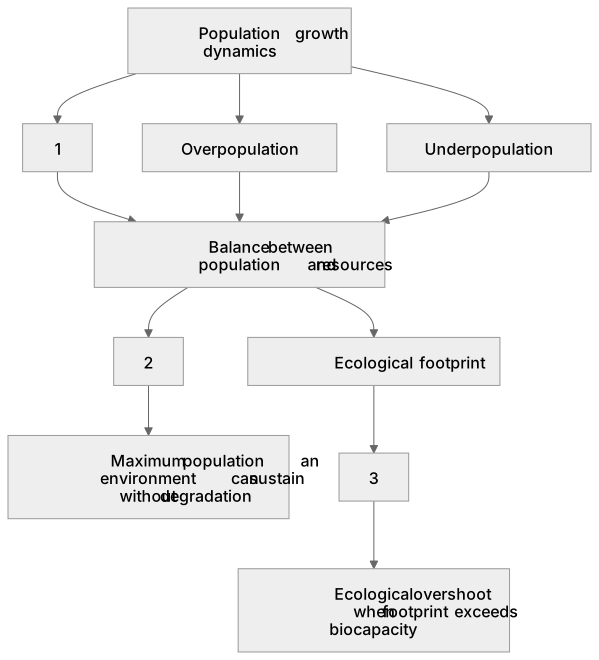
1Box 1
2Box 2
3Box 3
There is more to this lesson
The full lesson goes on to check your understanding and help you earn the marks. Create a free account to carry on, with your progress saved.
A week of Premium from your first lesson · Then the free plan continues · No card, no charge
Test your understanding of Principles of population ecology and their application to human populations: Population growth dynamics. Concepts of overpopulation, underpopulation and optimum population. Implications of population size and structure for the balance between population and resources; the concepts of ‘carrying capacity’ and ‘ecological footprint’ and their implications.
Active recall beats re-reading. Take an instant quiz now to test what you’ve learned and lock it into long-term memory.
A week of Premium from your first lesson · Then the free plan continues · No card, no charge