AQA · A-Level · Geography
Course version: 7037 · Version from Sept 2018
Understanding of the opportunities and limitations of qualitative…
Full specification wording
Qualitative skills and quantitative skills: understanding of the opportunities and limitations of qualitative techniques such as coding and sampling, and appreciation of how they actively create particular geographical representations
Qualitative techniques like coding and sampling offer opportunities to explore complex human experiences alongside distinct limitations.
Checked against the AQA 7037 specification (opens in a new tab) on .
- Point 2 of 6
- 3 key terms
Study notes
From the checked teaching notes for this specification point.
The idea
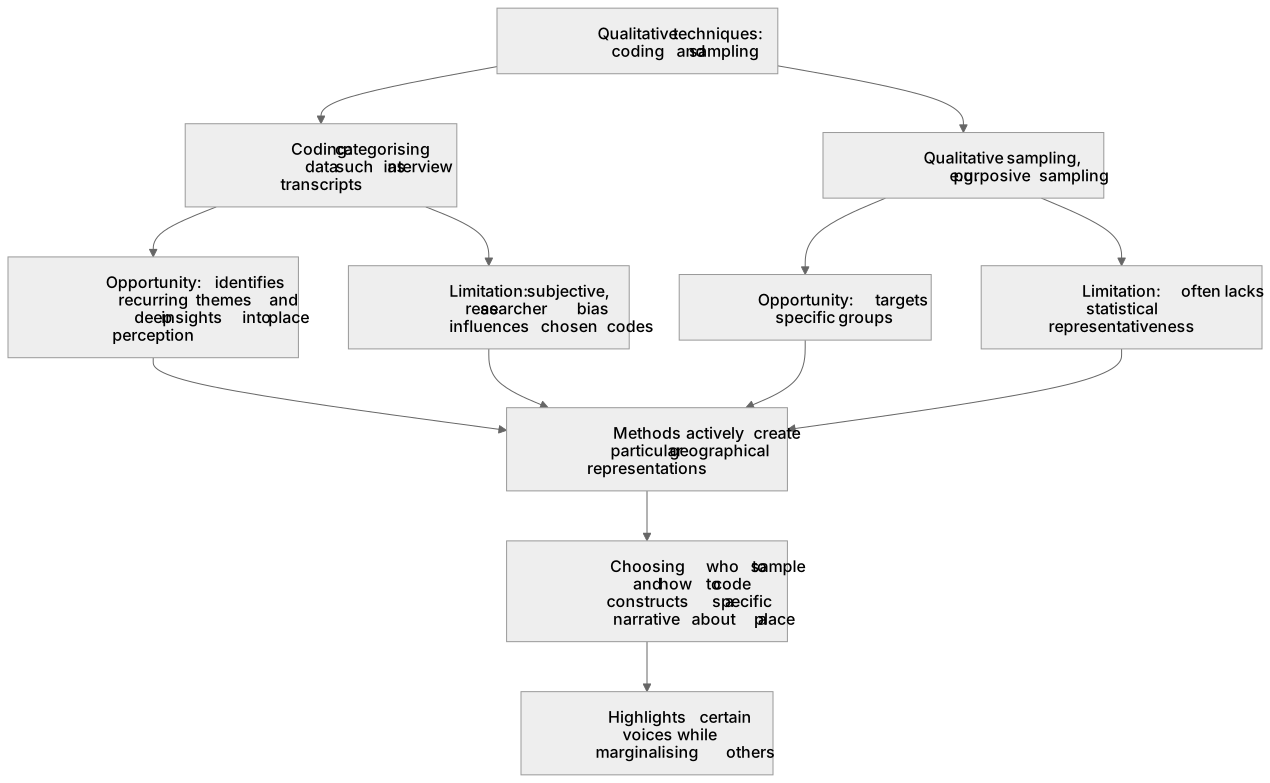
Qualitative techniques like coding and sampling offer opportunities to explore complex human experiences alongside distinct limitations. Coding involves categorising data, such as interview transcripts, to identify recurring themes. This provides deep insights into place perception but is subjective, as researcher bias influences the chosen codes. Qualitative sampling, such as purposive sampling, targets specific groups but often lacks statistical representativeness. Crucially, these methods do not passively record data; they actively create particular geographical representations. By choosing who to sample and how to code responses, researchers construct a specific narrative about a place, highlighting certain voices while marginalising others.
What earns the marks
- Explaining how coding transforms unstructured qualitative data into identifiable themes for geographical analysis.
- Identifying the limitations of qualitative sampling methods, such as the lack of statistical representativeness in purposive sampling.
- Evaluating how researcher bias during the coding process can influence the final geographical conclusions.
- Analysing how the choice of qualitative techniques actively constructs and shapes the representation of a place.
Common mistakes and how to put them right
Confusing qualitative sampling with quantitative random sampling.
Put it right: Recognise that qualitative sampling is often non-probability and aims for depth of insight rather than statistical representation.
Assuming coding is a purely objective process.
Put it right: Acknowledge that coding is inherently subjective, as the researcher decides which themes are significant, thereby shaping the representation.
Stating that qualitative techniques only collect pre-existing facts.
Put it right: Explain that these techniques actively create representations by filtering reality through the researcher's methodological choices.
Exam tips
- When discussing coding, provide a brief example of how an interview transcript about a local area might be categorised into themes like 'community' or 'decline'.
- Always link the limitations of a qualitative technique back to how it might skew the final representation of a place.
- Use the term 'positionality' to discuss how a researcher's own background influences their coding and sampling choices.
Try the lesson
The start of the Qualitative skills and quantitative skills: understanding of the opportunities and limitations of qualitative techniques such as coding and sampling, and appreciation of how they actively create particular geographical representations lesson, made from checked teaching notes for this specification point.
Have a go first
In qualitative geographical research, what is the primary purpose of 'coding' interview transcripts?
Listen
Qualitative techniques like coding and sampling offer opportunities to explore complex human experiences alongside distinct limitations. Coding involves categorising data, such as interview transcripts, to identify recurring themes. This provides deep insights into place perception but is subjective, as researcher bias influences the chosen codes. Qualitative sampling, such as purposive sampling, targets specific groups but often lacks statistical representativeness. Crucially, these methods do not passively record data; they actively create particular geographical representations. By choosing who to sample and how to code responses, researchers construct a specific narrative about a place, highlighting certain voices while marginalising others. A strong answer earns marks for these points. Explaining how coding transforms unstructured qualitative data into identifiable themes for geographical analysis. Identifying the limitations of qualitative sampling methods, such as the lack of statistical representativeness in purposive sampling. Evaluating how researcher bias during the coding process can influence the final geographical conclusions. Analysing how the choice of qualitative techniques actively constructs and shapes the representation of a place. A common slip: Confusing qualitative sampling with quantitative random sampling. Instead, Recognise that qualitative sampling is often non-probability and aims for depth of insight rather than statistical representation. Exam tip: When discussing coding, provide a brief example of how an interview transcript about a local area might be categorised into themes like 'community' or 'decline'.
See it
Key words
Say what each word means before you turn the card.
Data coding
Try answering aloud or in your head before turning the card.
Sampling strategies
Try answering aloud or in your head before turning the card.
Construction of place
Try answering aloud or in your head before turning the card.
See every definition
- Data coding
- Categorising data, such as interview transcripts, to identify recurring themes, which provides deep insights into place perception but is subjective as researcher bias influences the chosen codes.
- Sampling strategies
- Qualitative sampling, such as purposive sampling, targets specific groups but often lacks statistical representativeness.
- Construction of place
- Methods do not passively record data but actively create particular geographical representations, constructing a specific narrative about a place that highlights certain voices while marginalising others.
Label the diagram
Some boxes have lost their names. Pick the right name for each number.
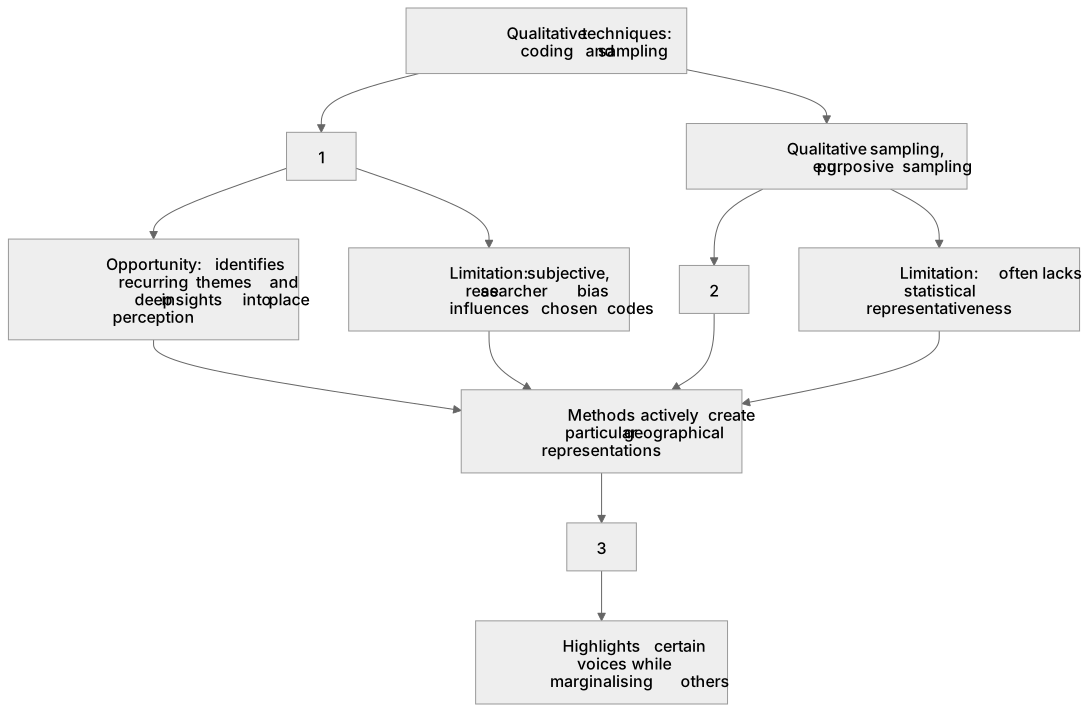
1Box 1
2Box 2
3Box 3
There is more to this lesson
The full lesson goes on to check your understanding and help you earn the marks. Create a free account to carry on, with your progress saved.
A week of Premium from your first lesson · Then the free plan continues · No card, no charge
Test your understanding of Qualitative skills and quantitative skills: understanding of the opportunities and limitations of qualitative techniques such as coding and sampling, and appreciation of how they actively create particular geographical representations
Active recall beats re-reading. Take an instant quiz now to test what you’ve learned and lock it into long-term memory.
A week of Premium from your first lesson · Then the free plan continues · No card, no charge