AQA · A-Level · Geography
Course version: 7037 · Version from Sept 2018
Use and understanding of a mixture of methodological approaches, including…
Full specification wording
Qualitative skills and quantitative skills: use and understanding of a mixture of methodological approaches, including interviews
Geographical research requires integrating various methodological approaches to build a comprehensive understanding of place and space.
Checked against the AQA 7037 specification (opens in a new tab) on .
- Point 1 of 6
- 4 key terms
Study notes
From the checked teaching notes for this specification point.
The idea
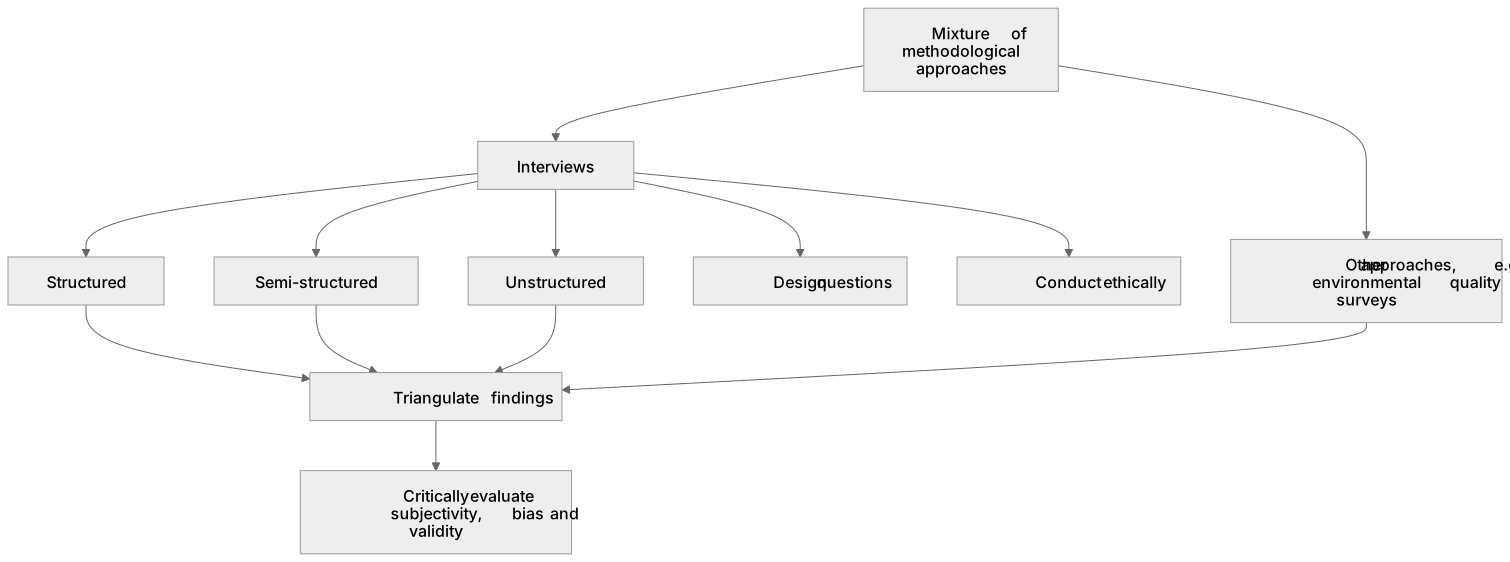
Geographical research requires integrating various methodological approaches to build a comprehensive understanding of place and space. Interviews can be structured, semi-structured, or unstructured, offering deep insights into people's lived experiences or perceptions of issues like urban regeneration. A robust methodology triangulates interview findings with other approaches, such as environmental quality surveys.
What earns the marks
- Design and conduct interviews (structured, semi-structured, or unstructured) to gather qualitative primary data.
- Triangulate interview data with other methodological approaches, such as quantitative surveys or secondary data analysis.
- Evaluate the strengths of interviews, such as gaining in-depth insights into human perceptions and lived experiences.
- Critically assess the limitations of interviews, including interviewer bias, subjectivity, and small sample sizes.
- Demonstrate an understanding of the ethical considerations required when conducting interviews with the public.
Common mistakes and how to put them right
Relying solely on interviews for an investigation.
Put it right: Triangulate qualitative interview data with quantitative methods to improve validity.
Failing to acknowledge bias in interview responses.
Put it right: Explicitly discuss how subjectivity affects the reliability of the data collected.
Using closed questions exclusively in an interview.
Put it right: Incorporate open-ended questions to gather the detailed qualitative insights that interviews are designed for.
Exam tips
- In fieldwork questions, justify your choice of interview type (e.g., semi-structured) based on your specific research aims.
- Discuss how you selected your interviewees (sampling strategy) and how this impacts the representativeness of your findings.
- When evaluating methodologies, contrast the rich detail gained from interviews with the broader trends identified through quantitative questionnaires.
Try the lesson
The start of the Qualitative skills and quantitative skills: use and understanding of a mixture of methodological approaches, including interviews lesson, made from checked teaching notes for this specification point.
Have a go first
A student is investigating the impact of a new bypass on a local village. They have collected quantitative traffic count data. Why would incorporating interviews with local residents improve their methodological approach?
Listen
Geographical research requires integrating various methodological approaches to build a comprehensive understanding of place and space. Interviews can be structured, semi-structured, or unstructured, offering deep insights into people's lived experiences or perceptions of issues like urban regeneration. A robust methodology triangulates interview findings with other approaches, such as environmental quality surveys. A strong answer earns marks for these points. Design and conduct interviews (structured, semi-structured, or unstructured) to gather qualitative primary data. Triangulate interview data with other methodological approaches, such as quantitative surveys or secondary data analysis. Evaluate the strengths of interviews, such as gaining in-depth insights into human perceptions and lived experiences. Critically assess the limitations of interviews, including interviewer bias, subjectivity, and small sample sizes. Exam tip: In fieldwork questions, justify your choice of interview type (e.g., semi-structured) based on your specific research aims.
See it
Key words
Say what each word means before you turn the card.
Qualitative data
Try answering aloud or in your head before turning the card.
Fieldwork methodology
Try answering aloud or in your head before turning the card.
Human perception
Try answering aloud or in your head before turning the card.
Data triangulation
Try answering aloud or in your head before turning the card.
See every definition
- Qualitative data
- Primary data gathered through interviews, offering deep insights into people's lived experiences or perceptions of issues like urban regeneration.
- Fieldwork methodology
- A mixture of methodological approaches, including interviews, used to gather primary data and build a comprehensive understanding of place and space.
- Human perception
- People's perceptions of issues, into which interviews can offer deep insights.
- Data triangulation
- Triangulating interview findings with other approaches, such as environmental quality surveys, to improve validity.
Label the diagram
Some boxes have lost their names. Pick the right name for each number.
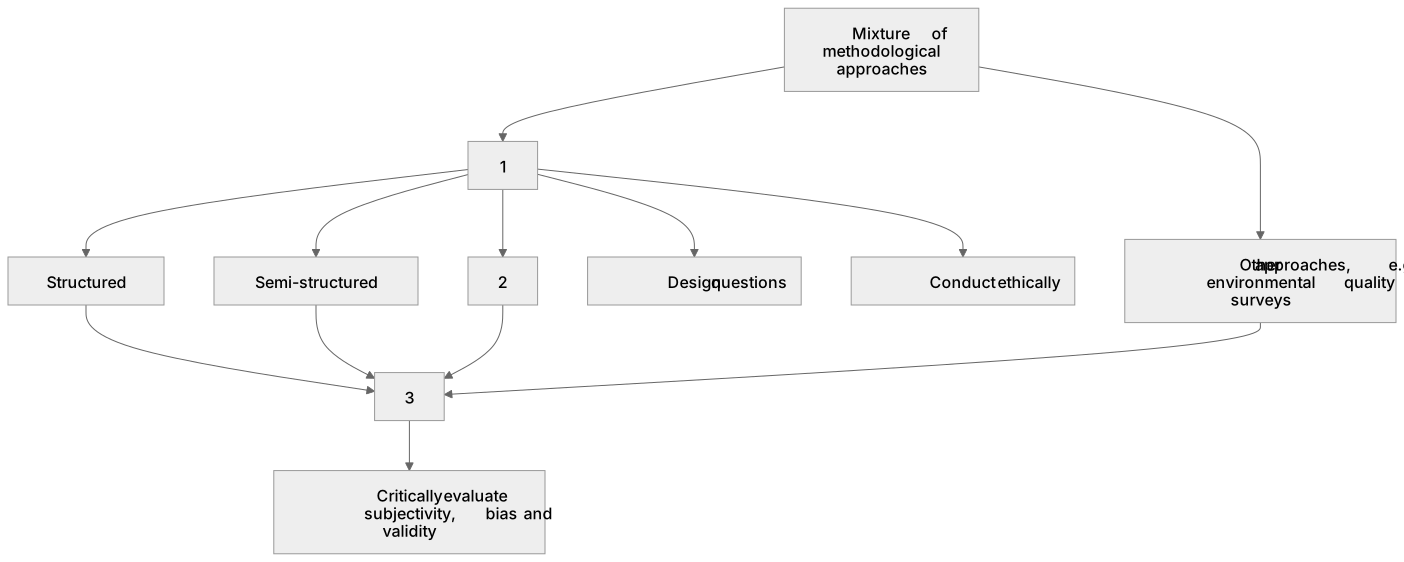
1Box 1
2Box 2
3Box 3
There is more to this lesson
The full lesson goes on to check your understanding and help you earn the marks. Create a free account to carry on, with your progress saved.
A week of Premium from your first lesson · Then the free plan continues · No card, no charge
Test your understanding of Qualitative skills and quantitative skills: use and understanding of a mixture of methodological approaches, including interviews
Active recall beats re-reading. Take an instant quiz now to test what you’ve learned and lock it into long-term memory.
A week of Premium from your first lesson · Then the free plan continues · No card, no charge