AQA · A-Level · Geography
Course version: 7037 · Version from Sept 2018
Concept of a resource. Resource classifications to include stock and flow…
Full specification wording
Resource development: Concept of a resource. Resource classifications to include stock and flow resources. Stock resource evaluation: measured reserves, indicated reserves, inferred resources, possible resources. Natural resource development over time: exploration, exploitation, development. Concept of the resource frontier. Concept of resource peak.
A resource is any aspect of the environment that can be used to meet human needs.
Checked against the AQA 7037 specification (opens in a new tab) on .
- Point 1 of 2
- 4 key terms
Study notes
From the checked teaching notes for this specification point.
The idea
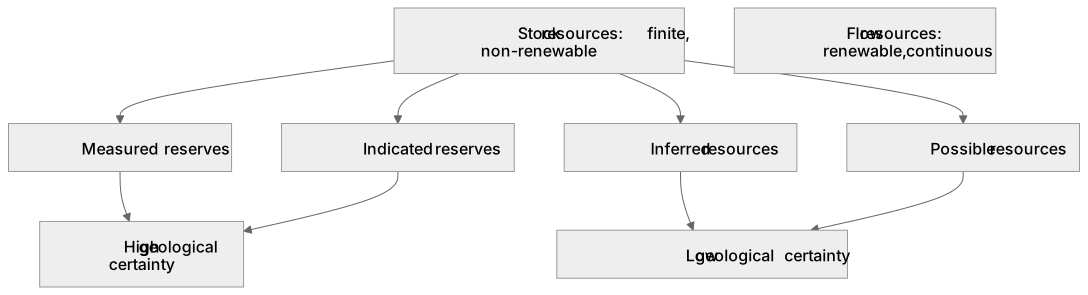
A resource is any aspect of the environment that can be used to meet human needs. Resources are classified as stock (non-renewable, finite) or flow (renewable, continuous). Evaluating stock resources involves categorising them by geological certainty: measured reserves (highly certain), indicated reserves, inferred resources, and possible resources (least certain). Resource development progresses through exploration, exploitation, and development. As accessible resources deplete, extraction moves to the resource frontier—remote or challenging areas like the Arctic. Finally, resource peak refers to the point in time when the maximum rate of extraction is reached, after which production enters terminal decline, as seen in Peak Oil theories.
What earns the marks
- Define stock resources as finite and non-renewable, and flow resources as renewable and continuous.
- Distinguish between the four levels of stock resource evaluation based on geological certainty and economic viability.
- Explain the chronological stages of resource development: exploration, exploitation, and development.
- Apply the concepts of the resource frontier and resource peak to specific examples, such as deep-water oil drilling or global coal production.
Common mistakes and how to put them right
Confusing 'reserves' with 'resources' in stock evaluation.
Put it right: Reserves (measured, indicated) are economically and technically viable to extract, whereas resources (inferred, possible) may not be.
Using 'resource peak' to mean the point when a resource runs out completely.
Put it right: Define resource peak as the point of maximum production rate, not the point of total depletion.
Failing to distinguish between the stages of exploration and exploitation.
Put it right: Clearly separate exploration (searching and assessing) from exploitation (the actual extraction and use).
Exam tips
- Use a specific example, such as oil or coal, to illustrate the transition from measured reserves to possible resources.
- When discussing the resource frontier, include the environmental and economic costs associated with operating in extreme environments.
- Be prepared to draw or interpret a Hubbert curve to illustrate the concept of resource peak in an exam.
Try the lesson
The start of the Resource development: Concept of a resource. Resource classifications to include stock and flow resources. Stock resource evaluation: measured reserves, indicated reserves, inferred resources, possible resources. Natural resource development over time: exploration, exploitation, development. Concept of the resource frontier. Concept of resource peak. lesson, made from checked teaching notes for this specification point.
Have a go first
Which statement best defines the fundamental difference between a stock resource and a flow resource?
Listen
A resource is any aspect of the environment that can be used to meet human needs. Resources are classified as stock (non-renewable, finite) or flow (renewable, continuous). Evaluating stock resources involves categorising them by geological certainty: measured reserves (highly certain), indicated reserves, inferred resources, and possible resources (least certain). Resource development progresses through exploration, exploitation, and development. As accessible resources deplete, extraction moves to the resource frontier—remote or challenging areas like the Arctic. Finally, resource peak refers to the point in time when the maximum rate of extraction is reached, after which production enters terminal decline, as seen in Peak Oil theories. A strong answer earns marks for these points. Define stock resources as finite and non-renewable, and flow resources as renewable and continuous. Distinguish between the four levels of stock resource evaluation based on geological certainty and economic viability. Explain the chronological stages of resource development: exploration, exploitation, and development. Apply the concepts of the resource frontier and resource peak to specific examples, such as deep-water oil drilling or global coal production. A common slip: Confusing 'reserves' with 'resources' in stock evaluation. Instead, reserves (measured, indicated) are economically and technically viable to extract, whereas resources (inferred, possible) may not be. Exam tip: Use a specific example, such as oil or coal, to illustrate the transition from measured reserves to possible resources.
See it
Key words
Say what each word means before you turn the card.
Resource classification
Try answering aloud or in your head before turning the card.
Resource evaluation
Try answering aloud or in your head before turning the card.
Resource frontiers
Try answering aloud or in your head before turning the card.
Peak production
Try answering aloud or in your head before turning the card.
See every definition
- Resource classification
- Resources are classified as stock, which are non-renewable and finite, or flow, which are renewable and continuous.
- Resource evaluation
- Evaluating stock resources involves categorising them by geological certainty, from measured reserves to possible resources.
- Resource frontiers
- As accessible resources deplete, extraction moves to remote or challenging areas such as the Arctic.
- Peak production
- The point in time when the maximum rate of extraction is reached, after which production enters terminal decline.
Label the diagram
Some boxes have lost their names. Pick the right name for each number.
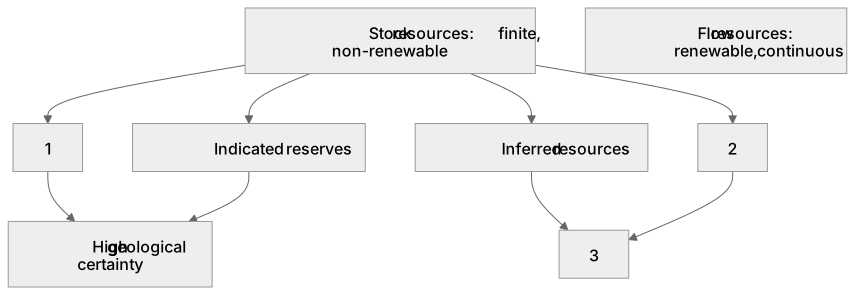
1Box 1
2Box 2
3Box 3
There is more to this lesson
The full lesson goes on to check your understanding and help you earn the marks. Create a free account to carry on, with your progress saved.
A week of Premium from your first lesson · Then the free plan continues · No card, no charge
Test your understanding of Resource development: Concept of a resource. Resource classifications to include stock and flow resources. Stock resource evaluation: measured reserves, indicated reserves, inferred resources, possible resources. Natural resource development over time: exploration, exploitation, development. Concept of the resource frontier. Concept of resource peak.
Active recall beats re-reading. Take an instant quiz now to test what you’ve learned and lock it into long-term memory.
A week of Premium from your first lesson · Then the free plan continues · No card, no charge