AQA · A-Level · Geography
Course version: 7037 · Version from Sept 2018
Sustainable resource development. Environmental Impact Assessment (EIA) in…
Full specification wording
Resource development: Sustainable resource development. Environmental Impact Assessment (EIA) in relation to resource development projects.
Sustainable resource development balances current economic and social needs for resources with the preservation of the environment for future generations.
Checked against the AQA 7037 specification (opens in a new tab) on .
- Point 2 of 2
Study notes
From the checked teaching notes for this specification point.
The idea
Sustainable resource development balances current economic and social needs for resources with the preservation of the environment for future generations. This requires careful management of extraction and processing to minimise ecological degradation. An Environmental Impact Assessment (EIA) is a crucial statutory tool used to evaluate the potential positive and negative environmental consequences of a proposed resource development project before it begins.
For example: Before opening a new copper mine, an EIA would assess potential water contamination, habitat destruction, and air pollution, proposing mitigation strategies such as water recycling systems or post-extraction land rehabilitation to ensure the project aligns with sustainability goals.
What earns the marks
- Define sustainable resource development as meeting present needs without compromising future generations' ability to meet theirs.
- Explain the purpose of an EIA in identifying and evaluating the environmental, social, and economic impacts of a project prior to decision-making.
- Describe the stages of an EIA, including screening, scoping, baseline studies, impact prediction, and mitigation planning.
- Evaluate the effectiveness of EIAs, noting that while they mandate mitigation, they can sometimes be influenced by economic pressures or lack strict enforcement.
Common mistakes and how to put them right
Confusing an EIA with an environmental audit.
Put it right: An EIA is conducted before a project begins, whereas an audit evaluates ongoing or completed operations.
Assuming EIAs only consider environmental factors.
Put it right: They must also evaluate social and economic impacts on local communities.
Believing an EIA guarantees a project will be sustainable.
Put it right: An EIA only informs decision-makers and proposes mitigation, but a project may still proceed with significant impacts.
Exam tips
- Use a specific case study of a resource development project to illustrate how an EIA influenced its planning or mitigation strategies.
- When evaluating EIAs, discuss both their strengths in preventing ecological damage and their limitations, such as cost and potential bias.
- Link the concept of sustainable resource development to broader geographical themes like the circular economy or planetary boundaries.
Try the lesson
The start of the Resource development: Sustainable resource development. Environmental Impact Assessment (EIA) in relation to resource development projects. lesson, made from checked teaching notes for this specification point.
Have a go first
Which of the following best describes the primary function of an Environmental Impact Assessment (EIA) in the context of a proposed resource development project?
Listen
Sustainable resource development balances current economic and social needs for resources with the preservation of the environment for future generations. This requires careful management of extraction and processing to minimise ecological degradation. An Environmental Impact Assessment (EIA) is a crucial statutory tool used to evaluate the potential positive and negative environmental consequences of a proposed resource development project before it begins. For example, before opening a new copper mine, an EIA would assess potential water contamination, habitat destruction, and air pollution, proposing mitigation strategies such as water recycling systems or post-extraction land rehabilitation to ensure the project aligns with sustainability goals. A strong answer earns marks for these points. Define sustainable resource development as meeting present needs without compromising future generations' ability to meet theirs. Explain the purpose of an EIA in identifying and evaluating the environmental, social, and economic impacts of a project prior to decision-making. Describe the stages of an EIA, including screening, scoping, baseline studies, impact prediction, and mitigation planning. Evaluate the effectiveness of EIAs, noting that while they mandate mitigation, they can sometimes be influenced by economic pressures or lack strict enforcement. Exam tip: Use a specific case study of a resource development project to illustrate how an EIA influenced its planning or mitigation strategies.
See it
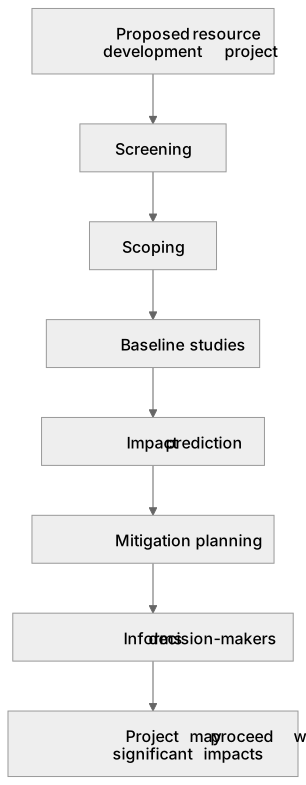
Put it in order
Put these steps in the order they happen.
- 1. Impact prediction
- 2. Project may proceed with significant impacts
- 3. Mitigation planning
- 4. Proposed resource development project
- 5. Screening
- 6. Informs decision-makers
- 7. Scoping
- 8. Baseline studies
Label the diagram
Some boxes have lost their names. Pick the right name for each number.
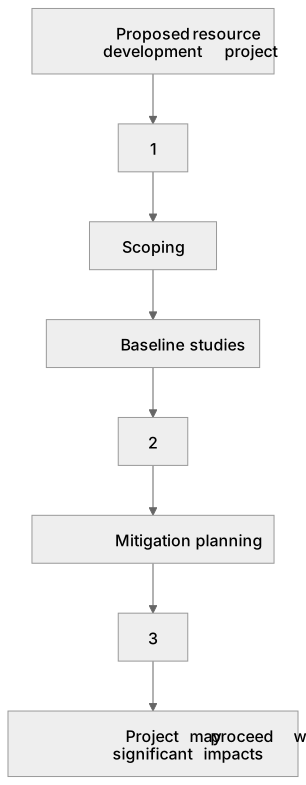
1Box 1
2Box 2
3Box 3
There is more to this lesson
The full lesson goes on to check your understanding and help you earn the marks. Create a free account to carry on, with your progress saved.
A week of Premium from your first lesson · Then the free plan continues · No card, no charge
Test your understanding of Resource development: Sustainable resource development. Environmental Impact Assessment (EIA) in relation to resource development projects.
Active recall beats re-reading. Take an instant quiz now to test what you’ve learned and lock it into long-term memory.
A week of Premium from your first lesson · Then the free plan continues · No card, no charge