AQA · A-Level · Geography
Course version: 7037 · Version from Sept 2018
Impacts and human responses as evidenced by a recent seismic event.
Full specification wording
Seismic hazards: Impacts and human responses as evidenced by a recent seismic event.
This case study must demonstrate specific impacts and human responses.
Checked against the AQA 7037 specification (opens in a new tab) on .
- Point 3 of 3
- 4 key terms
Study notes
From the checked teaching notes for this specification point.
The idea
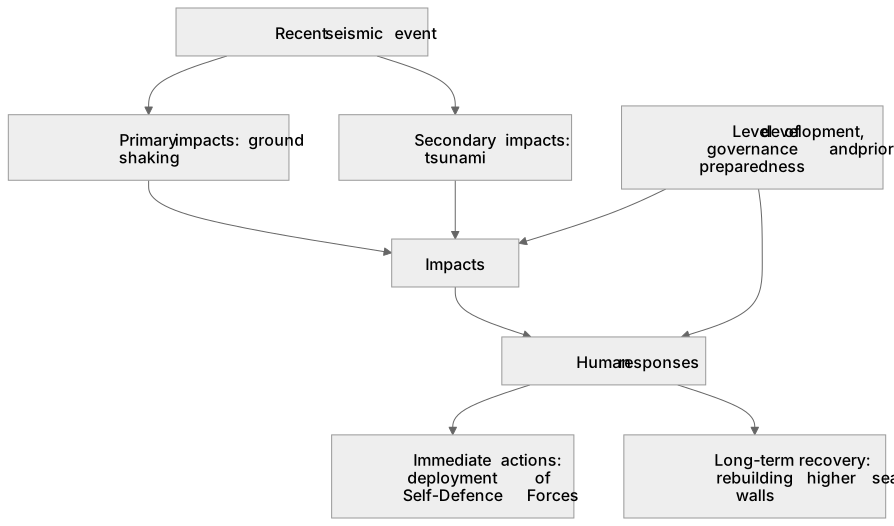
This case study must demonstrate specific impacts and human responses. For example, the 2011 Tōhoku earthquake in Japan illustrates severe primary impacts like ground shaking and devastating secondary impacts via a tsunami. Human responses must be evaluated, contrasting immediate actions like the deployment of the Self-Defence Forces with long-term recovery such as rebuilding higher sea walls. The chosen event should highlight how a country's level of development, governance, and prior preparedness influence both the scale of the impacts and the effectiveness of the subsequent human responses.
What earns the marks
- Provide specific, quantifiable data from a chosen recent seismic event (e.g., magnitude, death toll, economic cost in US dollars).
- Detail the specific primary and secondary impacts unique to the chosen case study, linking them to the tectonic setting.
- Analyse the timeline of human responses, distinguishing between immediate emergency relief and long-term reconstruction efforts.
- Evaluate how the specific geographical context (e.g., level of development, population density) influenced the severity of impacts and the success of responses.
Common mistakes and how to put them right
Using an outdated case study.
Put it right: Select a recent seismic event (ideally post-2000) to ensure relevance to modern hazard management and technology.
Providing generic impacts without specific evidence.
Put it right: Include precise facts, figures, and named locations relevant to the specific seismic event.
Failing to evaluate the response.
Put it right: Move beyond merely describing what happened by assessing the success or failure of the human responses.
Exam tips
- Memorise 5 to 7 key statistics for your chosen case study to provide concrete evidence in essay questions.
- Contrast your recent seismic event with another event in a country with a different level of development to highlight the role of vulnerability.
- Ensure you can discuss both the physical causes of the event and the human factors that turned the hazard into a disaster.
Try the lesson
The start of the Seismic hazards: Impacts and human responses as evidenced by a recent seismic event. lesson, made from checked teaching notes for this specification point.
Have a go first
During the 2011 Tohoku earthquake in Japan, which of the following was a major secondary environmental and economic impact?
Listen
This case study must demonstrate specific impacts and human responses. For example, the 2011 Tōhoku earthquake in Japan illustrates severe primary impacts like ground shaking and devastating secondary impacts via a tsunami. Human responses must be evaluated, contrasting immediate actions like the deployment of the Self-Defence Forces with long-term recovery such as rebuilding higher sea walls. The chosen event should highlight how a country's level of development, governance, and prior preparedness influence both the scale of the impacts and the effectiveness of the subsequent human responses. A strong answer earns marks for these points. Provide specific, quantifiable data from a chosen recent seismic event (e.g., magnitude, death toll, economic cost in US dollars). Detail the specific primary and secondary impacts unique to the chosen case study, linking them to the tectonic setting. Analyse the timeline of human responses, distinguishing between immediate emergency relief and long-term reconstruction efforts. Evaluate how the specific geographical context (e.g., level of development, population density) influenced the severity of impacts and the success of responses. A common slip: Using an outdated case study. Instead, select a recent seismic event (ideally post-2000) to ensure relevance to modern hazard management and technology. Exam tip: Memorise 5 to 7 key statistics for your chosen case study to provide concrete evidence in essay questions.
See it
Key words
Say what each word means before you turn the card.
Case Study Application
Try answering aloud or in your head before turning the card.
Human-Environment Interaction
Try answering aloud or in your head before turning the card.
Development and Vulnerability
Try answering aloud or in your head before turning the card.
Disaster Response
Try answering aloud or in your head before turning the card.
See every definition
- Case Study Application
- Analysing a recent seismic event, typically one occurring within the last thirty years, to demonstrate specific impacts and human responses.
- Human-Environment Interaction
- How a country's level of development, governance and prior preparedness influence both the scale of impacts and the effectiveness of subsequent human responses.
- Development and Vulnerability
- The way a country's level of development, governance and prior preparedness shape the severity of impacts and the success of responses to a seismic event.
- Disaster Response
- Human responses evaluated by contrasting immediate actions, such as deployment of the Self-Defence Forces, with long-term recovery such as rebuilding higher sea walls.
Label the diagram
Some boxes have lost their names. Pick the right name for each number.
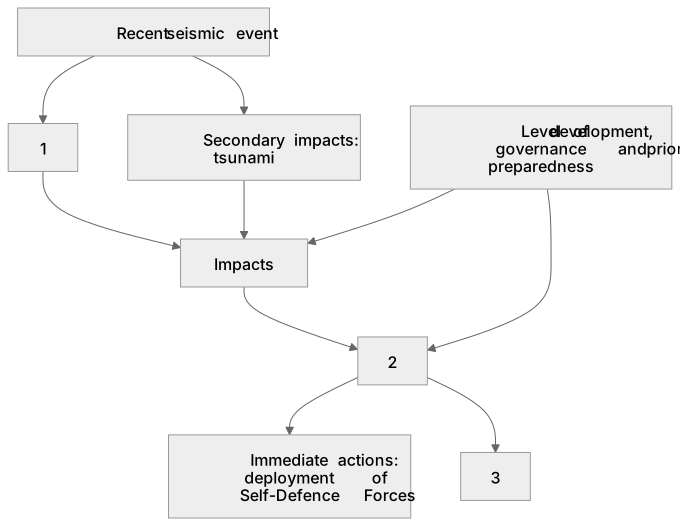
1Box 1
2Box 2
3Box 3
There is more to this lesson
The full lesson goes on to check your understanding and help you earn the marks. Create a free account to carry on, with your progress saved.
A week of Premium from your first lesson · Then the free plan continues · No card, no charge
Test your understanding of Seismic hazards: Impacts and human responses as evidenced by a recent seismic event.
Active recall beats re-reading. Take an instant quiz now to test what you’ve learned and lock it into long-term memory.
A week of Premium from your first lesson · Then the free plan continues · No card, no charge