AQA · A-Level · Geography
Course version: 7037 · Version from Sept 2018
Impacts: primary/secondary; environmental, social, economic, political.…
Full specification wording
Seismic hazards: Impacts: primary/secondary; environmental, social, economic, political. Short and long-term responses; risk management designed to reduce the impacts of the hazard through preparedness, mitigation, prevention and adaptation.
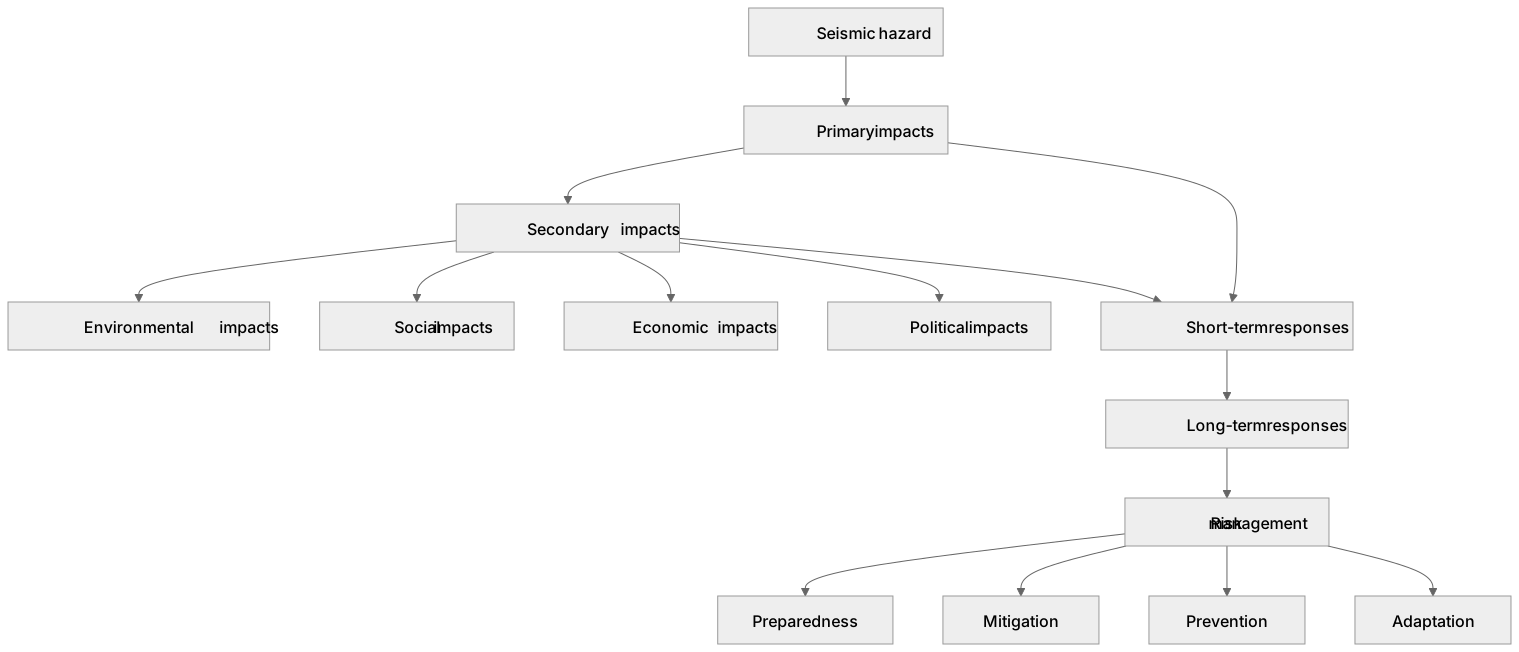
Seismic hazards generate primary impacts, such as ground shaking and crustal fracturing, which directly destroy infrastructure.
Checked against the AQA 7037 specification (opens in a new tab) on .
- Point 2 of 3
- 4 key terms
Study notes
From the checked teaching notes for this specification point.
The idea
Seismic hazards generate primary impacts, such as ground shaking and crustal fracturing, which directly destroy infrastructure. Secondary impacts follow, including tsunamis, landslides, and liquefaction, leading to complex environmental, social, economic, and political consequences like disease outbreaks or government collapse. Responses are categorised temporally: short-term emergency aid and search-and-rescue, versus long-term reconstruction and policy shifts. Risk management aims to reduce vulnerability through the hazard management cycle. This includes preparedness (early warning systems and evacuation drills), mitigation (aseismic building design), prevention (land-use zoning to avoid fault lines), and adaptation (changing lifestyles to cope with residual risks).
What earns the marks
- Distinguish clearly between primary impacts (direct result of the earthquake, e.g., ground shaking) and secondary impacts (resulting from primary impacts, e.g., fires from ruptured gas pipes).
- Categorise impacts accurately into environmental (habitat destruction), social (loss of life), economic (business disruption), and political (loss of governance).
- Evaluate the effectiveness of short-term responses (search and rescue, emergency shelter) versus long-term responses (rebuilding infrastructure, economic recovery).
- Apply the concepts of risk management: preparedness (education, drills), mitigation (retrofitting buildings), prevention (zoning laws), and adaptation (insurance, community resilience).
Common mistakes and how to put them right
Confusing primary and secondary impacts.
Put it right: Ensure primary impacts are direct physical effects of the event, while secondary impacts are the knock-on effects like tsunamis or disease.
Using mitigation and adaptation interchangeably.
Put it right: Mitigation reduces the severity of the hazard's impact (e.g., aseismic design), whereas adaptation involves adjusting living practices to tolerate the hazard.
Ignoring political impacts; correction: explicitly include political consequences such as government criticism, policy changes, or reliance on international aid.
Exam tips
- Use the Park Model (hazard response curve) to structure answers evaluating short-term versus long-term responses.
- When discussing risk management, explicitly use the terminology of preparedness, mitigation, prevention, and adaptation to access higher mark bands.
- Link the severity of impacts to the level of economic development, showing how vulnerability influences the scale of disaster.
Try the lesson
The start of the Seismic hazards: Impacts: primary/secondary; environmental, social, economic, political. Short and long-term responses; risk management designed to reduce the impacts of the hazard through preparedness, mitigation, prevention and adaptation. lesson, made from checked teaching notes for this specification point.
Have a go first
Which of the following is an example of a primary environmental impact of a seismic hazard?
Listen
Seismic hazards generate primary impacts, such as ground shaking and crustal fracturing, which directly destroy infrastructure. Secondary impacts follow, including tsunamis, landslides, and liquefaction, leading to complex environmental, social, economic, and political consequences like disease outbreaks or government collapse. Responses are categorised temporally: short-term emergency aid and search-and-rescue, versus long-term reconstruction and policy shifts. Risk management aims to reduce vulnerability through the hazard management cycle. This includes preparedness (early warning systems and evacuation drills), mitigation (aseismic building design), prevention (land-use zoning to avoid fault lines), and adaptation (changing lifestyles to cope with residual risks). A strong answer earns marks for these points. Distinguish clearly between primary impacts (direct result of the earthquake, e.g., ground shaking) and secondary impacts (resulting from primary impacts, e.g., fires from ruptured gas pipes). Categorise impacts accurately into environmental (habitat destruction), social (loss of life), economic (business disruption), and political (loss of governance). Evaluate the effectiveness of short-term responses (search and rescue, emergency shelter) versus long-term responses (rebuilding infrastructure, economic recovery). Apply the concepts of risk management: preparedness (education, drills), mitigation (retrofitting buildings), prevention (zoning laws), and adaptation (insurance, community resilience). A common slip: Confusing primary and secondary impacts. Instead, ensure primary impacts are direct physical effects of the event, while secondary impacts are the knock-on effects like tsunamis or disease. Exam tip: Use the Park Model (hazard response curve) to structure answers evaluating short-term versus long-term responses.
See it
Key words
Say what each word means before you turn the card.
Preparedness
Try answering aloud or in your head before turning the card.
Mitigation
Try answering aloud or in your head before turning the card.
Prevention
Try answering aloud or in your head before turning the card.
Adaptation
Try answering aloud or in your head before turning the card.
See every definition
- Preparedness
- Risk management designed to reduce the impacts of the hazard through measures such as early warning systems and evacuation drills.
- Mitigation
- Risk management designed to reduce the impacts of the hazard, for example through aseismic building design.
- Prevention
- Risk management designed to reduce the impacts of the hazard, such as land-use zoning to avoid fault lines.
- Adaptation
- Risk management designed to reduce the impacts of the hazard by changing lifestyles to cope with residual risks.
Label the diagram
Some boxes have lost their names. Pick the right name for each number.
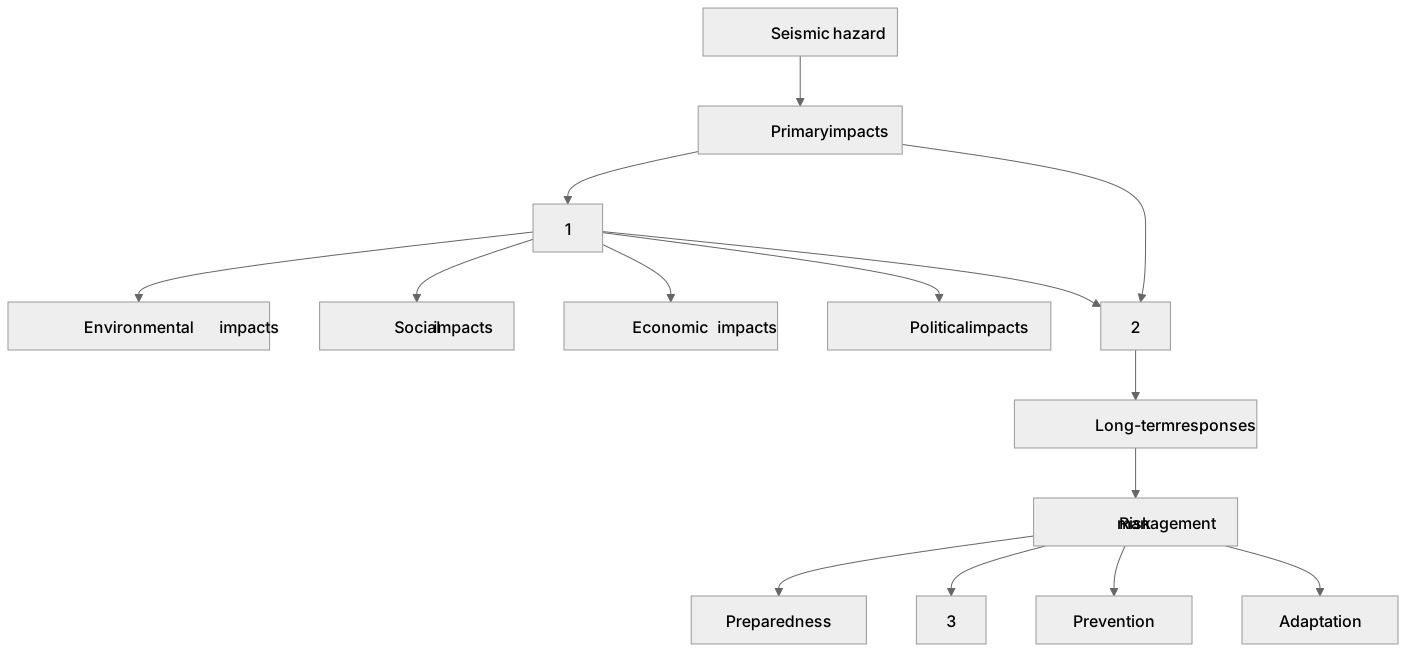
1Box 1
2Box 2
3Box 3
There is more to this lesson
The full lesson goes on to check your understanding and help you earn the marks. Create a free account to carry on, with your progress saved.
A week of Premium from your first lesson · Then the free plan continues · No card, no charge
Test your understanding of Seismic hazards: Impacts: primary/secondary; environmental, social, economic, political. Short and long-term responses; risk management designed to reduce the impacts of the hazard through preparedness, mitigation, prevention and adaptation.
Active recall beats re-reading. Take an instant quiz now to test what you’ve learned and lock it into long-term memory.
A week of Premium from your first lesson · Then the free plan continues · No card, no charge