AQA · A-Level · Geography
Course version: 7037 · Version from Sept 2018
The nature of seismicity and its relation to plate tectonics: forms of…
Full specification wording
Seismic hazards: The nature of seismicity and its relation to plate tectonics: forms of seismic hazard: earthquakes, shockwaves, tsunamis, liquefaction, landslides. Spatial distribution, randomness, magnitude, frequency, regularity, predictability of hazard events.
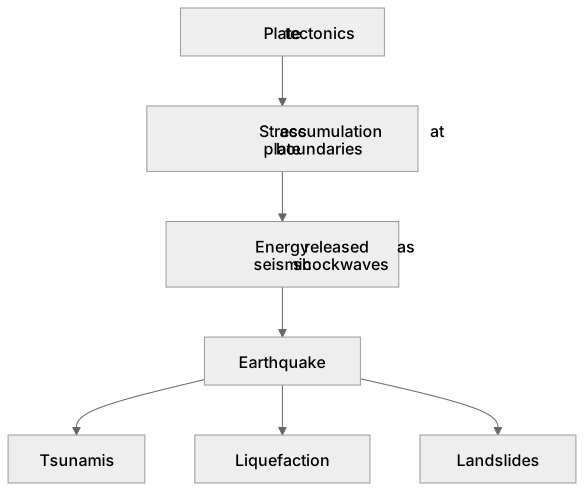
Seismicity is fundamentally driven by plate tectonics, where stress accumulation at plate boundaries releases energy as seismic shockwaves.
Checked against the AQA 7037 specification (opens in a new tab) on .
- Point 1 of 3
- 4 key terms
Study notes
From the checked teaching notes for this specification point.
The idea
Seismicity is fundamentally driven by plate tectonics, where stress accumulation at plate boundaries releases energy as seismic shockwaves. You must understand various forms of seismic hazard: the primary earthquake itself, and secondary hazards including tsunamis (displaced water columns), liquefaction (water-saturated sediment losing strength), and landslides. You also need to analyse the profile of these events. This involves examining their spatial distribution (mostly along plate margins), randomness versus regularity, and the inverse relationship between magnitude and frequency. Finally, evaluate the predictability of seismic events, noting that while spatial locations are known, exact temporal predictions remain impossible.
What earns the marks
- Explain how tectonic stress at different plate boundaries (constructive, destructive, conservative) generates seismic shockwaves.
- Describe the mechanisms of secondary hazards, such as how submarine earthquakes displace water to form tsunamis or how shaking causes liquefaction in saturated soils.
- Analyse the spatial distribution of earthquakes, noting their concentration along the Pacific Ring of Fire and other major fault lines.
- Evaluate the relationship between magnitude and frequency, demonstrating that high-magnitude events occur with lower frequency and less regularity.
- Discuss the limitations of predicting earthquakes, contrasting spatial predictability (seismic gaps) with the inability to make accurate short-term temporal predictions.
Common mistakes and how to put them right
Stating that earthquakes can be accurately predicted.
Put it right by explaining that only long-term forecasts and spatial probabilities can be calculated, not exact times.
Confusing the cause of tsunamis with tidal forces or weather.
Put it right: Ensure you attribute tectonic tsunamis to the vertical displacement of the seabed during an earthquake.
Describing liquefaction simply as melting ground.
Put it right: Correctly define it as the process where saturated, unconsolidated sediments temporarily lose strength and act as a fluid due to seismic shaking.
Exam tips
- Use the Moment Magnitude Scale (MMS) rather than the Richter scale when discussing earthquake magnitude in modern contexts.
- When discussing spatial distribution, always link the location of the seismic hazard back to the specific type of plate boundary and its associated tectonic processes.
- Prepare to compare the predictability of seismic hazards with other hazards like volcanoes or tropical storms, highlighting why earthquakes are uniquely difficult to forecast.
Try the lesson
The start of the Seismic hazards: The nature of seismicity and its relation to plate tectonics: forms of seismic hazard: earthquakes, shockwaves, tsunamis, liquefaction, landslides. Spatial distribution, randomness, magnitude, frequency, regularity, predictability of hazard events. lesson, made from checked teaching notes for this specification point.
Have a go first
Which of the following best describes the seismic hazard known as liquefaction?
Listen
Seismicity is fundamentally driven by plate tectonics, where stress accumulation at plate boundaries releases energy as seismic shockwaves. You must understand various forms of seismic hazard: the primary earthquake itself, and secondary hazards including tsunamis (displaced water columns), liquefaction (water-saturated sediment losing strength), and landslides. You also need to analyse the profile of these events. This involves examining their spatial distribution (mostly along plate margins), randomness versus regularity, and the inverse relationship between magnitude and frequency. Finally, evaluate the predictability of seismic events, noting that while spatial locations are known, exact temporal predictions remain impossible. A strong answer earns marks for these points. Explain how tectonic stress at different plate boundaries (constructive, destructive, conservative) generates seismic shockwaves. Describe the mechanisms of secondary hazards, such as how submarine earthquakes displace water to form tsunamis or how shaking causes liquefaction in saturated soils. Analyse the spatial distribution of earthquakes, noting their concentration along the Pacific Ring of Fire and other major fault lines. Evaluate the relationship between magnitude and frequency, demonstrating that high-magnitude events occur with lower frequency and less regularity. A common slip: Stating that earthquakes can be accurately predicted. Instead, explaining that only long-term forecasts and spatial probabilities can be calculated, not exact times. Exam tip: Use the Moment Magnitude Scale (MMS) rather than the Richter scale when discussing earthquake magnitude in modern contexts.
See it
Key words
Say what each word means before you turn the card.
Seismic hazard
Try answering aloud or in your head before turning the card.
Spatial distribution
Try answering aloud or in your head before turning the card.
Magnitude and frequency
Try answering aloud or in your head before turning the card.
Predictability
Try answering aloud or in your head before turning the card.
See every definition
- Seismic hazard
- Forms include earthquakes, shockwaves, tsunamis, liquefaction and landslides, driven by stress accumulation at plate boundaries releasing energy.
- Spatial distribution
- The pattern of hazard events, mostly along plate margins, examined alongside randomness, regularity and predictability.
- Magnitude and frequency
- An inverse relationship in which high-magnitude events occur with lower frequency and less regularity.
- Predictability
- Spatial locations are known, but exact temporal predictions remain impossible.
Label the diagram
Some boxes have lost their names. Pick the right name for each number.
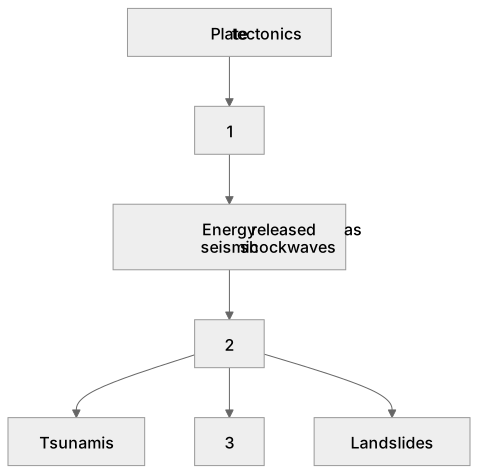
1Box 1
2Box 2
3Box 3
There is more to this lesson
The full lesson goes on to check your understanding and help you earn the marks. Create a free account to carry on, with your progress saved.
A week of Premium from your first lesson · Then the free plan continues · No card, no charge
Test your understanding of Seismic hazards: The nature of seismicity and its relation to plate tectonics: forms of seismic hazard: earthquakes, shockwaves, tsunamis, liquefaction, landslides. Spatial distribution, randomness, magnitude, frequency, regularity, predictability of hazard events.
Active recall beats re-reading. Take an instant quiz now to test what you’ve learned and lock it into long-term memory.
A week of Premium from your first lesson · Then the free plan continues · No card, no charge