AQA · A-Level · Geography
Course version: 7037 · Version from Sept 2018
Factors contributing to the character of places: Endogenous: location,…
Full specification wording
The nature and importance of places: Factors contributing to the character of places: Endogenous: location, topography, physical geography, land use, built environment and infrastructure, demographic and economic characteristics. Exogenous: relationships with other places.
A place's character is shaped by internal (endogenous) and external (exogenous) factors.
Checked against the AQA 7037 specification (opens in a new tab) on .
- Point 4 of 4
- 4 key terms
Study notes
From the checked teaching notes for this specification point.
The idea
A place's character is shaped by internal (endogenous) and external (exogenous) factors. Endogenous factors originate internally, including physical geography like topography and location, alongside human aspects such as land use, the built environment, infrastructure, and demographic and economic characteristics. For example, a coastal town's character is rooted in its physical setting and local fishing economy. Exogenous factors involve relationships with other places, including flows of people, capital, resources, and ideas. A town's character might be transformed exogenously by international migration or foreign direct investment, demonstrating that places are dynamic, interconnected entities rather than isolated, static locations.
What earns the marks
- Define endogenous factors as the local, internal characteristics that create a place's identity, including both physical and human elements.
- Identify specific physical endogenous factors such as topography, relief, drainage, and absolute location.
- Identify specific human endogenous factors including land use, infrastructure, built environment, and demographic or economic profiles.
- Define exogenous factors as the external relationships and connections a place has with other places.
- Explain how exogenous flows of people (migration), money (investment), and resources alter the demographic and economic character of a place.
Common mistakes and how to put them right
Confusing endogenous and exogenous factors.
Put it right: Endogenous means internal (originating from within) and exogenous means external (originating from outside).
Treating physical geography as the only endogenous factor.
Put it right: Include human characteristics such as the built environment, infrastructure, and local demographics as key endogenous factors.
Viewing places as static and unchanging.
Put it right: Emphasise that exogenous relationships continuously alter the character of a place over time.
Exam tips
- Use specific examples of how an exogenous factor, such as a new transport link, has changed the endogenous demographic characteristics of a chosen place.
- When evaluating the character of a place, weigh the relative importance of physical topography against modern economic characteristics.
- Clearly distinguish between land use (e.g., agricultural, industrial) and the built environment (e.g., architectural styles, density of housing).
Try the lesson
The start of the The nature and importance of places: Factors contributing to the character of places: Endogenous: location, topography, physical geography, land use, built environment and infrastructure, demographic and economic characteristics. Exogenous: relationships with other places. lesson, made from checked teaching notes for this specification point.
Have a go first
Which of the following is classified as an exogenous factor contributing to the character of a place?
Listen
A place's character is shaped by internal (endogenous) and external (exogenous) factors. Endogenous factors originate internally, including physical geography like topography and location, alongside human aspects such as land use, the built environment, infrastructure, and demographic and economic characteristics. For example, a coastal town's character is rooted in its physical setting and local fishing economy. Exogenous factors involve relationships with other places, including flows of people, capital, resources, and ideas. A town's character might be transformed exogenously by international migration or foreign direct investment, demonstrating that places are dynamic, interconnected entities rather than isolated, static locations. A strong answer earns marks for these points. Define endogenous factors as the local, internal characteristics that create a place's identity, including both physical and human elements. Identify specific physical endogenous factors such as topography, relief, drainage, and absolute location. Identify specific human endogenous factors including land use, infrastructure, built environment, and demographic or economic profiles. Define exogenous factors as the external relationships and connections a place has with other places. A common slip: Confusing endogenous and exogenous factors. Instead, endogenous means internal (originating from within) and exogenous means external (originating from outside). Exam tip: Use specific examples of how an exogenous factor, such as a new transport link, has changed the endogenous demographic characteristics of a chosen place.
See it

Key words
Say what each word means before you turn the card.
Endogenous factors
Try answering aloud or in your head before turning the card.
Exogenous factors
Try answering aloud or in your head before turning the card.
Topography
Try answering aloud or in your head before turning the card.
Land use
Try answering aloud or in your head before turning the card.
See every definition
- Endogenous factors
- The local, internal characteristics that create a place's identity, including both physical and human elements.
- Exogenous factors
- The external relationships and connections a place has with other places.
- Topography
- A physical endogenous factor, alongside location, that helps shape the internal character of a place.
- Land use
- A human endogenous factor, alongside the built environment and infrastructure, that shapes the internal character of a place.
Label the diagram
Some boxes have lost their names. Pick the right name for each number.
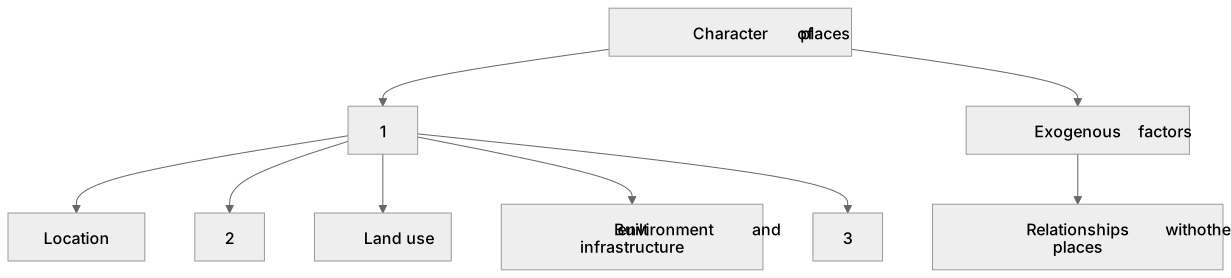
1Box 1
2Box 2
3Box 3
There is more to this lesson
The full lesson goes on to check your understanding and help you earn the marks. Create a free account to carry on, with your progress saved.
A week of Premium from your first lesson · Then the free plan continues · No card, no charge
Test your understanding of The nature and importance of places: Factors contributing to the character of places: Endogenous: location, topography, physical geography, land use, built environment and infrastructure, demographic and economic characteristics. Exogenous: relationships with other places.
Active recall beats re-reading. Take an instant quiz now to test what you’ve learned and lock it into long-term memory.
A week of Premium from your first lesson · Then the free plan continues · No card, no charge