AQA · A-Level · Geography
Course version: 7037 · Version from Sept 2018
Categories of place: near places and far places, experienced places and…
Full specification wording
The nature and importance of places: Categories of place: near places and far places, experienced places and media places.
Geographers categorise places to understand human perception.
Checked against the AQA 7037 specification (opens in a new tab) on .
- Point 3 of 4
- 4 key terms
Study notes
From the checked teaching notes for this specification point.
The idea
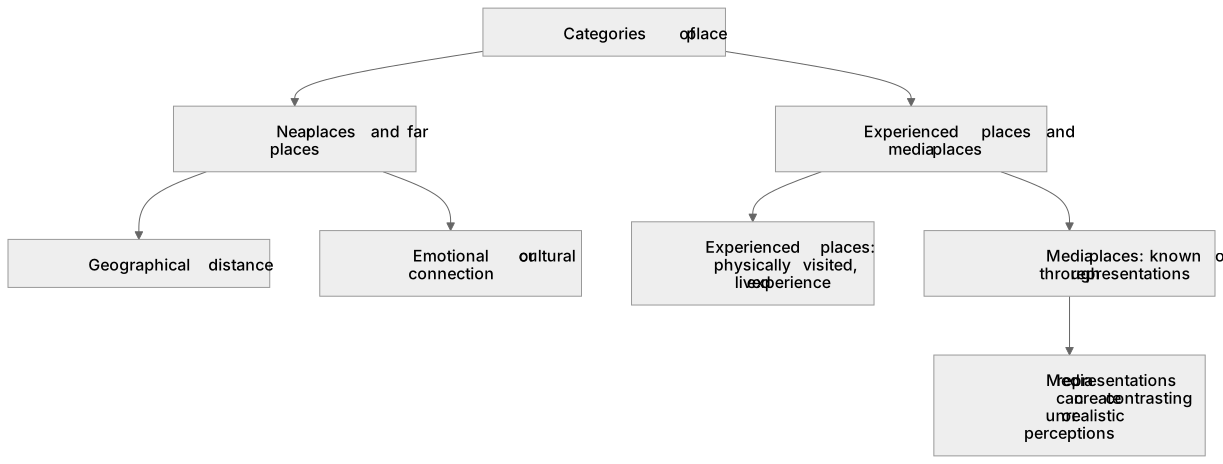
Geographers categorise places to understand human perception. 'Near' and 'far' places refer to objective geographical distance, but crucially, they also describe emotional or cultural connections. A distant city might feel 'near' due to globalised culture, while a neighbouring town could feel 'far' if its social landscape is alienating. 'Experienced places' are those a person has physically visited, allowing them to develop a multi-sensory lived experience. In contrast, 'media places' are known only through representations in film, literature, or news.
For example: Someone might perceive Paris as a romantic media place from watching films, which may contrast sharply with the complex, everyday reality of the actual experienced place.
What earns the marks
- Distinguish between near and far places in terms of both geographical distance and emotional or cultural proximity.
- Define experienced places as locations where a person has spent time and developed a lived experience.
- Define media places as locations perceived solely through representations such as television, literature, or social media.
- Evaluate how media representations can create contrasting or unrealistic perceptions of a place compared to the reality of experiencing it firsthand.
Common mistakes and how to put them right
Defining near and far places solely by physical distance.
Put it right: Explain that near and far also refer to emotional attachment and cultural familiarity.
Assuming media places are entirely fictional.
Put it right: Clarify that media places are real locations, but the individual's understanding of them is constructed entirely through secondary media sources.
Treating experienced places as having a single objective reality.
Put it right: Recognise that different individuals will have different lived experiences of the exact same physical location.
Exam tips
- Contrast a media representation of a distant place with statistical data to show how media places can be romanticised or stigmatised.
- Use the concept of 'time-space compression' to explain how globalisation is making geographically far places feel culturally nearer.
- When analysing qualitative sources, identify whether the creator is presenting an experienced reality or constructing a media narrative.
Try the lesson
The start of the The nature and importance of places: Categories of place: near places and far places, experienced places and media places. lesson, made from checked teaching notes for this specification point.
Have a go first
What is the primary distinction between an 'experienced place' and a 'media place'?
Listen
Geographers categorise places to understand human perception. Near' and 'far' places refer to objective geographical distance, but crucially, they also describe emotional or cultural connections. A distant city might feel 'near' due to globalised culture, while a neighbouring town could feel 'far' if its social landscape is alienating. Experienced places' are those a person has physically visited, allowing them to develop a multi-sensory lived experience. In contrast, 'media places' are known only through representations in film, literature, or news. For example, someone might perceive Paris as a romantic media place from watching films, which may contrast sharply with the complex, everyday reality of the actual experienced place. A strong answer earns marks for these points. Distinguish between near and far places in terms of both geographical distance and emotional or cultural proximity. Define experienced places as locations where a person has spent time and developed a lived experience. Define media places as locations perceived solely through representations such as television, literature, or social media. Evaluate how media representations can create contrasting or unrealistic perceptions of a place compared to the reality of experiencing it firsthand. A common slip: Defining near and far places solely by physical distance. Instead, explain that near and far also refer to emotional attachment and cultural familiarity. Exam tip: Contrast a media representation of a distant place with statistical data to show how media places can be romanticised or stigmatised.
See it
Key words
Say what each word means before you turn the card.
Near and far places
Try answering aloud or in your head before turning the card.
Experienced places
Try answering aloud or in your head before turning the card.
Media places
Try answering aloud or in your head before turning the card.
Time-space compression
Try answering aloud or in your head before turning the card.
See every definition
- Near and far places
- Places distinguished by objective geographical distance, but also by emotional or cultural connections, so a distant city might feel near through globalised culture.
- Experienced places
- Locations a person has physically visited, allowing them to develop a multi-sensory lived experience.
- Media places
- Locations known only through representations in film, literature, or news, rather than through physical visit.
- Time-space compression
- A concept explaining how globalisation is making geographically far places feel culturally nearer.
Label the diagram
Some boxes have lost their names. Pick the right name for each number.
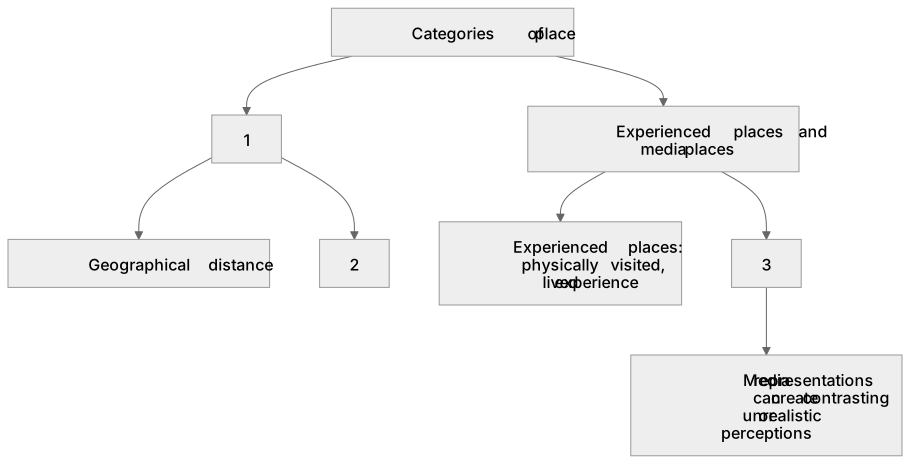
1Box 1
2Box 2
3Box 3
There is more to this lesson
The full lesson goes on to check your understanding and help you earn the marks. Create a free account to carry on, with your progress saved.
A week of Premium from your first lesson · Then the free plan continues · No card, no charge
Test your understanding of The nature and importance of places: Categories of place: near places and far places, experienced places and media places.
Active recall beats re-reading. Take an instant quiz now to test what you’ve learned and lock it into long-term memory.
A week of Premium from your first lesson · Then the free plan continues · No card, no charge