AQA · A-Level · Geography
Course version: 7037 · Version from Sept 2018
The concept of place and the importance of place in human life and…
Full specification wording
The nature and importance of places: The concept of place and the importance of place in human life and experience.
Place is fundamentally more than a physical location; it is a space given meaning through human experience.
Checked against the AQA 7037 specification (opens in a new tab) on .
- Point 1 of 4
- 4 key terms
Study notes
From the checked teaching notes for this specification point.
The idea
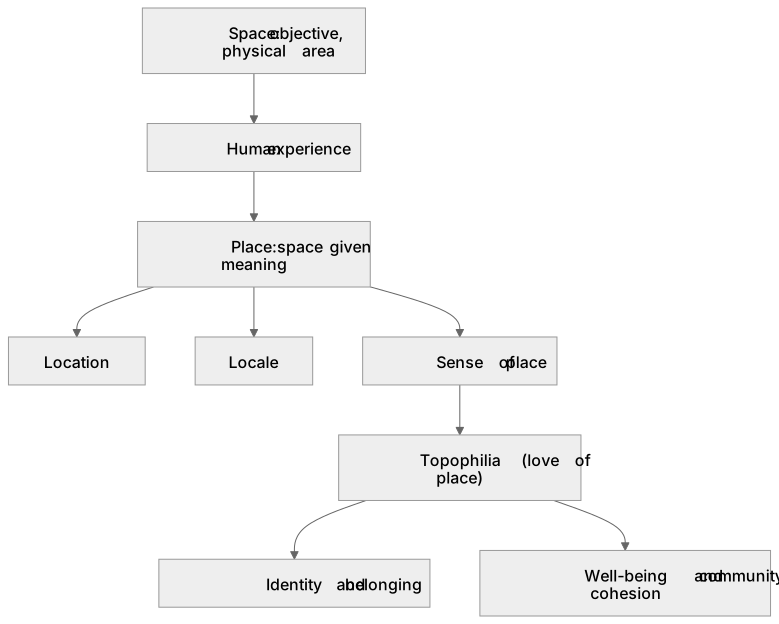
Place is fundamentally more than a physical location; it is a space given meaning through human experience. Geographers define place using three interconnected elements: location (objective coordinates), locale (the material setting where everyday social interactions occur), and sense of place (the subjective emotional attachment people develop). The importance of place in human life is profound, as it shapes personal and cultural identity, fosters a sense of belonging, and influences overall well-being.
For example: A local community centre is not merely a building at a specific grid reference; it is a vital locale that hosts shared experiences, generating a strong topophilia or love of place that anchors human experience and memory.
What earns the marks
- Define place as a combination of location, locale and subjective sense of place.
- Explain how human experiences and social interactions transform an objective space into a meaningful place.
- Analyse the role of place in constructing personal, local and national identities.
- Evaluate how a strong sense of place (topophilia) contributes to human well-being and community cohesion.
Common mistakes and how to put them right
Using the terms 'space' and 'place' interchangeably.
Put it right: Define 'space' as an objective, physical area and 'place' as a space that has been given meaning through human experience.
Focusing only on the physical characteristics of a location.
Put it right: Ensure answers address the emotional and subjective attachments (sense of place) that people hold.
Assuming everyone experiences a place in the exact same way.
Put it right: Recognise that sense of place is highly subjective and varies based on age, gender, ethnicity and personal history.
Exam tips
- Use the specific terminology of location, locale and sense of place to structure your definitions and explanations.
- Support theoretical concepts with concrete examples from your local or distant studied places to demonstrate understanding.
- Consider how the loss of a place, such as through gentrification or natural disaster, highlights its importance to human experience.
Try the lesson
The start of the The nature and importance of places: The concept of place and the importance of place in human life and experience. lesson, made from checked teaching notes for this specification point.
Have a go first
In human geography, how is the concept of 'place' most accurately distinguished from the concept of 'space'?
Listen
Place is fundamentally more than a physical location; it is a space given meaning through human experience. Geographers define place using three interconnected elements: location (objective coordinates), locale (the material setting where everyday social interactions occur), and sense of place (the subjective emotional attachment people develop). The importance of place in human life is profound, as it shapes personal and cultural identity, fosters a sense of belonging, and influences overall well-being. For example, a local community centre is not merely a building at a specific grid reference; it is a vital locale that hosts shared experiences, generating a strong topophilia or love of place that anchors human experience and memory. A strong answer earns marks for these points. Define place as a combination of location, locale and subjective sense of place. Explain how human experiences and social interactions transform an objective space into a meaningful place. Analyse the role of place in constructing personal, local and national identities. Evaluate how a strong sense of place (topophilia) contributes to human well-being and community cohesion. A common slip: Using the terms 'space' and 'place' interchangeably. Instead, Define 'space' as an objective, physical area and 'place' as a space that has been given meaning through human experience. Exam tip: Use the specific terminology of location, locale and sense of place to structure your definitions and explanations.
See it
Key words
Say what each word means before you turn the card.
Place
Try answering aloud or in your head before turning the card.
Sense of place
Try answering aloud or in your head before turning the card.
Identity
Try answering aloud or in your head before turning the card.
Topophilia
Try answering aloud or in your head before turning the card.
See every definition
- Place
- A space given meaning through human experience, defined using the interconnected elements of location, locale and sense of place.
- Sense of place
- The subjective emotional attachment people develop to a place.
- Identity
- Something shaped by place, alongside belonging and overall well-being, in human life.
- Topophilia
- A strong love of place, generated by shared experiences, that anchors human experience and memory.
Label the diagram
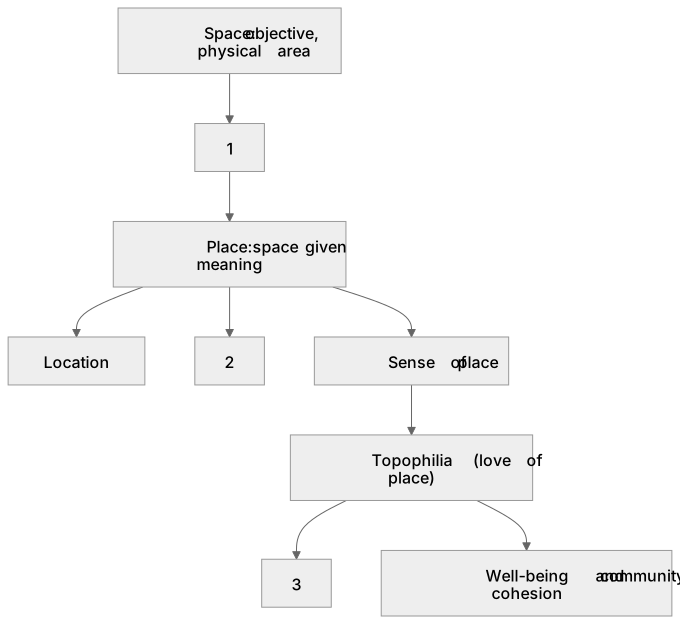
Some boxes have lost their names. Pick the right name for each number.
1Box 1
2Box 2
3Box 3
There is more to this lesson
The full lesson goes on to check your understanding and help you earn the marks. Create a free account to carry on, with your progress saved.
A week of Premium from your first lesson · Then the free plan continues · No card, no charge
Test your understanding of The nature and importance of places: The concept of place and the importance of place in human life and experience.
Active recall beats re-reading. Take an instant quiz now to test what you’ve learned and lock it into long-term memory.
A week of Premium from your first lesson · Then the free plan continues · No card, no charge