AQA · A-Level · Geography
Course version: 7037 · Version from Sept 2018
Insider and outsider perspectives on place.
Full specification wording
The nature and importance of places: Insider and outsider perspectives on place.
An insider perspective on place involves a strong sense of belonging, familiarity, and emotional attachment, often developed through long-term residence.
Checked against the AQA 7037 specification (opens in a new tab) on .
- Point 2 of 4
- 2 key terms
Study notes
From the checked teaching notes for this specification point.
The idea
An insider perspective on place involves a strong sense of belonging, familiarity, and emotional attachment, often developed through long-term residence. For example, a lifelong resident of a coastal town understands its hidden social codes and seasonal rhythms. Conversely, an outsider perspective is characterised by feelings of alienation, unfamiliarity, or exclusion. A tourist or newly arrived migrant might view the same town purely aesthetically or find its social structures impenetrable. These perspectives are fluid and subjective; factors like age, gender, sexuality, or ethnicity can make someone feel like an outsider even in their hometown. Understanding these contrasting viewpoints is crucial for analysing how different groups interact with and contest the meaning of a specific location.
What earns the marks
- Define insider perspectives as feelings of belonging, familiarity, and inclusion within a place.
- Define outsider perspectives as feelings of alienation, unfamiliarity, or exclusion from a place.
- Explain how demographic factors such as age, ethnicity, gender, or socio-economic status influence whether an individual feels like an insider or outsider.
- Analyse how insider and outsider perspectives shape different lived experiences and representations of the same geographical location.
Common mistakes and how to put them right
Assuming insider and outsider status is permanent.
Put it right: Recognise that these perspectives are fluid and can change over time as people integrate or as places evolve.
Equating 'insider' strictly with being born in a place.
Put it right: Acknowledge that long-term residents or active community members can develop strong insider perspectives regardless of birthplace.
Treating all residents as a homogenous group of insiders.
Put it right: Evaluate how minority groups or marginalised individuals may feel like outsiders within their own local area.
Exam tips
- Use specific qualitative data, such as poetry or interviews, to illustrate contrasting insider and outsider feelings in your case studies.
- Discuss how regeneration projects can shift perspectives, sometimes making established residents feel like outsiders in their own gentrified neighbourhoods.
- When evaluating representations of place, explicitly state whether the source reflects an insider or outsider viewpoint and how this biases the portrayal.
Try the lesson
The start of the The nature and importance of places: Insider and outsider perspectives on place. lesson, made from checked teaching notes for this specification point.
Have a go first
Which of the following best describes an 'insider' perspective on a place?
Listen
An insider perspective on place involves a strong sense of belonging, familiarity, and emotional attachment, often developed through long-term residence. For example, a lifelong resident of a coastal town understands its hidden social codes and seasonal rhythms. Conversely, an outsider perspective is characterised by feelings of alienation, unfamiliarity, or exclusion. A tourist or newly arrived migrant might view the same town purely aesthetically or find its social structures impenetrable. These perspectives are fluid and subjective; factors like age, gender, sexuality, or ethnicity can make someone feel like an outsider even in their hometown. Understanding these contrasting viewpoints is crucial for analysing how different groups interact with and contest the meaning of a specific location. A strong answer earns marks for these points. Define insider perspectives as feelings of belonging, familiarity, and inclusion within a place. Define outsider perspectives as feelings of alienation, unfamiliarity, or exclusion from a place. Explain how demographic factors such as age, ethnicity, gender, or socio-economic status influence whether an individual feels like an insider or outsider. Analyse how insider and outsider perspectives shape different lived experiences and representations of the same geographical location. A common slip: Assuming insider and outsider status is permanent. Instead, recognise that these perspectives are fluid and can change over time as people integrate or as places evolve. Exam tip: Use specific qualitative data, such as poetry or interviews, to illustrate contrasting insider and outsider feelings in your case studies.
See it

Key words
Say what each word means before you turn the card.
Insider perspective
Try answering aloud or in your head before turning the card.
Outsider perspective
Try answering aloud or in your head before turning the card.
See every definition
- Insider perspective
- A strong sense of belonging, familiarity, and emotional attachment to a place, often developed through long-term residence.
- Outsider perspective
- Feelings of alienation, unfamiliarity, or exclusion from a place, as might be experienced by a tourist or newly arrived migrant.
Label the diagram
Some boxes have lost their names. Pick the right name for each number.
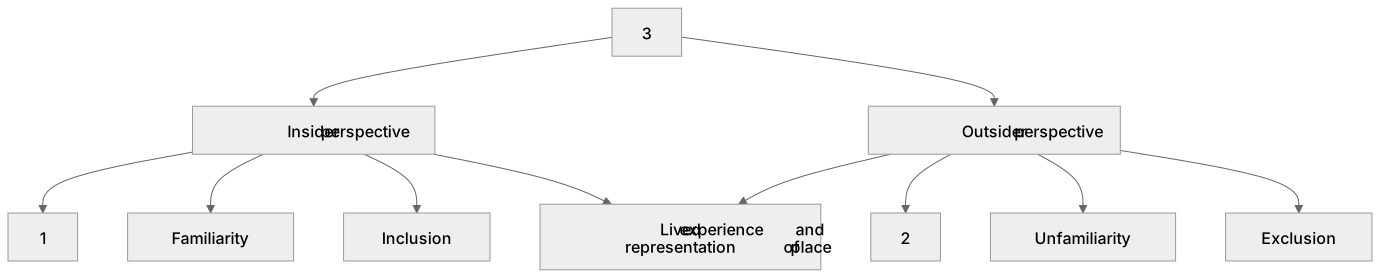
1Box 1
2Box 2
3Box 3
There is more to this lesson
The full lesson goes on to check your understanding and help you earn the marks. Create a free account to carry on, with your progress saved.
A week of Premium from your first lesson · Then the free plan continues · No card, no charge
Test your understanding of The nature and importance of places: Insider and outsider perspectives on place.
Active recall beats re-reading. Take an instant quiz now to test what you’ve learned and lock it into long-term memory.
A week of Premium from your first lesson · Then the free plan continues · No card, no charge