AQA · A-Level · Geography
Course version: 7037 · Version from Sept 2018
Global distribution and size of major stores of water – lithosphere,…
Full specification wording
The water cycle: Global distribution and size of major stores of water – lithosphere, hydrosphere, cryosphere and atmosphere.
Earth's water is distributed unevenly across four major stores.
Checked against the AQA 7037 specification (opens in a new tab) on .
- Point 1 of 5
- 4 key terms
Study notes
From the checked teaching notes for this specification point.
The idea
Earth's water is distributed unevenly across four major stores. The hydrosphere is the largest, containing approximately 96.5% of global water, primarily in oceans (around 1.338 × 10⁹ km³). The cryosphere holds about 1.7% of global water, forming the largest freshwater store, distributed mainly across the Antarctic and Greenland ice sheets. The lithosphere contains roughly 1.7% as groundwater stored in aquifers and soil moisture. The atmosphere is the smallest store, holding just 0.001% (around 1.3 × 10⁴ km³) as water vapour. While the atmospheric store is tiny in size, it is crucial for the rapid global distribution of water. Understanding the relative size and spatial distribution of these stores is vital for analysing global water security.
What earns the marks
- Identify the hydrosphere (oceans, seas) as the largest global water store, holding over 96% of all water.
- Recognise the cryosphere (ice caps, glaciers) as the largest store of freshwater, accounting for nearly 69% of all freshwater globally.
- Describe the lithosphere's role in storing water as groundwater in aquifers, representing about 30% of global freshwater.
- Explain that the atmosphere holds a very small percentage of global water (0.001%) but plays a disproportionately large role in redistributing water globally.
Common mistakes and how to put them right
Stating that rivers and lakes hold the majority of freshwater.
Put it right: Specify that the cryosphere (ice) holds the vast majority of the world's freshwater.
Confusing the lithosphere and hydrosphere.
Put it right: Define the lithosphere as water stored in rocks and soil (groundwater), and the hydrosphere as liquid surface water (oceans, lakes).
Underestimating the importance of the atmospheric store due to its small size.
Put it right: Emphasise that despite its small volume, the atmosphere is highly dynamic and essential for the water cycle's rapid fluxes.
Exam tips
- Memorise the approximate percentages of the major stores (e.g. oceans 96.5%, cryosphere 1.7%) to support your answers with quantitative evidence.
- When discussing the distribution of water, contrast the saline water of the hydrosphere with the freshwater stores of the cryosphere and lithosphere.
- Use the specific terms lithosphere, hydrosphere, cryosphere, and atmosphere rather than generic terms like 'ground' or 'air'.
Try the lesson
The start of the The water cycle: Global distribution and size of major stores of water – lithosphere, hydrosphere, cryosphere and atmosphere. lesson, made from checked teaching notes for this specification point.
Have a go first
Which of the following represents the largest store of freshwater within the global water cycle?
Listen
Earth's water is distributed unevenly across four major stores. The hydrosphere is the largest, containing approximately 96.5% of global water, primarily in oceans (around 1.338 × 10⁹ km³). The cryosphere holds about 1.7% of global water, forming the largest freshwater store, distributed mainly across the Antarctic and Greenland ice sheets. The lithosphere contains roughly 1.7% as groundwater stored in aquifers and soil moisture. The atmosphere is the smallest store, holding just 0.001% (around 1.3 × 10⁴ km³) as water vapour. While the atmospheric store is tiny in size, it is crucial for the rapid global distribution of water. Understanding the relative size and spatial distribution of these stores is vital for analysing global water security. A strong answer earns marks for these points. Identify the hydrosphere (oceans, seas) as the largest global water store, holding over 96% of all water. Recognise the cryosphere (ice caps, glaciers) as the largest store of freshwater, accounting for nearly 69% of all freshwater globally. Describe the lithosphere's role in storing water as groundwater in aquifers, representing about 30% of global freshwater. Explain that the atmosphere holds a very small percentage of global water (0.001%) but plays a disproportionately large role in redistributing water globally. A common slip: Stating that rivers and lakes hold the majority of freshwater. Instead, specify that the cryosphere (ice) holds the vast majority of the world's freshwater. Exam tip: Memorise the approximate percentages of the major stores (e.g. oceans 96.5%, cryosphere 1.7%) to support your answers with quantitative evidence.
See it
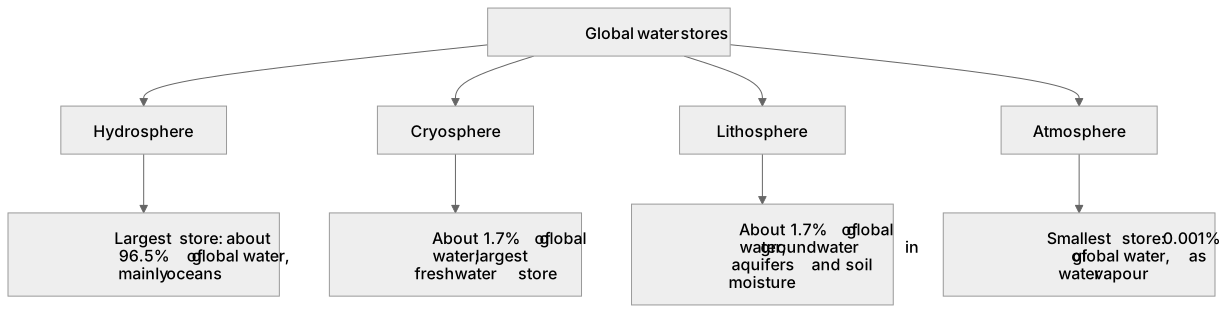
Key words
Say what each word means before you turn the card.
Hydrosphere
Try answering aloud or in your head before turning the card.
Cryosphere
Try answering aloud or in your head before turning the card.
Lithosphere
Try answering aloud or in your head before turning the card.
Atmosphere
Try answering aloud or in your head before turning the card.
See every definition
- Hydrosphere
- The largest store, containing approximately 96.5% of global water, primarily in oceans.
- Cryosphere
- Holds about 1.7% of global water and forms the largest freshwater store, mainly across the Antarctic and Greenland ice sheets.
- Lithosphere
- Contains roughly 1.7% as groundwater stored in aquifers and soil moisture.
- Atmosphere
- The smallest store, holding just 0.001% as water vapour, yet crucial for the rapid global distribution of water.
Label the diagram
Some boxes have lost their names. Pick the right name for each number.
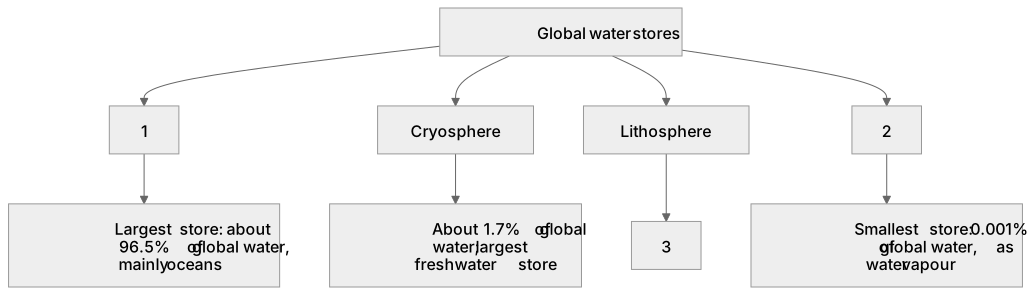
1Box 1
2Box 2
3Box 3
There is more to this lesson
The full lesson goes on to check your understanding and help you earn the marks. Create a free account to carry on, with your progress saved.
A week of Premium from your first lesson · Then the free plan continues · No card, no charge
Test your understanding of The water cycle: Global distribution and size of major stores of water – lithosphere, hydrosphere, cryosphere and atmosphere.
Active recall beats re-reading. Take an instant quiz now to test what you’ve learned and lock it into long-term memory.
A week of Premium from your first lesson · Then the free plan continues · No card, no charge