AQA · A-Level · Geography
Course version: 7037 · Version from Sept 2018
Processes driving change in the magnitude of these stores over time and…
Full specification wording
The water cycle: Processes driving change in the magnitude of these stores over time and space, including flows and transfers: evaporation, condensation, cloud formation, causes of precipitation and cryospheric processes at hill slope, drainage basin and global scales with reference to varying timescales involved.
Water stores fluctuate in magnitude across varying spatial and temporal scales due to dynamic flows and transfers.
Checked against the AQA 7037 specification (opens in a new tab) on .
- Point 2 of 5
- 3 key terms
Study notes
From the checked teaching notes for this specification point.
The idea
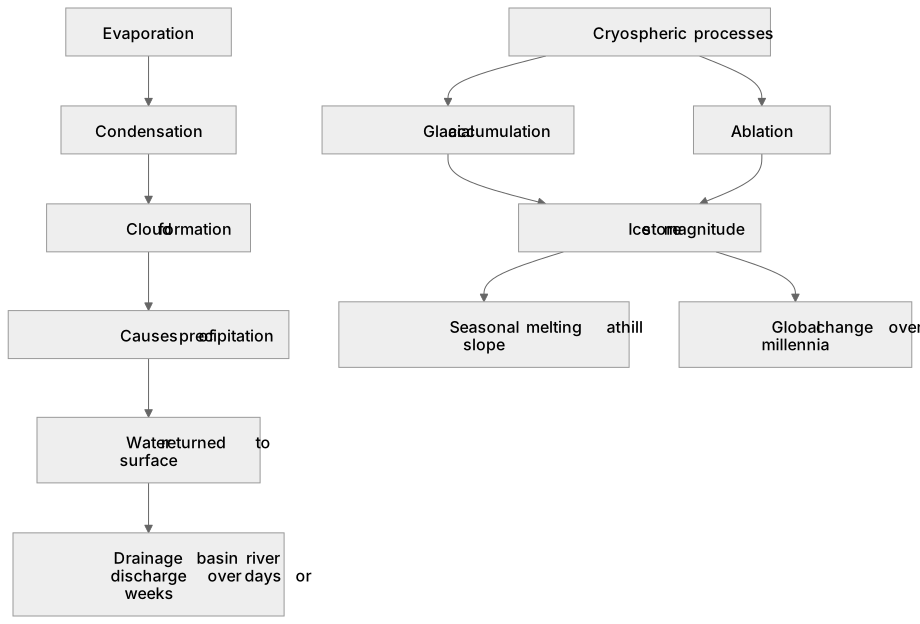
Water stores fluctuate in magnitude across varying spatial and temporal scales due to dynamic flows and transfers. Globally, evaporation from oceans and subsequent condensation drive cloud formation, transferring water vapour into the atmosphere. Precipitation, caused by frontal, orographic, or convectional uplift, returns water to the surface. Cryospheric processes, such as glacial accumulation and ablation, operate over long timescales, locking up freshwater globally but also affecting local hill slopes through seasonal melting. At the drainage basin scale, these processes dictate river discharge over days or weeks, whereas global cryospheric changes occur over millennia. Understanding these transfers explains how water moves between stores, constantly altering their magnitude over time and space.
What earns the marks
- Explain how evaporation and condensation transfer water between the hydrosphere and atmosphere.
- Describe the three main causes of precipitation (frontal, orographic, convectional) and their role in cloud formation.
- Analyse how cryospheric processes (accumulation and ablation) change the magnitude of ice stores over seasonal and millennial timescales.
- Compare the impact of these processes at different spatial scales, from a single hill slope to an entire drainage basin or the global system.
Common mistakes and how to put them right
Confusing spatial scales; correction: clearly distinguish between hill slope (local), drainage basin (regional), and global scales when discussing processes.
Assuming cryospheric processes only occur over long timescales.
Put it right: Acknowledge that while glacial advance and retreat takes millennia, seasonal melting affects hill slopes annually.
Failing to link cloud formation to specific uplift mechanisms.
Put it right: Explain that precipitation requires air to rise, cool, and condense via frontal, orographic, or convectional processes.
Exam tips
- Use specific examples of timescales, such as diurnal evaporation rates versus millennial glacial periods, to demonstrate depth of knowledge.
- When discussing changes in store magnitude, explicitly state which store is increasing and which is decreasing as a result of a specific flow.
- Ensure you can explain the physical process of condensation and how it leads to cloud formation and subsequent precipitation.
Try the lesson
The start of the The water cycle: Processes driving change in the magnitude of these stores over time and space, including flows and transfers: evaporation, condensation, cloud formation, causes of precipitation and cryospheric processes at hill slope, drainage basin and global scales with reference to varying timescales involved. lesson, made from checked teaching notes for this specification point.
Have a go first
Which of the following best describes the process of condensation within the water cycle?
Listen
Water stores fluctuate in magnitude across varying spatial and temporal scales due to dynamic flows and transfers. Globally, evaporation from oceans and subsequent condensation drive cloud formation, transferring water vapour into the atmosphere. Precipitation, caused by frontal, orographic, or convectional uplift, returns water to the surface. Cryospheric processes, such as glacial accumulation and ablation, operate over long timescales, locking up freshwater globally but also affecting local hill slopes through seasonal melting. At the drainage basin scale, these processes dictate river discharge over days or weeks, whereas global cryospheric changes occur over millennia. Understanding these transfers explains how water moves between stores, constantly altering their magnitude over time and space. A strong answer earns marks for these points. Explain how evaporation and condensation transfer water between the hydrosphere and atmosphere. Describe the three main causes of precipitation (frontal, orographic, convectional) and their role in cloud formation. Analyse how cryospheric processes (accumulation and ablation) change the magnitude of ice stores over seasonal and millennial timescales. Compare the impact of these processes at different spatial scales, from a single hill slope to an entire drainage basin or the global system. A common slip: Assuming cryospheric processes only occur over long timescales. Instead, acknowledge that while glacial advance and retreat takes millennia, seasonal melting affects hill slopes annually. Exam tip: Use specific examples of timescales, such as diurnal evaporation rates versus millennial glacial periods, to demonstrate depth of knowledge.
See it
Key words
Say what each word means before you turn the card.
evaporation
Try answering aloud or in your head before turning the card.
cryospheric processes
Try answering aloud or in your head before turning the card.
drainage basin scale
Try answering aloud or in your head before turning the card.
See every definition
- evaporation
- A flow that transfers water from the hydrosphere to the atmosphere, driving cloud formation together with condensation.
- cryospheric processes
- Glacial accumulation and ablation, operating over long timescales, which lock up freshwater globally and affect local hill slopes through seasonal melting.
- drainage basin scale
- A scale at which these processes dictate river discharge over days or weeks.
Label the diagram
Some boxes have lost their names. Pick the right name for each number.
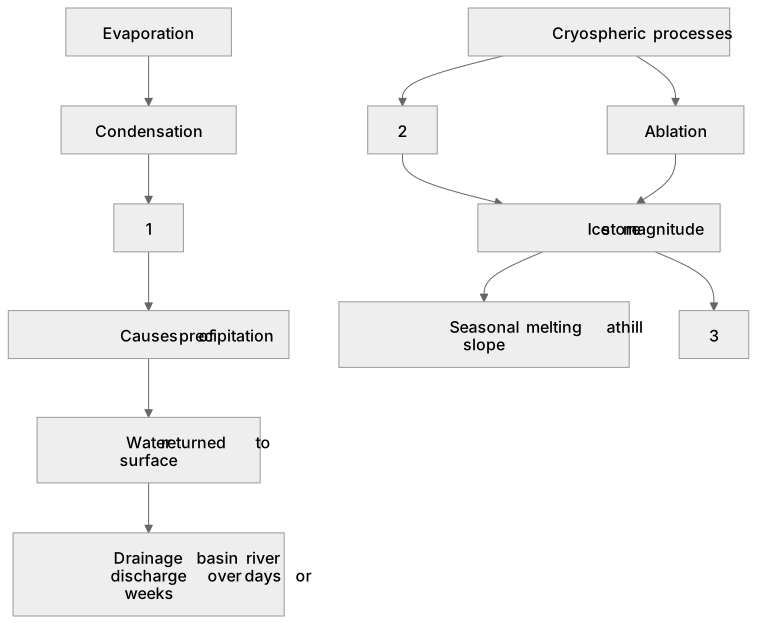
1Box 1
2Box 2
3Box 3
There is more to this lesson
The full lesson goes on to check your understanding and help you earn the marks. Create a free account to carry on, with your progress saved.
A week of Premium from your first lesson · Then the free plan continues · No card, no charge
Test your understanding of The water cycle: Processes driving change in the magnitude of these stores over time and space, including flows and transfers: evaporation, condensation, cloud formation, causes of precipitation and cryospheric processes at hill slope, drainage basin and global scales with reference to varying timescales involved.
Active recall beats re-reading. Take an instant quiz now to test what you’ve learned and lock it into long-term memory.
A week of Premium from your first lesson · Then the free plan continues · No card, no charge