AQA · A-Level · Geography
Course version: 7037 · Version from Sept 2018
Urban climate: Pollution reduction policies.
Pollution reduction policies mitigate poor urban air quality and health risks.
Checked against the AQA 7037 specification (opens in a new tab) on .
- Point 3 of 3
- 4 key terms
Study notes
From the checked teaching notes for this specification point.
The idea
Pollution reduction policies mitigate poor urban air quality and health risks. Traffic management is a primary focus, using Clean Air Zones, congestion charging, and pedestrianisation to reduce vehicular emissions of nitrogen oxides and particulates. Technological policies include subsidising electric vehicles and improving public transport to encourage modal shifts. Industrial emissions are managed through strict legislation, like the UK Clean Air Acts, and mandatory smokestack scrubbers. Evaluating these policies requires assessing economic costs against environmental benefits, while recognising that atmospheric pollution easily crosses municipal boundaries, complicating local enforcement and requiring coordinated national strategies.
What earns the marks
- Identify specific local policies aimed at reducing vehicular emissions, such as congestion charges or Ultra Low Emission Zones.
- Explain how national legislation, such as the Clean Air Acts, regulates industrial emissions and domestic fuel burning.
- Evaluate the effectiveness of technological solutions, such as electric vehicle subsidies or improved public transport infrastructure.
- Discuss the challenges of implementing pollution reduction policies, including economic impacts on businesses and the transboundary nature of air pollution.
Common mistakes and how to put them right
Listing global climate change agreements instead of urban pollution reduction policies.
Put it right: Focus on local or national policies targeting urban air quality.
Assuming policies are universally successful without drawbacks.
Put it right: Evaluate the limitations, such as the displacement of traffic to areas just outside a congestion charge zone.
Confusing carbon dioxide reduction with air quality improvement.
Put it right: Focus on pollutants that directly affect urban air quality and health, such as particulates and nitrogen dioxide.
Exam tips
- Always support your evaluation of a policy with a specific, named case study, such as London's ULEZ or Beijing's traffic restrictions.
- Consider the social and economic impacts of pollution policies, such as how congestion charges might disproportionately affect lower-income drivers.
- Use the concept of 'modal shift' when discussing how policies encourage people to move from private cars to public transport or active travel.
Try the lesson
The start of the Urban climate: Pollution reduction policies. lesson, made from checked teaching notes for this specification point.
Have a go first
Which of the following is a direct policy measure implemented by city authorities to reduce vehicular particulate pollution?
Listen
Pollution reduction policies mitigate poor urban air quality and health risks. Traffic management is a primary focus, using Clean Air Zones, congestion charging, and pedestrianisation to reduce vehicular emissions of nitrogen oxides and particulates. Technological policies include subsidising electric vehicles and improving public transport to encourage modal shifts. Industrial emissions are managed through strict legislation, like the UK Clean Air Acts, and mandatory smokestack scrubbers. Evaluating these policies requires assessing economic costs against environmental benefits, while recognising that atmospheric pollution easily crosses municipal boundaries, complicating local enforcement and requiring coordinated national strategies. A strong answer earns marks for these points. Identify specific local policies aimed at reducing vehicular emissions, such as congestion charges or Ultra Low Emission Zones. Explain how national legislation, such as the Clean Air Acts, regulates industrial emissions and domestic fuel burning. Evaluate the effectiveness of technological solutions, such as electric vehicle subsidies or improved public transport infrastructure. Discuss the challenges of implementing pollution reduction policies, including economic impacts on businesses and the transboundary nature of air pollution. A common slip: Listing global climate change agreements instead of urban pollution reduction policies. Instead, focus on local or national policies targeting urban air quality. Exam tip: Always support your evaluation of a policy with a specific, named case study, such as London's ULEZ or Beijing's traffic restrictions.
See it
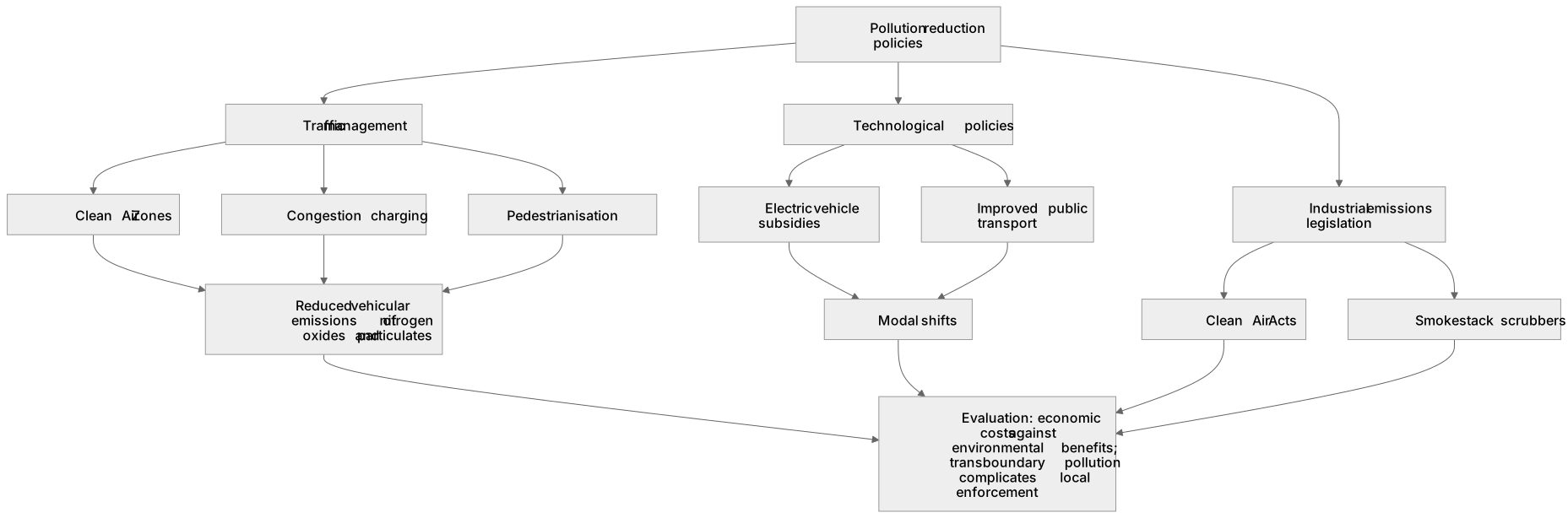
Key words
Say what each word means before you turn the card.
Pollution reduction policies
Try answering aloud or in your head before turning the card.
Modal shifts
Try answering aloud or in your head before turning the card.
Transboundary nature of air pollution
Try answering aloud or in your head before turning the card.
Congestion charging
Try answering aloud or in your head before turning the card.
See every definition
- Pollution reduction policies
- Measures that mitigate poor urban air quality and health risks, assessed by weighing economic costs against environmental benefits.
- Modal shifts
- Encouraging people to move from private cars to public transport or active travel, supported by subsidising electric vehicles and improving public transport.
- Transboundary nature of air pollution
- Atmospheric pollution easily crosses municipal boundaries, complicating local enforcement and requiring coordinated national strategies.
- Congestion charging
- A traffic management measure used to reduce vehicular emissions, though traffic may be displaced to areas just outside the zone.
Label the diagram
Some boxes have lost their names. Pick the right name for each number.
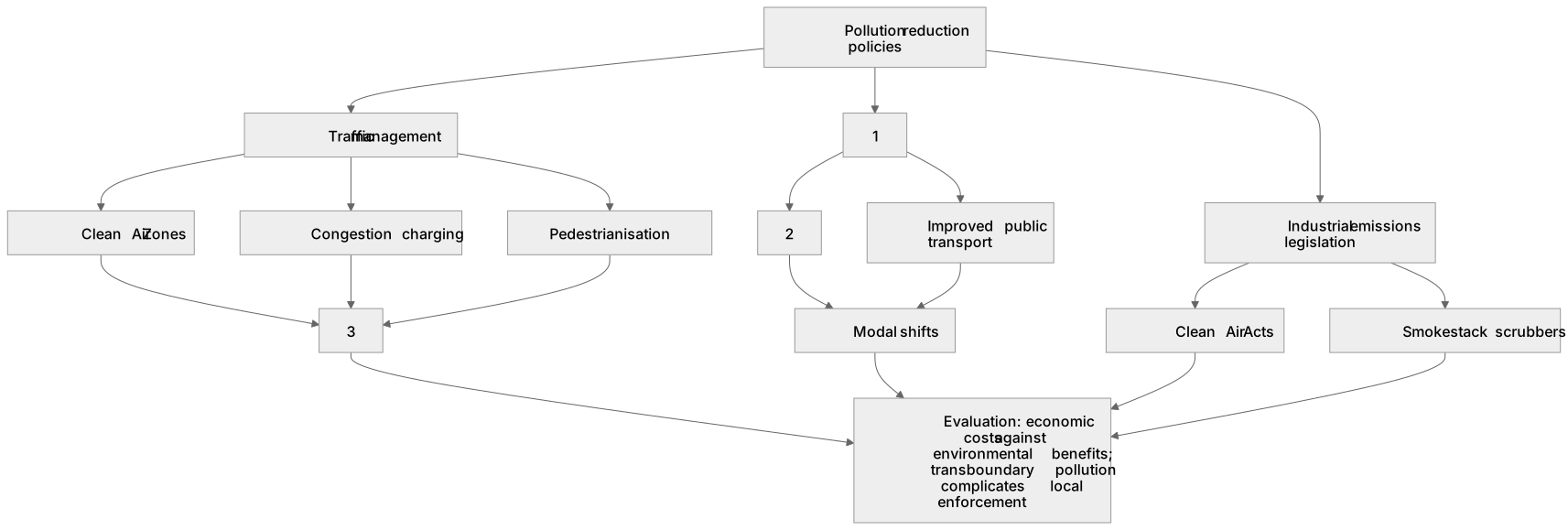
1Box 1
2Box 2
3Box 3
There is more to this lesson
The full lesson goes on to check your understanding and help you earn the marks. Create a free account to carry on, with your progress saved.
A week of Premium from your first lesson · Then the free plan continues · No card, no charge
Test your understanding of Urban climate: Pollution reduction policies.
Active recall beats re-reading. Take an instant quiz now to test what you’ve learned and lock it into long-term memory.
A week of Premium from your first lesson · Then the free plan continues · No card, no charge