AQA · A-Level · Geography
Course version: 7037 · Version from Sept 2018
Urban temperatures: the urban heat island effect. Precipitation: frequency…
Full specification wording
Urban climate: Urban temperatures: the urban heat island effect. Precipitation: frequency and intensity. Fogs and thunderstorms in urban environments. Wind: the effects of urban structures and layout on wind speed, direction and frequency. Air quality: particulate and photo-chemical pollution.
Urban microclimates differ vastly from rural areas.
Checked against the AQA 7037 specification (opens in a new tab) on .
- Point 2 of 3
- 4 key terms
Study notes
From the checked teaching notes for this specification point.
The idea
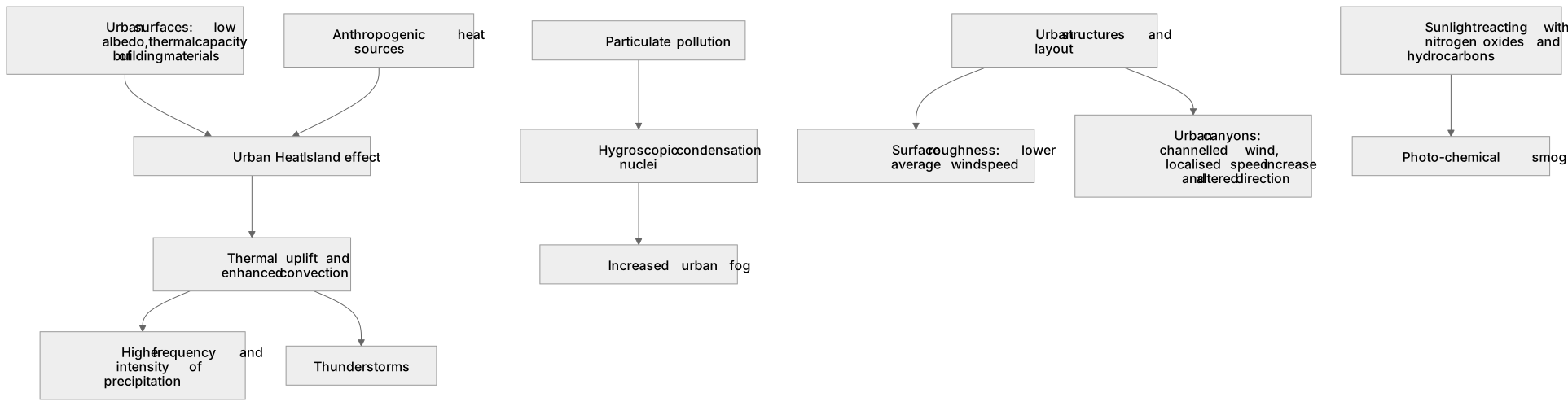
Urban microclimates differ vastly from rural areas. The Urban Heat Island (UHI) effect makes cities warmer due to low albedo surfaces absorbing insolation and anthropogenic heat. This thermal uplift increases the frequency and intensity of precipitation and thunderstorms via enhanced convection. Abundant condensation nuclei from particulate pollution also increase urban fog. Urban structures alter wind; high-rise buildings create canyon effects, channelling winds to increase speed and alter direction, though overall surface roughness reduces average wind speed. Finally, air quality suffers from particulates (PM10) and photo-chemical smog, which forms when sunlight reacts with vehicle exhaust emissions like nitrogen oxides.
What earns the marks
- Explain the UHI effect using surface albedo, the thermal capacity of building materials, and anthropogenic heat sources.
- Link increased urban temperatures to enhanced convection, leading to a higher frequency and intensity of thunderstorms and precipitation.
- Describe how urban structures create friction that lowers overall wind speed, while urban canyons channel wind, increasing localised speed and altering direction.
- Explain the formation of photo-chemical smog through the reaction of sunlight with nitrogen oxides and volatile organic compounds.
- Connect high levels of particulate matter to their role as hygroscopic condensation nuclei, increasing the incidence of urban fogs.
Common mistakes and how to put them right
Stating that urban areas always have higher wind speeds.
Put it right: Specify that while urban canyons increase localised wind speeds, overall urban surface roughness decreases average wind speed.
Confusing the global greenhouse effect with the UHI effect.
Put it right: Explain UHI through localised surface albedo and anthropogenic heat, not global atmospheric gas concentrations.
Describing photo-chemical smog as just a mixture of smoke and fog.
Put it right: Define it as a secondary pollutant formed by a chemical reaction requiring sunlight, nitrogen oxides, and hydrocarbons.
Exam tips
- Use specific examples of urban structures, such as the Venturi effect in urban canyons, to explain localised wind speed increases.
- When discussing precipitation, explicitly mention both frequency and intensity, linking them directly to thermal uplift and condensation nuclei.
- Clearly distinguish between particulate pollution (physical matter like soot or dust) and photo-chemical pollution (chemical reactions requiring sunlight).
Try the lesson
The start of the Urban climate: Urban temperatures: the urban heat island effect. Precipitation: frequency and intensity. Fogs and thunderstorms in urban environments. Wind: the effects of urban structures and layout on wind speed, direction and frequency. Air quality: particulate and photo-chemical pollution. lesson, made from checked teaching notes for this specification point.
Have a go first
Which characteristic of urban environments is a primary contributor to the urban heat island effect?
Listen
Urban microclimates differ vastly from rural areas. The Urban Heat Island (UHI) effect makes cities warmer due to low albedo surfaces absorbing insolation and anthropogenic heat. This thermal uplift increases the frequency and intensity of precipitation and thunderstorms via enhanced convection. Abundant condensation nuclei from particulate pollution also increase urban fog. Urban structures alter wind; high-rise buildings create canyon effects, channelling winds to increase speed and alter direction, though overall surface roughness reduces average wind speed. Finally, air quality suffers from particulates (PM10) and photo-chemical smog, which forms when sunlight reacts with vehicle exhaust emissions like nitrogen oxides. A strong answer earns marks for these points. Explain the UHI effect using surface albedo, the thermal capacity of building materials, and anthropogenic heat sources. Link increased urban temperatures to enhanced convection, leading to a higher frequency and intensity of thunderstorms and precipitation. Describe how urban structures create friction that lowers overall wind speed, while urban canyons channel wind, increasing localised speed and altering direction. Explain the formation of photo-chemical smog through the reaction of sunlight with nitrogen oxides and volatile organic compounds. A common slip: Stating that urban areas always have higher wind speeds. Instead, specify that while urban canyons increase localised wind speeds, overall urban surface roughness decreases average wind speed. Exam tip: Use specific examples of urban structures, such as the Venturi effect in urban canyons, to explain localised wind speed increases.
See it
Key words
Say what each word means before you turn the card.
Urban heat island effect
Try answering aloud or in your head before turning the card.
Photo-chemical smog
Try answering aloud or in your head before turning the card.
Urban canyons
Try answering aloud or in your head before turning the card.
Particulate pollution
Try answering aloud or in your head before turning the card.
See every definition
- Urban heat island effect
- Makes cities warmer due to low albedo surfaces absorbing insolation and anthropogenic heat.
- Photo-chemical smog
- A secondary pollutant formed when sunlight reacts with vehicle exhaust emissions like nitrogen oxides.
- Urban canyons
- Channel winds to increase localised speed and alter direction, though overall surface roughness reduces average wind speed.
- Particulate pollution
- Physical matter such as soot or dust, which acts as hygroscopic condensation nuclei and increases the incidence of urban fogs.
Label the diagram
Some boxes have lost their names. Pick the right name for each number.
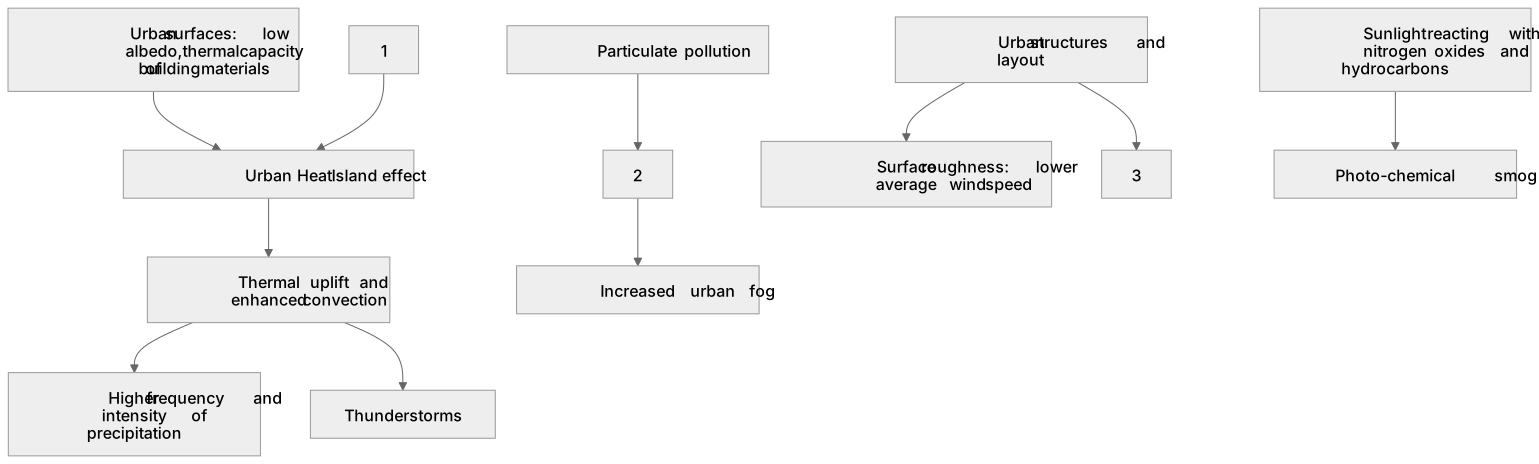
1Box 1
2Box 2
3Box 3
There is more to this lesson
The full lesson goes on to check your understanding and help you earn the marks. Create a free account to carry on, with your progress saved.
A week of Premium from your first lesson · Then the free plan continues · No card, no charge
Test your understanding of Urban climate: Urban temperatures: the urban heat island effect. Precipitation: frequency and intensity. Fogs and thunderstorms in urban environments. Wind: the effects of urban structures and layout on wind speed, direction and frequency. Air quality: particulate and photo-chemical pollution.
Active recall beats re-reading. Take an instant quiz now to test what you’ve learned and lock it into long-term memory.
A week of Premium from your first lesson · Then the free plan continues · No card, no charge