AQA · A-Level · Geography
Course version: 7037 · Version from Sept 2018
The impact of urban forms and processes on local climate and weather.
Full specification wording
Urban climate: The impact of urban forms and processes on local climate and weather.
Urban forms and processes significantly modify local climate and weather, creating distinct urban microclimates.
Checked against the AQA 7037 specification (opens in a new tab) on .
- Point 1 of 3
Study notes
From the checked teaching notes for this specification point.
The idea
Urban forms and processes significantly modify local climate and weather, creating distinct urban microclimates. Tall buildings and narrow streets alter wind through channelling and turbulence, although greater surface roughness usually reduces average wind speed. Dark, low-albedo materials absorb solar energy, while heat released by buildings, traffic and industry strengthens the urban heat island. Particulate pollution can supply hygroscopic condensation nuclei, contributing to greater cloud, fog and precipitation under suitable moisture conditions, often downwind. Photochemical smog has a different mechanism: nitrogen oxides and volatile organic compounds react in strong sunlight to produce pollutants including ground-level ozone. These effects vary with weather, urban form, emissions and city size.
What earns the marks
- Explanation of how urban forms, including building height, density, and the low albedo of construction materials, contribute to the Urban Heat Island effect.
- Description of how urban structures alter wind speed and direction, including the urban canyon effect and frictional drag.
- Analysis of how urban processes, such as emissions from transport and industry, provide condensation nuclei that increase local precipitation and cloud cover.
- Discussion of the impact of anthropogenic heat generation on local temperature profiles compared to surrounding rural areas.
Common mistakes and how to put them right
Stating that cities always have higher wind speeds.
Put it right: Clarify that while the canyon effect can cause localised high winds, overall average wind speeds are typically lower in cities due to increased surface friction.
Confusing global warming with the Urban Heat Island effect.
Put it right: Distinguish between the localised UHI effect caused by urban surfaces and heat, and the global greenhouse effect caused by atmospheric gases.
Failing to link urban processes to precipitation.
Put it right: Explicitly explain that urban emissions provide hygroscopic condensation nuclei, which encourage cloud formation and higher rainfall downwind of urban areas.
Exam tips
- Use specific terminology such as 'albedo', 'anthropogenic heat', 'hygroscopic nuclei', and 'urban canyon' to access higher mark bands.
- Be prepared to interpret isothermal maps showing temperature variations across an urban area to illustrate the Urban Heat Island effect.
- Clearly distinguish between the impacts of urban forms, which are physical structures and materials, and urban processes, which are human activities and emissions.
Try the lesson
The start of the Urban climate: The impact of urban forms and processes on local climate and weather. lesson, made from checked teaching notes for this specification point.
Have a go first
How do the building materials typically used in urban forms, such as tarmac and concrete, contribute to the urban heat island effect?
Listen
Urban forms and processes significantly modify local climate and weather, creating distinct urban microclimates. Tall buildings and narrow streets alter wind through channelling and turbulence, although greater surface roughness usually reduces average wind speed. Dark, low-albedo materials absorb solar energy, while heat released by buildings, traffic and industry strengthens the urban heat island. Particulate pollution can supply hygroscopic condensation nuclei, contributing to greater cloud, fog and precipitation under suitable moisture conditions, often downwind. Photochemical smog has a different mechanism: nitrogen oxides and volatile organic compounds react in strong sunlight to produce pollutants including ground-level ozone. These effects vary with weather, urban form, emissions and city size. A strong answer earns marks for these points. Explanation of how urban forms, including building height, density, and the low albedo of construction materials, contribute to the Urban Heat Island effect. Description of how urban structures alter wind speed and direction, including the urban canyon effect and frictional drag. Analysis of how urban processes, such as emissions from transport and industry, provide condensation nuclei that increase local precipitation and cloud cover. Discussion of the impact of anthropogenic heat generation on local temperature profiles compared to surrounding rural areas. A common slip: Stating that cities always have higher wind speeds. Instead, Clarify that while the canyon effect can cause localised high winds, overall average wind speeds are typically lower in cities due to increased surface friction. Exam tip: Use specific terminology such as 'albedo', 'anthropogenic heat', 'hygroscopic nuclei', and 'urban canyon' to access higher mark bands.
See it
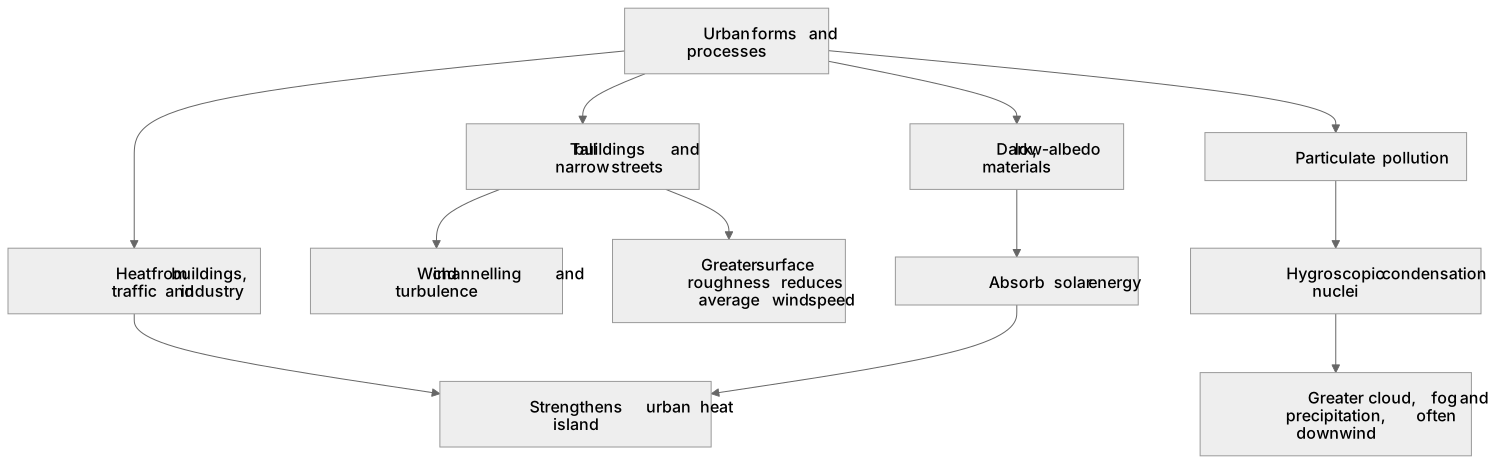
Label the diagram
Some boxes have lost their names. Pick the right name for each number.
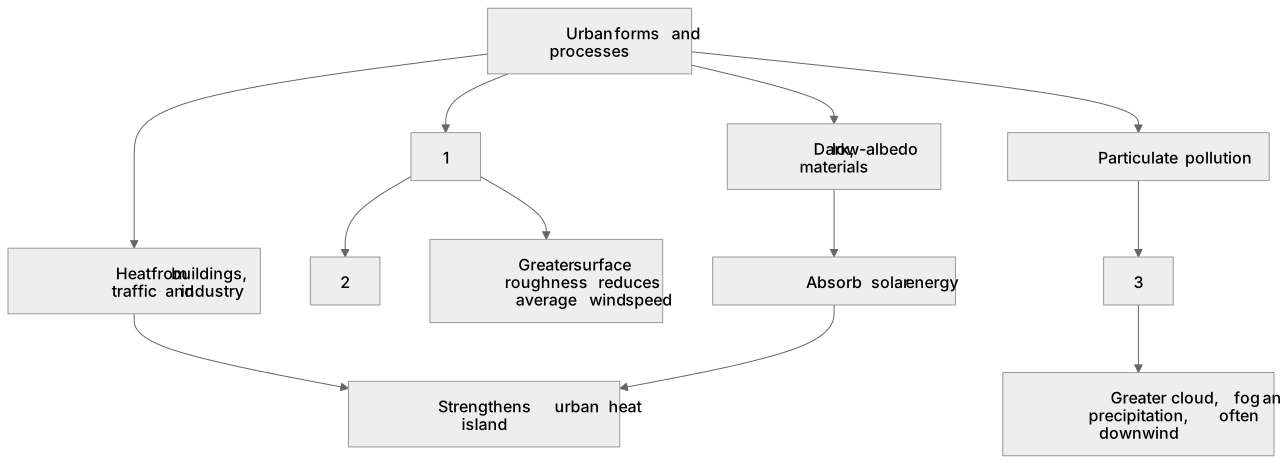
1Box 1
2Box 2
3Box 3
There is more to this lesson
The full lesson goes on to check your understanding and help you earn the marks. Create a free account to carry on, with your progress saved.
A week of Premium from your first lesson · Then the free plan continues · No card, no charge
Test your understanding of Urban climate: The impact of urban forms and processes on local climate and weather.
Active recall beats re-reading. Take an instant quiz now to test what you’ve learned and lock it into long-term memory.
A week of Premium from your first lesson · Then the free plan continues · No card, no charge