AQA · A-Level · Geography
Course version: 7037 · Version from Sept 2018
Urban change: deindustrialisation, decentralisation, rise of service…
Full specification wording
Urbanisation: Urban change: deindustrialisation, decentralisation, rise of service economy.
Urban change in developed nations is characterised by three major shifts.
Checked against the AQA 7037 specification (opens in a new tab) on .
- Point 3 of 4
- 2 key terms
Study notes
From the checked teaching notes for this specification point.
The idea
Urban change in developed nations is characterised by three major shifts. Deindustrialisation involves the absolute decline of manufacturing industries, often leaving derelict brownfield sites and causing structural unemployment, as seen in Sheffield's steel industry. Decentralisation is the movement of people and businesses from city centres to the rural-urban fringe, driven by cheaper land and improved transport, leading to retail parks and suburbanisation. Concurrently, the rise of the service economy has transformed urban employment and land use, replacing factories with office blocks, financial districts, and leisure facilities, fundamentally altering the economic geography of post-industrial cities.
What earns the marks
- Define deindustrialisation and explain its economic and social impacts on traditional manufacturing cities.
- Analyse the causes of decentralisation, including push factors from the inner city and pull factors of the rural-urban fringe.
- Evaluate the consequences of decentralisation on the central business district, such as retail decline or the doughnut effect.
- Explain how the rise of the service economy has led to the regeneration of urban areas and changes in employment structures.
Common mistakes and how to put them right
Using deindustrialisation as a synonym for total economic decline.
Put it right: While it causes job losses in manufacturing, it often occurs alongside the growth of the service economy.
Confusing decentralisation with counter-urbanisation.
Put it right: Decentralisation often refers to movement to the urban fringe, whereas counter-urbanisation is movement to rural areas.
Failing to link the three concepts; students often treat them in isolation rather than explaining how deindustrialisation and decentralisation paved the way for a service-led urban core.
Exam tips
- Link deindustrialisation to specific social impacts, such as structural unemployment and the spiral of decline in inner-city areas.
- Use a case study of a post-industrial city to demonstrate the spatial impacts of the service economy's rise.
- Discuss the doughnut effect when explaining the impacts of retail and commercial decentralisation on the traditional central business district.
Try the lesson
The start of the Urbanisation: Urban change: deindustrialisation, decentralisation, rise of service economy. lesson, made from checked teaching notes for this specification point.
Have a go first
Which of the following best describes the process of deindustrialisation in an urban area?
Listen
Urban change in developed nations is characterised by three major shifts. Deindustrialisation involves the absolute decline of manufacturing industries, often leaving derelict brownfield sites and causing structural unemployment, as seen in Sheffield's steel industry. Decentralisation is the movement of people and businesses from city centres to the rural-urban fringe, driven by cheaper land and improved transport, leading to retail parks and suburbanisation. Concurrently, the rise of the service economy has transformed urban employment and land use, replacing factories with office blocks, financial districts, and leisure facilities, fundamentally altering the economic geography of post-industrial cities. A strong answer earns marks for these points. Define deindustrialisation and explain its economic and social impacts on traditional manufacturing cities. Analyse the causes of decentralisation, including push factors from the inner city and pull factors of the rural-urban fringe. Evaluate the consequences of decentralisation on the central business district, such as retail decline or the doughnut effect. Explain how the rise of the service economy has led to the regeneration of urban areas and changes in employment structures. Exam tip: Link deindustrialisation to specific social impacts, such as structural unemployment and the spiral of decline in inner-city areas.
See it
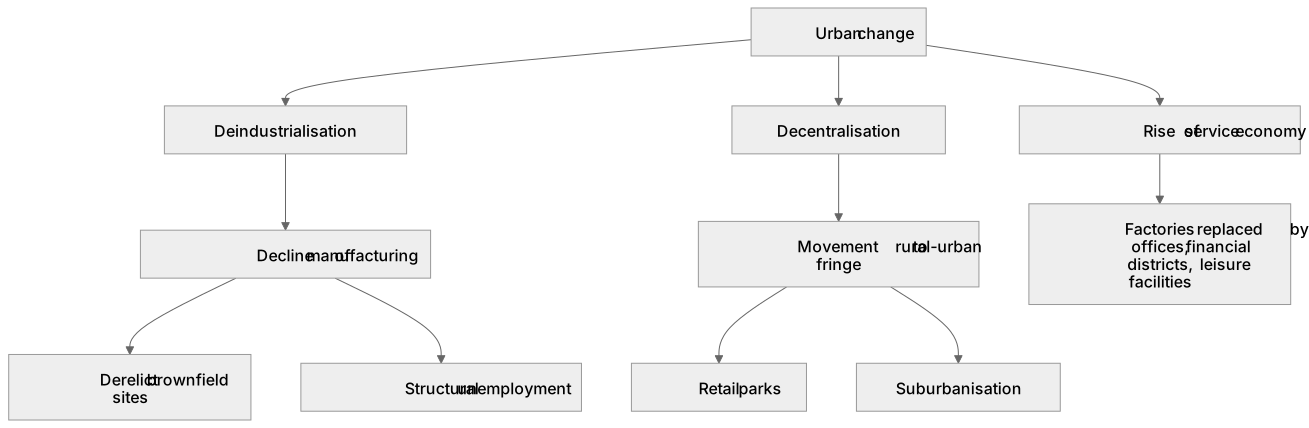
Key words
Say what each word means before you turn the card.
Deindustrialisation
Try answering aloud or in your head before turning the card.
Decentralisation
Try answering aloud or in your head before turning the card.
See every definition
- Deindustrialisation
- The absolute decline of manufacturing industries, often leaving derelict brownfield sites and causing structural unemployment.
- Decentralisation
- The movement of people and businesses from city centres to the rural-urban fringe, driven by cheaper land and improved transport.
Label the diagram
Some boxes have lost their names. Pick the right name for each number.
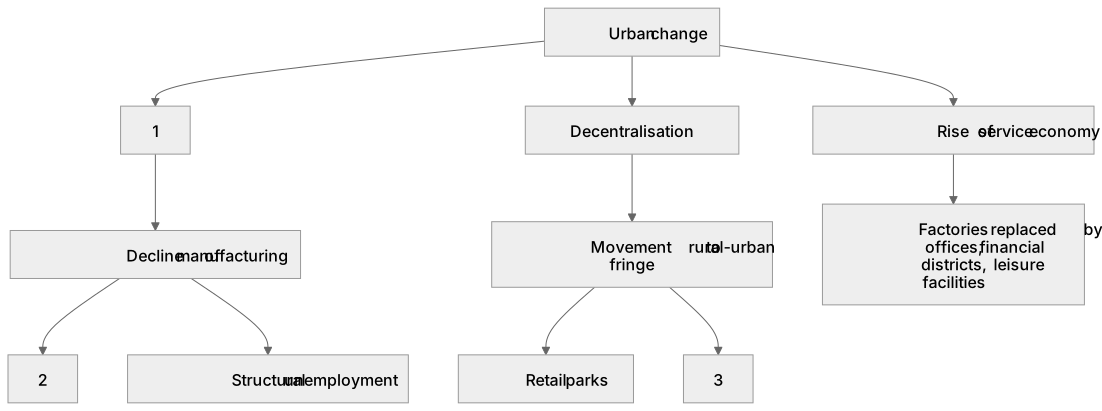
1Box 1
2Box 2
3Box 3
There is more to this lesson
The full lesson goes on to check your understanding and help you earn the marks. Create a free account to carry on, with your progress saved.
A week of Premium from your first lesson · Then the free plan continues · No card, no charge
Test your understanding of Urbanisation: Urban change: deindustrialisation, decentralisation, rise of service economy.
Active recall beats re-reading. Take an instant quiz now to test what you’ve learned and lock it into long-term memory.
A week of Premium from your first lesson · Then the free plan continues · No card, no charge