AQA · A-Level · Geography
Course version: 7037 · Version from Sept 2018
Urbanisation: Urban policy and regeneration in Britain since 1979.
Urban policy in Britain since 1979 has evolved through distinct phases to tackle the legacy of deindustrialisation.
Checked against the AQA 7037 specification (opens in a new tab) on .
- Point 4 of 4
Study notes
From the checked teaching notes for this specification point.
The idea
Urban policy in Britain since 1979 has evolved through distinct phases to tackle the legacy of deindustrialisation. Initially, the 1980s focused on property-led regeneration, using Urban Development Corporations (UDCs) like the London Docklands to attract private investment through tax incentives and deregulation. The 1990s shifted towards partnership schemes, such as City Challenge, requiring local authorities to bid for funding alongside private and community partners. From 1997, area-based initiatives like the New Deal for Communities targeted specific deprived neighbourhoods, emphasising social outcomes alongside economic growth. Recent policies focus on devolution and 'Levelling Up' to address regional disparities.
What earns the marks
- Identify specific urban policies from different eras, such as UDCs, City Challenge, and the New Deal for Communities.
- Evaluate the success of property-led regeneration in creating economic growth versus its frequent failure to address local social needs.
- Explain the shift from top-down, property-focused approaches to bottom-up, community-partnership models.
- Assess the role of private investment and public funding in driving urban regeneration across different decades.
Common mistakes and how to put them right
Confusing the chronological order of policies.
Put it right: Learn the timeline: UDCs in the 1980s, City Challenge in the 1990s, and New Deal for Communities in the 2000s.
Assuming regeneration only involves physical rebuilding.
Put it right: Ensure you discuss social and economic regeneration, such as job creation, education, and community health improvements.
Stating that UDCs were universally successful.
Put it right: Acknowledge that while UDCs attracted significant investment, they often displaced local working-class communities and failed to provide suitable local employment.
Exam tips
- Use specific case studies, such as the London Docklands Development Corporation (LDDC) or Hulme City Challenge, to illustrate policy impacts.
- Compare the aims and outcomes of two different policy eras to demonstrate critical evaluation skills.
- Always link the introduction of a policy to the specific urban problems of that era, such as 1980s deindustrialisation and inner-city decline.
Try the lesson
The start of the Urbanisation: Urban policy and regeneration in Britain since 1979. lesson, made from checked teaching notes for this specification point.
Have a go first
Which of the following was a primary characteristic of Urban Development Corporations (UDCs) established in Britain during the 1980s?
Listen
Urban policy in Britain since 1979 has evolved through distinct phases to tackle the legacy of deindustrialisation. Initially, the 1980s focused on property-led regeneration, using Urban Development Corporations (UDCs) like the London Docklands to attract private investment through tax incentives and deregulation. The 1990s shifted towards partnership schemes, such as City Challenge, requiring local authorities to bid for funding alongside private and community partners. From 1997, area-based initiatives like the New Deal for Communities targeted specific deprived neighbourhoods, emphasising social outcomes alongside economic growth. Recent policies focus on devolution and 'Levelling Up' to address regional disparities. A strong answer earns marks for these points. Identify specific urban policies from different eras, such as UDCs, City Challenge, and the New Deal for Communities. Evaluate the success of property-led regeneration in creating economic growth versus its frequent failure to address local social needs. Explain the shift from top-down, property-focused approaches to bottom-up, community-partnership models. Assess the role of private investment and public funding in driving urban regeneration across different decades. A common slip: Confusing the chronological order of policies. Instead, Learn the timeline: UDCs in the 1980s, City Challenge in the 1990s, and New Deal for Communities in the 2000s. Exam tip: Use specific case studies, such as the London Docklands Development Corporation (LDDC) or Hulme City Challenge, to illustrate policy impacts.
See it
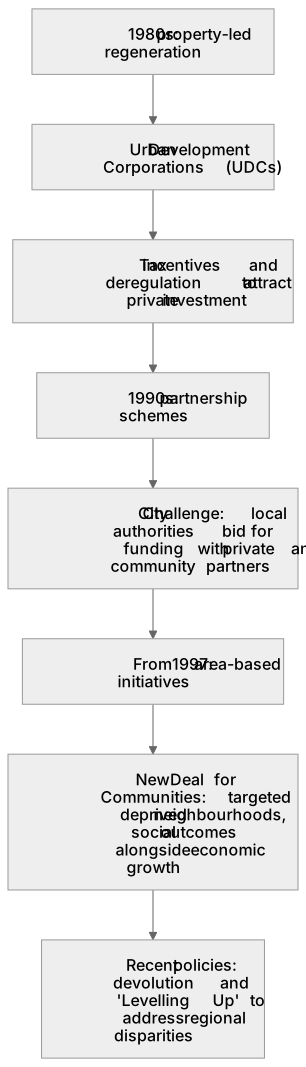
Put it in order
Put these steps in the order they happen.
- 1. City Challenge: local authorities bid for funding with private and community partners
- 2. Recent policies: devolution and 'Levelling Up' to address regional disparities
- 3. From 1997: area-based initiatives
- 4. 1980s: property-led regeneration
- 5. Urban Development Corporations (UDCs)
- 6. New Deal for Communities: targeted deprived neighbourhoods, social outcomes alongside economic growth
- 7. Tax incentives and deregulation to attract private investment
- 8. 1990s: partnership schemes
Label the diagram
Some boxes have lost their names. Pick the right name for each number.
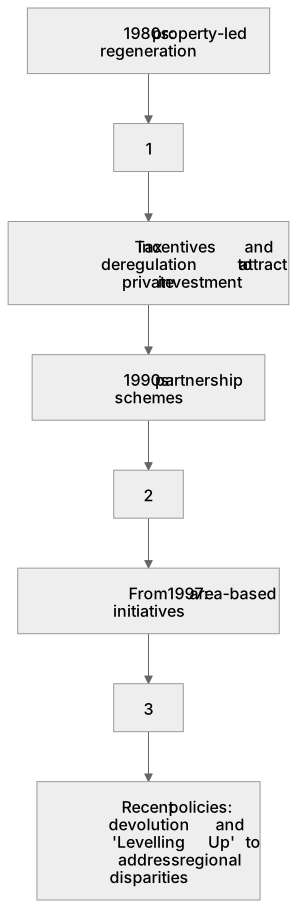
1Box 1
2Box 2
3Box 3
There is more to this lesson
The full lesson goes on to check your understanding and help you earn the marks. Create a free account to carry on, with your progress saved.
A week of Premium from your first lesson · Then the free plan continues · No card, no charge
Test your understanding of Urbanisation: Urban policy and regeneration in Britain since 1979.
Active recall beats re-reading. Take an instant quiz now to test what you’ve learned and lock it into long-term memory.
A week of Premium from your first lesson · Then the free plan continues · No card, no charge