AQA · A-Level · German
Adverbs and adverbials
German adverbs and adverbials let candidates say when, why, how, where and how often things happen. This GCSE guide builds confident TeKaMoLo word order, inversion, comparison and direction language across Listening, Speaking, Reading and Writing, with exam-style practice and bilingual model answers.
- 17 min read
- 4 worked examples
- 7 practice questions
- 10 key terms
Study Notes

Overview
Adverbs and adverbials are high-value grammar because they turn a basic statement into a precise, developed response. Compare Ich spiele Tennis. (I play tennis.) with Normalerweise spiele ich am Samstag sehr gern Tennis im Park. (Normally I really like playing tennis in the park on Saturdays.) The second response gives time, manner, place and opinion; in a GCSE response, that creates more to credit for communication and range.
This is a board-neutral GCSE German guide. Your exact paper layout, timings and mark totals depend on your school and exam board, so check the current specification. However, accurate word order, clear detail and a purposeful range of vocabulary are always worth rehearsing. In extended writing, an examiner can only give credit for ambitious language if it is understandable and grammatically controlled.
Examiner habit: candidates often know good vocabulary but lose accuracy when they put the verb in the wrong place after a time phrase. The quickest upgrade is to remember: the finite verb is idea number two.
Essential Vocabulary
Tier 1 — Foundation Core
All words in this table are adverbs, so they have no grammatical gender.
| German | English | Gender | Example Sentence | English translation |
|---|---|---|---|---|
| heute | today | — | Ich lerne heute Deutsch. | I am learning German today. |
| morgen | tomorrow | — | Morgen gehe ich ins Kino. | Tomorrow I am going to the cinema. |
| gestern | yesterday | — | Gestern war ich sehr müde. | Yesterday I was very tired. |
| immer | always | — | Ich mache immer meine Hausaufgaben. | I always do my homework. |
| oft | often | — | Wir spielen oft Fußball. | We often play football. |
| manchmal | sometimes | — | Manchmal esse ich in der Mensa. | Sometimes I eat in the cafeteria. |
| selten | rarely | — | Er sieht selten fern. | He rarely watches television. |
| nie | never | — | Meine Schwester kommt nie zu spät. | My sister is never late. |
| hier | here | — | Meine Freunde warten hier. | My friends are waiting here. |
| dort | there | — | Das Museum ist dort. | The museum is there. |
| schnell | quickly / fast | — | Sie läuft schnell nach Hause. | She runs home quickly. |
| langsam | slowly | — | Bitte sprich langsam. | Please speak slowly. |
| gut | well | — | Mein Bruder kocht gut. | My brother cooks well. |
| schlecht | badly | — | Ich habe letzte Nacht schlecht geschlafen. | I slept badly last night. |
| sehr | very | — | Der Film war sehr spannend. | The film was very exciting. |
| auch | also / too | — | Ich komme auch mit. | I am coming too. |
| nur | only | — | Ich habe nur zehn Euro. | I only have ten euros. |
| schon | already | — | Wir haben schon gegessen. | We have already eaten. |
Tier 2 — Higher Tier
| German | English | Gender | Example Sentence | English translation |
|---|---|---|---|---|
| normalerweise | normally | — | Normalerweise stehe ich um sieben Uhr auf. | Normally I get up at seven o’clock. |
| glücklicherweise | fortunately | — | Glücklicherweise hat es nicht geregnet. | Fortunately, it did not rain. |
| leider | unfortunately | — | Leider kann ich heute nicht kommen. | Unfortunately, I cannot come today. |
| wahrscheinlich | probably | — | Ich werde wahrscheinlich morgen lernen. | I will probably study tomorrow. |
| plötzlich | suddenly | — | Plötzlich fing es an zu schneien. | Suddenly it started to snow. |
| besonders | especially | — | Ich mag Musik besonders gern. | I especially like music. |
| ziemlich | quite / fairly | — | Die Klassenarbeit war ziemlich schwierig. | The test was quite difficult. |
| kaum | hardly / barely | — | Ich habe kaum Zeit. | I hardly have any time. |
| inzwischen | meanwhile / by now | — | Inzwischen verstehe ich die Regel besser. | By now I understand the rule better. |
| deshalb | therefore | — | Es regnet; deshalb bleibe ich zu Hause. | It is raining; therefore I am staying at home. |
| überall | everywhere | — | In Berlin kann man überall Deutsch hören. | In Berlin you can hear German everywhere. |
| nirgendwo | nowhere | — | Ich kann meine Schlüssel nirgendwo finden. | I cannot find my keys anywhere. |
High-Frequency Words and Phrases
| Phrase | English | Usage context |
|---|---|---|
| ab und zu | now and then | Frequency; a natural alternative to manchmal. |
| von Zeit zu Zeit | from time to time | Higher-tier frequency phrase. |
| am liebsten | most of all | Strong preference with activities. |
| auf jeden Fall | definitely / in any case | Convincing opinion or plan. |
| auf keinen Fall | definitely not / under no circumstances | Strong negative opinion. |
| zum Beispiel | for example | Develop an idea with an example. |
| im Allgemeinen | in general | Give a balanced general view. |
| meiner Meinung nach | in my opinion | Start an opinion politely. |
| zuerst … dann … schließlich | first … then … finally | Sequence events in the past. |
| früher als | earlier than | Comparative time phrase. |
| viel später | much later | Narrative detail. |
| direkt neben | directly next to | Precise place description. |
Cover and recall: Cover the English column. Can you say and spell five frequency adverbs without looking? Then cover the German column and translate them back into English.
Grammar Focus
Key Structure 1: TeKaMoLo — ordering multiple adverbials
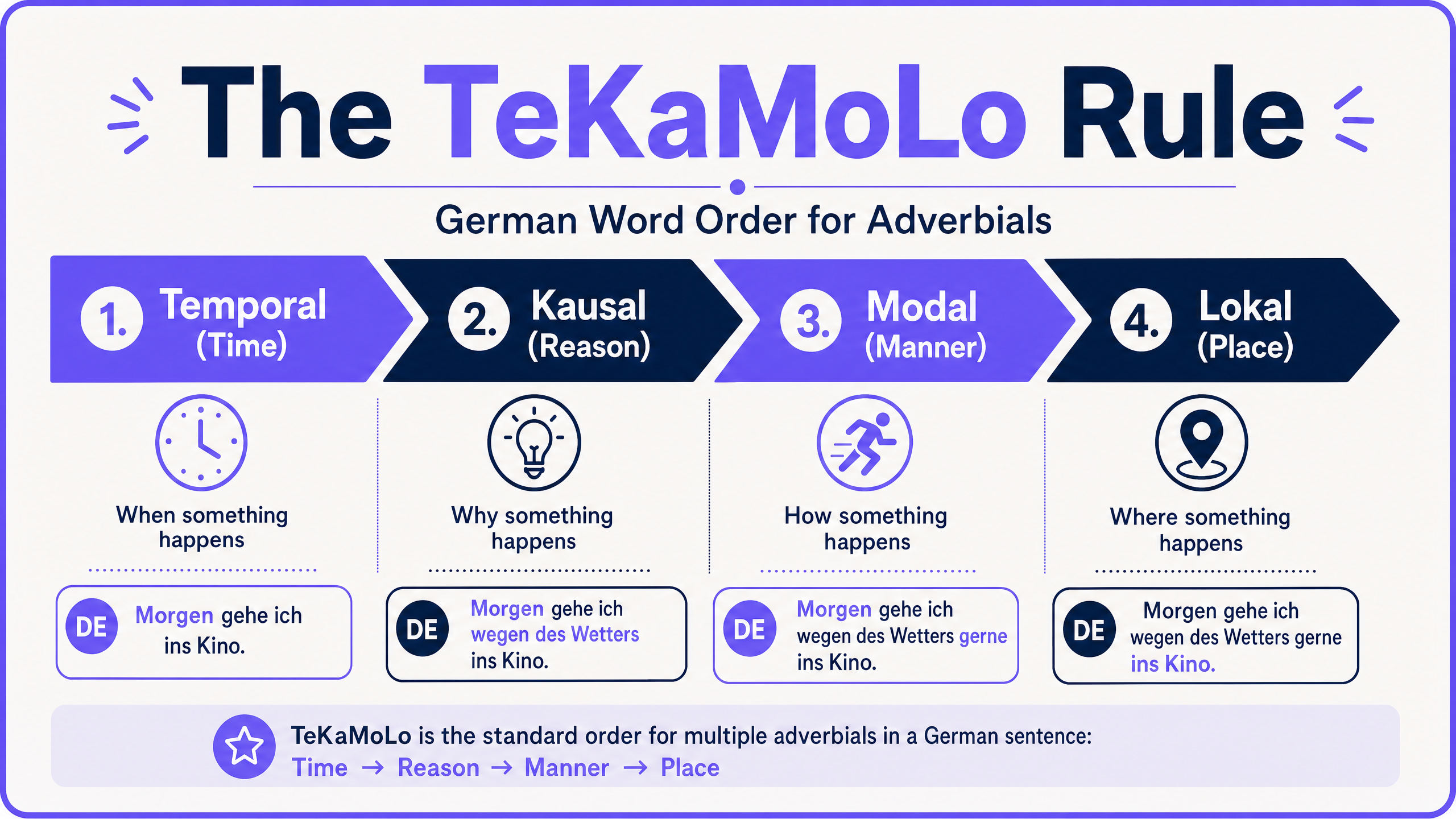
When to use it: When a sentence includes several pieces of extra information, German normally orders them as Temporal (when), Kausal (why), Modal (how) and Lokal (where). At GCSE, the most useful simplified pattern is Time → Manner → Place. A reason can come between time and manner.
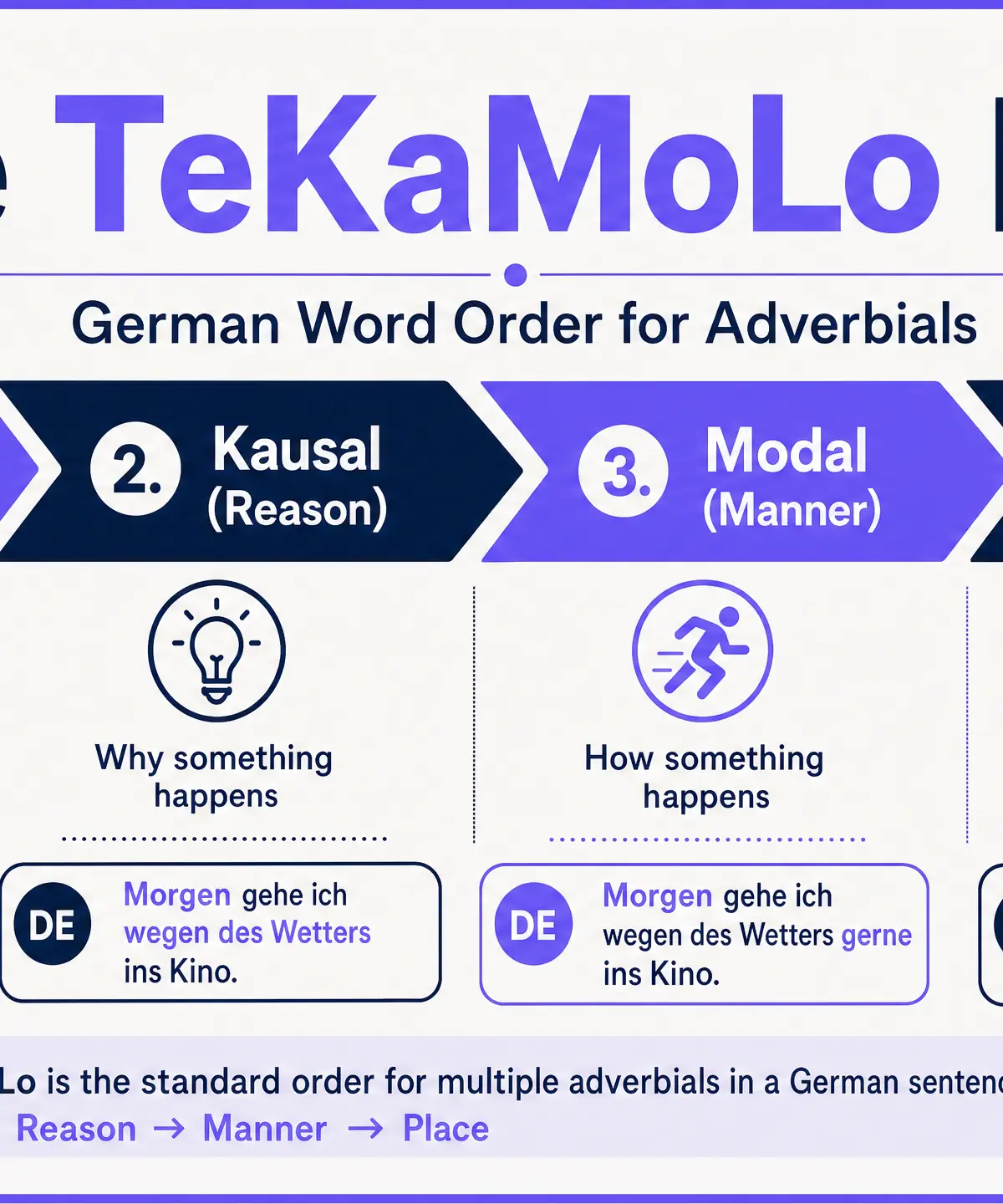
| Question answered | German label | Example |
|---|---|---|
| When? | Temporal | heute, am Samstag, letztes Jahr |
| Why? | Kausal | wegen des Wetters, aus Zeitmangel |
| How? | Modal | schnell, mit dem Bus, gern |
| Where? | Lokal | in der Stadt, nach Berlin, zu Hause |
Model sentence: **Ich fahre heute wegen des Wetters schnell nach Berlin.**I am travelling to Berlin quickly today because of the weather.
The finite verb remains near the beginning; then the adverbials follow in their logical German order. Do not translate English word order mechanically.
Conjugation Table: fahren (to travel / go by vehicle)
| Subject | Verb form | English |
|---|---|---|
| ich | fahre | I travel / go |
| du | fährst | you travel / go |
| er / sie / es | fährt | he / she / it travels / goes |
| wir | fahren | we travel / go |
| ihr | fahrt | you all travel / go |
| sie / Sie | fahren | they / you (formal) travel / go |
Examiner commentary: A candidate who writes Wir fahren am Samstag mit dem Zug nach Hamburg has used a clear time–manner–place sequence. Credit is given for a sensible, comprehensible order even where the expression is not maximally complex.
What if? You start with a time phrase: Am Samstag fahren wir mit dem Zug nach Hamburg. TeKaMoLo still works; only the subject moves because the verb must still be second.
Key Structure 2: Inversion after a sentence opener
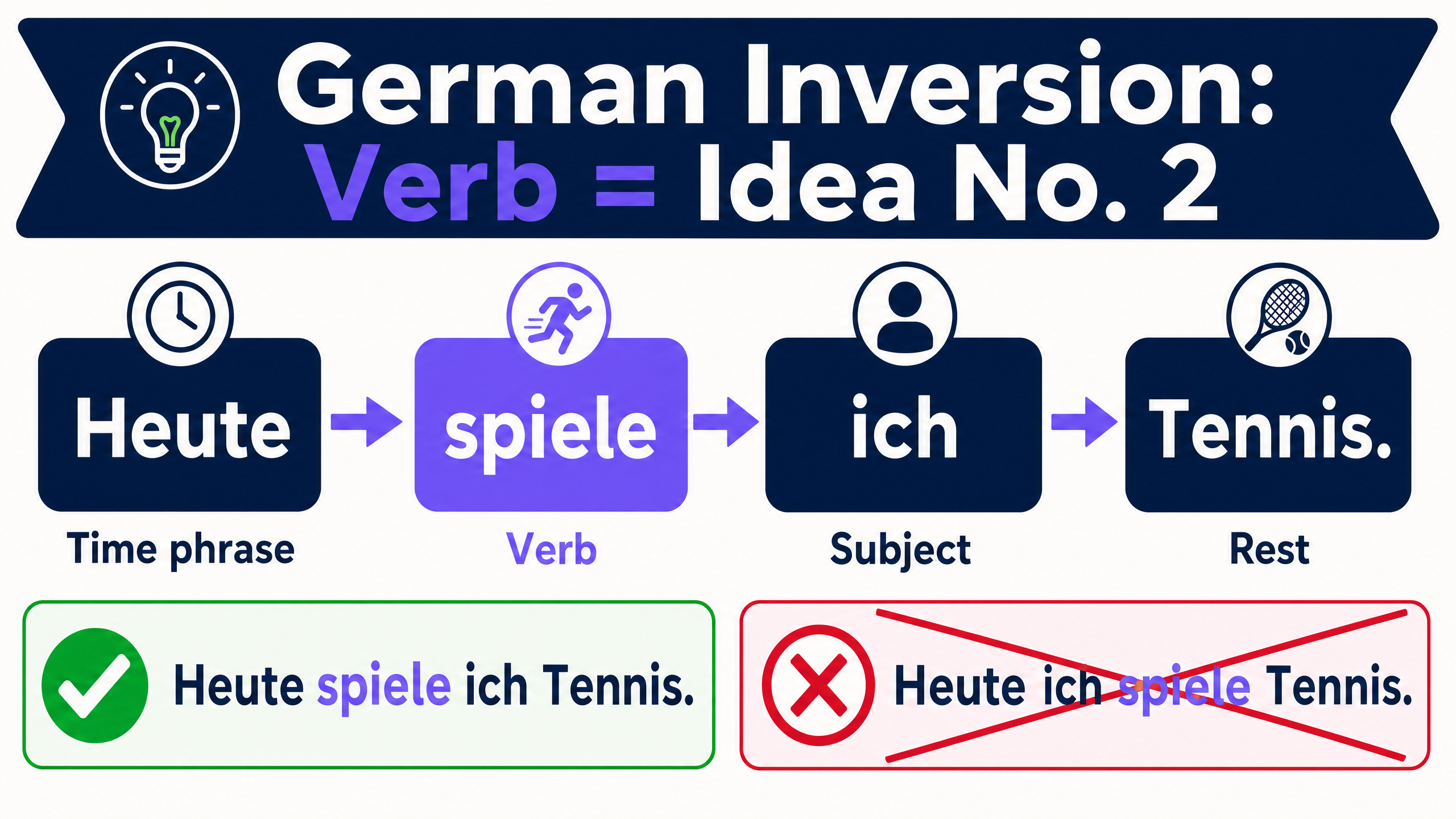
When to use it: Start sentences with adverbials to vary your writing and sound less repetitive. When an adverbial comes first, the finite verb is still the second idea, then the subject follows. This movement is called inversion.
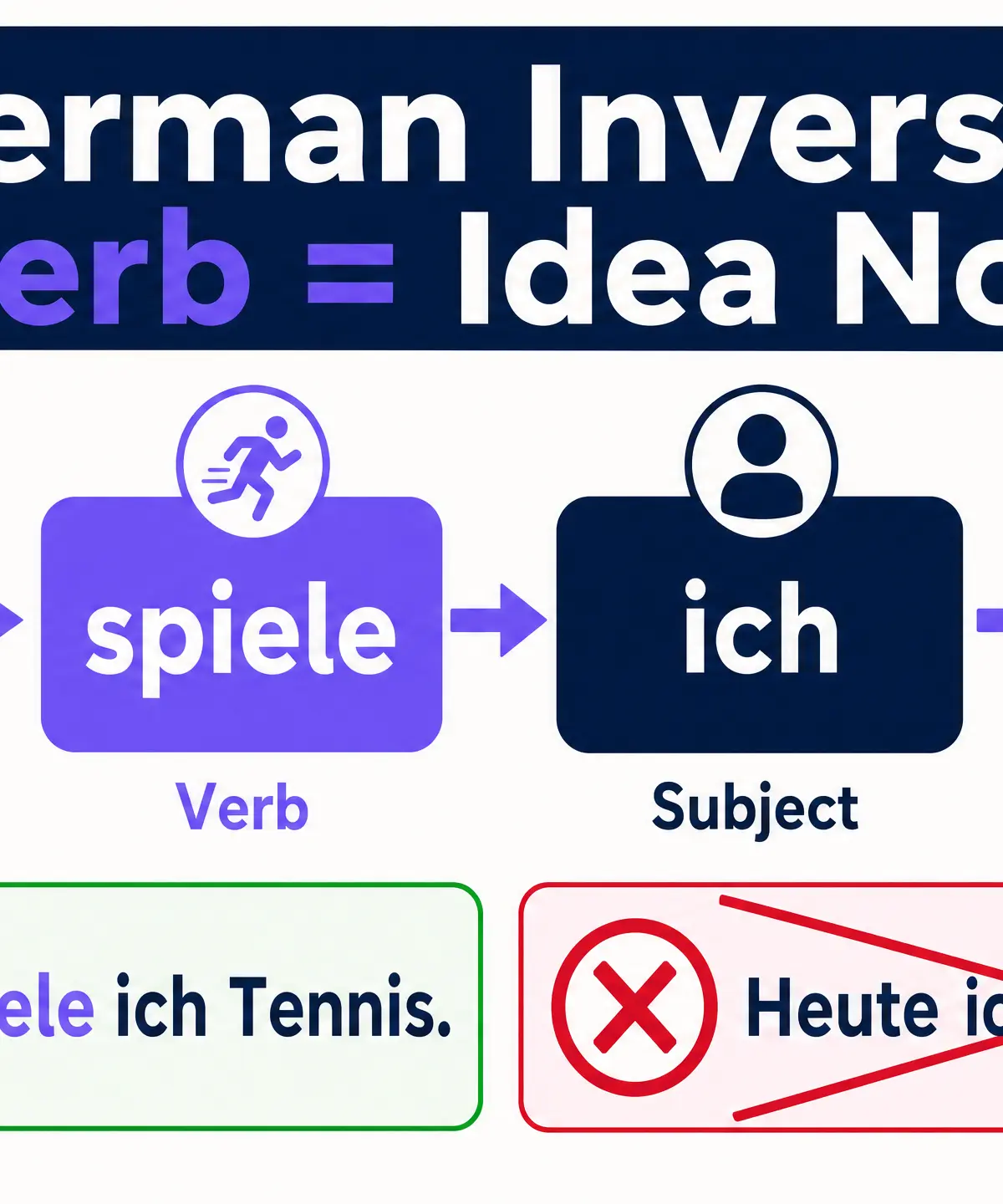
| English idea | Correct German | Why it works |
|---|---|---|
| Normally I play tennis. | Normalerweise spiele ich Tennis. | The opener is first; spiele is second. |
| Yesterday I was tired. | Gestern war ich müde. | The finite verb war is second. |
| Unfortunately I cannot come. | Leider kann ich nicht kommen. | The modal verb kann is second; kommen goes last. |
Conjugation Table: sein (to be)
| Subject | Verb form | English |
|---|---|---|
| ich | bin | I am |
| du | bist | you are |
| er / sie / es | ist | he / she / it is |
| wir | sind | we are |
| ihr | seid | you all are |
| sie / Sie | sind | they / you (formal) are |
Micro-drill: Change Ich bin heute müde into a sentence beginning with Heute. Answer: Heute bin ich müde. If you wrote Heute ich bin, repair it before moving on.
Key Structure 3: Comparing actions, expressing preferences and direction
When to use it: Comparative and superlative adverbs make opinions more precise. They are especially useful in a speaking conversation or a 150-word Higher writing response. Use gern → lieber → am liebsten, gut → besser → am besten, and viel → mehr → am meisten.
| Base adverb | Comparative | Superlative | Model answer |
|---|---|---|---|
| gern | lieber | am liebsten | Ich schwimme lieber, aber ich tanze am liebsten. |
| gut | besser | am besten | Meine Schwester singt besser als ich. |
| viel | mehr | am meisten | Am Wochenende lerne ich am meisten. |
Use als after a comparative: Ich lerne schneller als mein Freund.
Conjugation Table: mögen (to like) — useful with adverbs of preference
| Subject | Verb form | English |
|---|---|---|
| ich | mag | I like |
| du | magst | you like |
| er / sie / es | mag | he / she / it likes |
| wir | mögen | we like |
| ihr | mögt | you all like |
| sie / Sie | mögen | they / you (formal) like |
Directional adverbs: Use hier / dort for a fixed place, but use hin or her when movement matters. Komm bitte herein! means Come in (towards the speaker). Ich gehe hinaus. means I am going out (away from the speaker). For GCSE, learn the question contrast: Wo? (where, stationary), Wohin? (where to), and Woher? (where from).
Negation checkpoint: Put nicht before the part you specifically deny: Ich komme nicht heute, sondern morgen. For a general negative statement, it normally comes late: Ich komme heute nicht.
Listening Skills
What to Expect
In a listening task, an adverbial is often the one word that decides the mark. A speaker may first mention one day, place or activity and then correct it: Nicht heute, sondern morgen (not today, but tomorrow). Read the question before the recording begins and underline the information type you need: time, frequency, manner, reason or location.
Listening Strategies
- Read first: Predict likely German answers. If the question says “How often?”, expect nie, selten, manchmal, oft, or immer.
- Listen for corrections: aber, sondern, doch, leider, and eigentlich can reverse the first idea.
- Catch small qualifiers: kaum means hardly, fast means almost, and ziemlich means quite. These words often distinguish two plausible options.
- Write a symbol: Use a tiny timeline: Y for yesterday, T for today, and M for tomorrow. This reduces avoidable tense mistakes.
Common Listening Traps
| Trap | What it really means | Safe response |
|---|---|---|
| also | so / therefore | Do not translate it as also; use auch for also/too. |
| fast | almost | Do not confuse it with schnell (quickly). |
| schon | already | Listen for whether an action is completed. |
| erst | only / not until | It may signal a later time than expected. |
| gar nicht | not at all | Stronger than simply nicht. |
| kaum | hardly | It signals very little or very rarely. |
Listening recall: You hear: Ich gehe kaum ins Schwimmbad, weil ich keine Zeit habe. What does kaum tell you? Answer: the speaker hardly ever goes swimming.
Speaking Skills
Role Play Scenarios
Scenario 1 — Travel informationCandidate: **Ich möchte morgen früh nach München fahren. Wann fährt der nächste Zug?**English: I would like to travel to Munich tomorrow morning. When does the next train leave?
Scenario 2 — Leisure plansCandidate: **Normalerweise spiele ich am Wochenende Fußball, aber heute gehe ich lieber schwimmen.**English: Normally I play football at the weekend, but today I would rather go swimming.
Scenario 3 — Giving directionsCandidate: **Das Kino ist direkt neben dem Bahnhof. Gehen Sie zuerst geradeaus und dann nach links.**English: The cinema is directly next to the station. First go straight ahead and then left.
Speaking upgrade: answer, justify and extend. For example: Ich gehe gern ins Kino, weil die Filme spannend sind. Letztes Wochenende war ich auch dort. One developed answer earns more credit than three isolated one-word replies.
Photo Card Practice
| Question | Model answer in German | English translation |
|---|---|---|
| Was siehst du auf dem Foto? | Auf dem Foto sehe ich Jugendliche, die schnell im Park laufen. | In the photo I see young people who are running quickly in the park. |
| Wie findest du Sport? | Ich finde Sport besonders wichtig, weil man dadurch gesund bleibt. | I find sport especially important because it keeps you healthy. |
| Was machst du normalerweise am Wochenende? | Normalerweise treffe ich meine Freunde in der Stadt. | Normally I meet my friends in town. |
| Was hast du gestern gemacht? | Gestern habe ich gemütlich zu Hause einen Film gesehen. | Yesterday I watched a film comfortably at home. |
| Was wirst du nächstes Wochenende machen? | Ich werde wahrscheinlich mit meiner Familie nach Berlin fahren. | I will probably travel to Berlin with my family. |
General Conversation Questions
| Question (German) | Model answer (German) | English translation |
|---|---|---|
| Wie oft benutzt du dein Handy? | Ich benutze mein Handy ziemlich oft, aber abends lege ich es normalerweise weg. | I use my mobile quite often, but in the evening I normally put it away. |
| Wo machst du am liebsten deine Hausaufgaben? | Am liebsten mache ich meine Hausaufgaben ruhig in meinem Zimmer. | I most like doing my homework quietly in my room. |
| Warum lernst du Deutsch? | Ich lerne Deutsch, weil ich später wahrscheinlich in Deutschland arbeiten möchte. | I learn German because I will probably want to work in Germany later. |
| Was hast du letztes Wochenende gemacht? | Letztes Wochenende bin ich mit Freunden in die Stadt gegangen und wir haben dort lange eingekauft. | Last weekend I went into town with friends and we shopped there for a long time. |
| Wie wirst du in Zukunft reisen? | In Zukunft werde ich möglichst oft mit dem Zug reisen, weil das umweltfreundlicher ist. | In future I will travel by train as often as possible because it is more environmentally friendly. |
| Wohin gehst du nach der Schule? | Nach der Schule gehe ich meistens direkt nach Hause, aber dienstags gehe ich zum Training. | After school I usually go straight home, but on Tuesdays I go to training. |
Writing Skills
Translation Practice
| English | German | Key grammar tested |
|---|---|---|
| I often play football after school. | Ich spiele nach der Schule oft Fußball. | Frequency adverb in a straightforward sentence. |
| Normally I read in the evening. | Normalerweise lese ich abends. | Inversion after a sentence opener. |
| My brother sings better than me. | Mein Bruder singt besser als ich. | Comparative adverb plus als. |
| Yesterday we went quickly to the park because the weather was good. | Gestern sind wir wegen des guten Wetters schnell in den Park gegangen. | Inversion; time–reason–manner–place. |
| Unfortunately, I will probably not be able to come tomorrow. | Leider werde ich morgen wahrscheinlich nicht kommen können. | Future tense, inversion, adverbs and final infinitive. |
Extended Writing
**Model 90-word response (Foundation):**Normalerweise stehe ich um sieben Uhr auf und gehe schnell zur Schule. In der Pause rede ich oft mit meinen Freunden. Ich finde die Schule manchmal ziemlich anstrengend, aber Mathe mag ich sehr, weil der Lehrer nett ist. Gestern habe ich nach der Schule Fußball gespielt. Das war besonders toll, denn meine Mannschaft hat gewonnen. Nächstes Wochenende werde ich wahrscheinlich zu Hause bleiben. Ich möchte für meine Prüfungen lernen, aber am Abend sehe ich gern fern.
Why it earns credit: It covers several time frames, uses adverbs naturally and varies sentence openings. A candidate could improve it further by adding a wider range of connectives and a second justified opinion.
**Model 150-word response (Higher):**Meiner Meinung nach ist Freizeit extrem wichtig, weil man sich nach einer langen Schulwoche entspannen muss. Normalerweise verbringe ich Samstagvormittag mit meiner Familie, und am Nachmittag treffe ich oft Freunde in der Stadt. Wir gehen gern einkaufen, aber ich esse am liebsten gemütlich in einem kleinen Restaurant, weil das Essen dort besonders lecker ist.
Letztes Wochenende war jedoch anders. Wegen des schlechten Wetters sind wir nicht in den Park gegangen. Stattdessen haben wir zu Hause einen Film gesehen und später lange Musik gehört. Ziemlich überraschend war der Film besser als erwartet.
Nächstes Wochenende werde ich wahrscheinlich mehr lernen, denn meine Prüfungen beginnen bald. Obwohl das manchmal langweilig ist, arbeite ich am besten morgens, wenn das Haus noch ruhig ist. Danach werde ich auf jeden Fall Sport machen, weil ich dadurch besser konzentriert bleiben kann. In Zukunft möchte ich häufiger mit Freunden reisen und vielleicht einmal nach Österreich fahren.
Examiner commentary: Marks are awarded for secure communication across time frames, accurate verb placement after openers, controlled comparison (besser als) and ambitious adverbials such as ziemlich überraschend, wahrscheinlich and auf jeden Fall. Credit is given for clear meaning even if one ambitious phrase is not flawless; repeated word-order errors would limit accuracy.
Writing Checklist
- Content: Have you answered every bullet point and added at least one specific detail?
- Range: Have you used frequency, time, manner and place adverbs rather than repeating sehr?
- Word order: When you begin with gestern, normalerweise, leider, or another opener, is the finite verb idea number two?
- Tenses: For Higher practice, have you included a past, present and future idea accurately?
- Proofread: Search specifically for also/auch, fast/schnell, gern/lieber/am liebsten and the position of nicht.
Reading Skills
Key Strategies
Find the time frame first, then locate the exact evidence. Qualifiers matter: Ich finde den Film nicht besonders gut means “I do not find the film particularly good”, not “I find the film very good.”
For gap-fill work, identify the missing grammar category. After a time opener, expect the finite verb. For frequency, scan for immer, oft, selten, and nie.
False Friends and Tricky Words
| Word | Looks like | Actually means |
|---|---|---|
| also | also | so / therefore |
| fast | fast | almost |
| aktuell | actual | current / up-to-date |
| bekommen | become | to receive / get |
| eventuell | eventually | possibly |
| bald | bald | soon |
| Gift | gift | poison |
Reading mini-text: **Zuerst wollte Leon heute ins Kino gehen. Wegen des Regens bleibt er aber zu Hause und sieht später einen Film.**Translation: At first Leon wanted to go to the cinema today. However, because of the rain he is staying at home and will watch a film later.
Question: Why has Leon changed his plan? Because of the rain. A one-mark response needs the precise reason, not the general fact that he is at home.
Cultural Knowledge
Time language can make travel and social plans sound authentic: pünktlich (on time), rechtzeitig (in good time) and gleich (in a moment / soon, depending on context). In a speaking answer about visiting Berlin, Vienna or Zürich, a well-placed adverbial such as am Samstagmorgen, mit der Straßenbahn or direkt im Zentrum gives your answer a sense of real place without adding unnecessary risk.
Final Examiner-Style Reminders
Visual Resources
2 diagrams and illustrations
Interactive Diagrams
2 interactive diagrams to visualise key concepts
Conceptual Flow Outline
Inversion: the finite verb stays as idea number two.
Conceptual Flow Outline
TeKaMoLo ordering for multiple German adverbials.
Worked Examples
4 worked examples — open one to explore the question and available guidance.
Practice Questions
Test your understanding — click to reveal model answers
Listening: You hear 'Morgen fahre ich mit dem Bus zur Schule.' How will the speaker travel to school tomorrow?
Hint: Find the transport phrase after the time word.
Speaking: Answer 'Was machst du am liebsten nach der Schule?' in one developed German sentence.
Hint: Use am liebsten, give a reason and add a place or time phrase.
Reading: Translate into English: 'Leider habe ich gestern kaum gelernt.'
Hint: Translate each adverb: leider, gestern, kaum.
Writing: Translate into German: 'Normally I go quickly to the sports centre after school.'
Hint: Begin with Normalerweise, then use inversion.
Listening: You hear 'Ich gehe nicht ins Kino, sondern direkt nach Hause.' Where is the speaker going?
Hint: The word sondern introduces the corrected information.
Writing: Write two German sentences comparing your preferences for two activities, using lieber and am liebsten.
Hint: Use gern for a basic like, lieber for a preference and am liebsten for your top choice.
Reading: In the sentence 'Woher kommst du gerade?', what does woher ask?
Hint: Contrast Wo? Wohin? and Woher?