AQA · A-Level · History
Course version: 7042 · Version from Sept 2017
What were the political issues and how well did rulers handle them?
Full specification wording
1B Spain in the Age of Discovery, 1469–1598 (A-level only) – consequence in this period through the following key questions:: What were the political issues and how well did rulers handle them?
This topic evaluates the central political challenges faced by Spanish monarchs between 1469 and 1598, and assesses their effectiveness in managing them.
Checked against the AQA 7042 specification (opens in a new tab) on .
- Point 1 of 6
- 4 key terms
Study notes
From the checked teaching notes for this specification point.
The idea
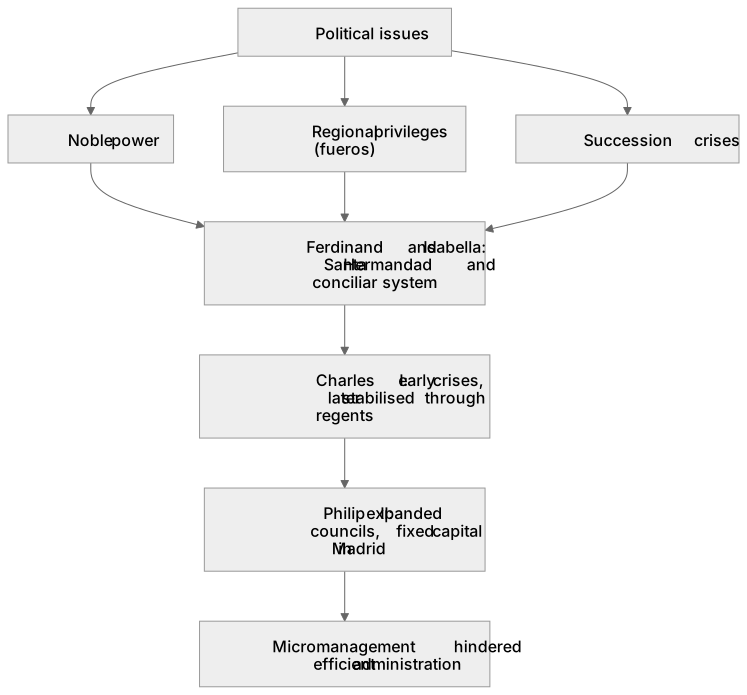
This topic evaluates the central political challenges faced by Spanish monarchs between 1469 and 1598, and assesses their effectiveness in managing them. Key political issues included establishing royal authority over powerful nobles, managing the distinct constitutional traditions of Castile and Aragon, and navigating complex successions. Rulers handled these with varying success. Ferdinand and Isabella utilised the Santa Hermandad and the conciliar system to centralise power, though regional autonomy persisted. Charles I faced early political crises like the Comuneros revolt but later stabilised governance through regents. Philip II expanded the conciliar system and established a fixed capital in Madrid, yet his micromanagement often hindered efficient political administration.
What earns the marks
- Identify specific political issues such as noble power, regional privileges (fueros), and succession crises.
- Evaluate the methods used by monarchs to assert authority, such as the development of the conciliar system and the use of letrados.
- Assess the effectiveness of Ferdinand and Isabella in pacifying Castile and managing the union of the crowns.
- Analyse the political challenges of Charles I's early reign, including his foreign origins and absentee rule, and his subsequent adaptations.
- Evaluate Philip II's administrative style, focusing on his reliance on councils, secretaries, and the impact of his sedentary kingship in Madrid.
Common mistakes and how to put them right
Treating Spain as a fully unified political entity.
Put it right: Acknowledge that Castile and Aragon retained separate laws, institutions, and political identities throughout the period.
Assuming Charles I's reign was politically disastrous due to early revolts.
Put it right: Recognise that he successfully stabilised Spanish politics later in his reign, largely through capable regents and conciliar government.
Describing Philip II's administration as entirely efficient.
Put it right: Evaluate how his extreme micromanagement and the slow conciliar system often caused severe political paralysis.
Exam tips
- Always link specific political policies back to the overarching question of how successfully the ruler handled the issue.
- Use the contrast between Castilian centralisation and Aragonese decentralisation to evaluate the limits of royal authority.
- When discussing Philip II, provide specific examples of his conciliar system, such as the Council of State, to demonstrate detailed knowledge of his political handling.
Try the lesson
The start of the 1B Spain in the Age of Discovery, 1469–1598 (A-level only) – consequence in this period through the following key questions:: What were the political issues and how well did rulers handle them? lesson, made from checked teaching notes for this specification point.
Have a go first
How did Isabella of Castile primarily address the political issue of widespread lawlessness and noble dominance in the countryside during the early years of her reign?
Listen
This topic evaluates the central political challenges faced by Spanish monarchs between 1469 and 1598, and assesses their effectiveness in managing them. Key political issues included establishing royal authority over powerful nobles, managing the distinct constitutional traditions of Castile and Aragon, and navigating complex successions. Rulers handled these with varying success. Ferdinand and Isabella utilised the Santa Hermandad and the conciliar system to centralise power, though regional autonomy persisted. Charles I faced early political crises like the Comuneros revolt but later stabilised governance through regents. Philip II expanded the conciliar system and established a fixed capital in Madrid, yet his micromanagement often hindered efficient political administration. A strong answer earns marks for these points. Identify specific political issues such as noble power, regional privileges (fueros), and succession crises. Evaluate the methods used by monarchs to assert authority, such as the development of the conciliar system and the use of letrados. Assess the effectiveness of Ferdinand and Isabella in pacifying Castile and managing the union of the crowns. Analyse the political challenges of Charles I's early reign, including his foreign origins and absentee rule, and his subsequent adaptations. A common slip: Treating Spain as a fully unified political entity. Instead, acknowledge that Castile and Aragon retained separate laws, institutions, and political identities throughout the period. Exam tip: Always link specific political policies back to the overarching question of how successfully the ruler handled the issue.
See it
Key words
Say what each word means before you turn the card.
Centralisation vs. Regionalism
Try answering aloud or in your head before turning the card.
Royal Authority and Absolutism
Try answering aloud or in your head before turning the card.
Conciliar Government
Try answering aloud or in your head before turning the card.
Succession and Dynastic Politics
Try answering aloud or in your head before turning the card.
See every definition
- Centralisation vs. Regionalism
- Establishing royal authority over powerful nobles and centralising power, while regional autonomy persisted and Castile and Aragon retained separate laws, institutions, and political identities.
- Royal Authority and Absolutism
- Establishing royal authority over powerful nobles and asserting authority through methods such as the conciliar system and the use of letrados.
- Conciliar Government
- A system of councils used to centralise power and assert authority, expanded by Philip II, whose slow workings often caused severe political paralysis.
- Succession and Dynastic Politics
- Navigating complex successions, including succession crises, as one of the central political challenges faced by Spanish monarchs.
Label the diagram
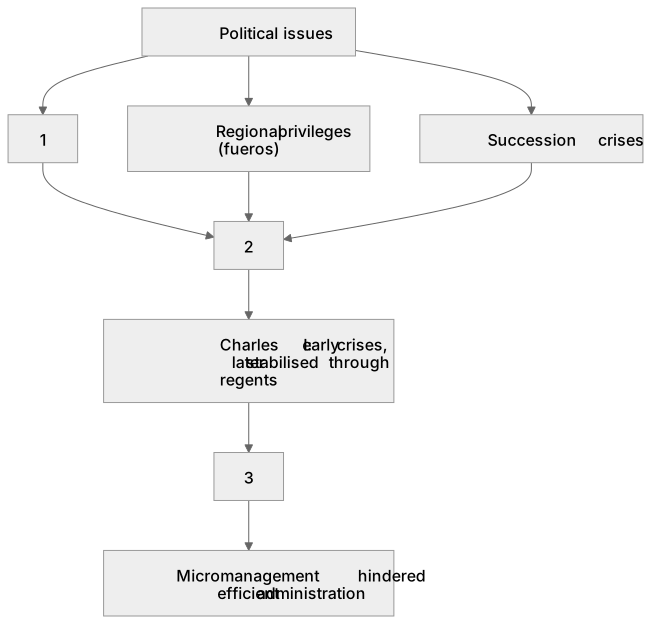
Some boxes have lost their names. Pick the right name for each number.
1Box 1
2Box 2
3Box 3
There is more to this lesson
The full lesson goes on to check your understanding and help you earn the marks. Create a free account to carry on, with your progress saved.
A week of Premium from your first lesson · Then the free plan continues · No card, no charge
Test your understanding of 1B Spain in the Age of Discovery, 1469–1598 (A-level only) – consequence in this period through the following key questions:: What were the political issues and how well did rulers handle them?
Active recall beats re-reading. Take an instant quiz now to test what you’ve learned and lock it into long-term memory.
A week of Premium from your first lesson · Then the free plan continues · No card, no charge