AQA · A-Level · History
Course version: 7042 · Version from Sept 2017
Where did opposition come from and how was it dealt with?
Full specification wording
1B Spain in the Age of Discovery, 1469–1598 (A-level only) – consequence in this period through the following key questions:: Where did opposition come from and how was it dealt with?
This topic examines the origins of opposition to the Spanish crown and evaluates the methods used by monarchs to manage it.
Checked against the AQA 7042 specification (opens in a new tab) on .
- Point 2 of 6
- 4 key terms
Study notes
From the checked teaching notes for this specification point.
The idea
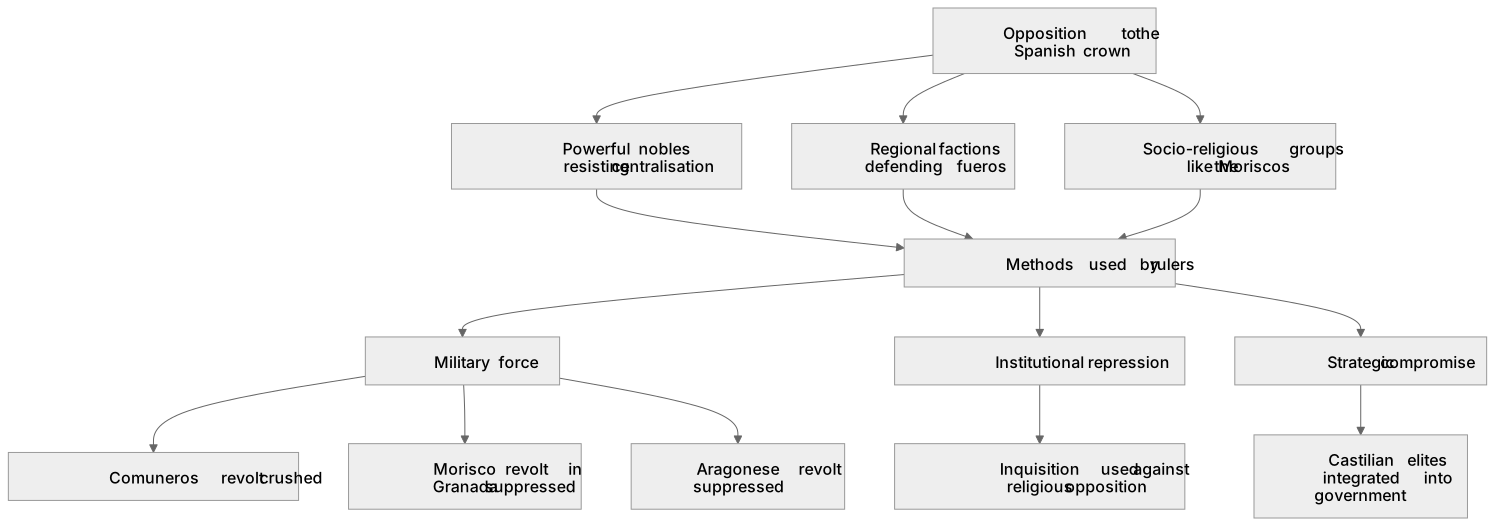
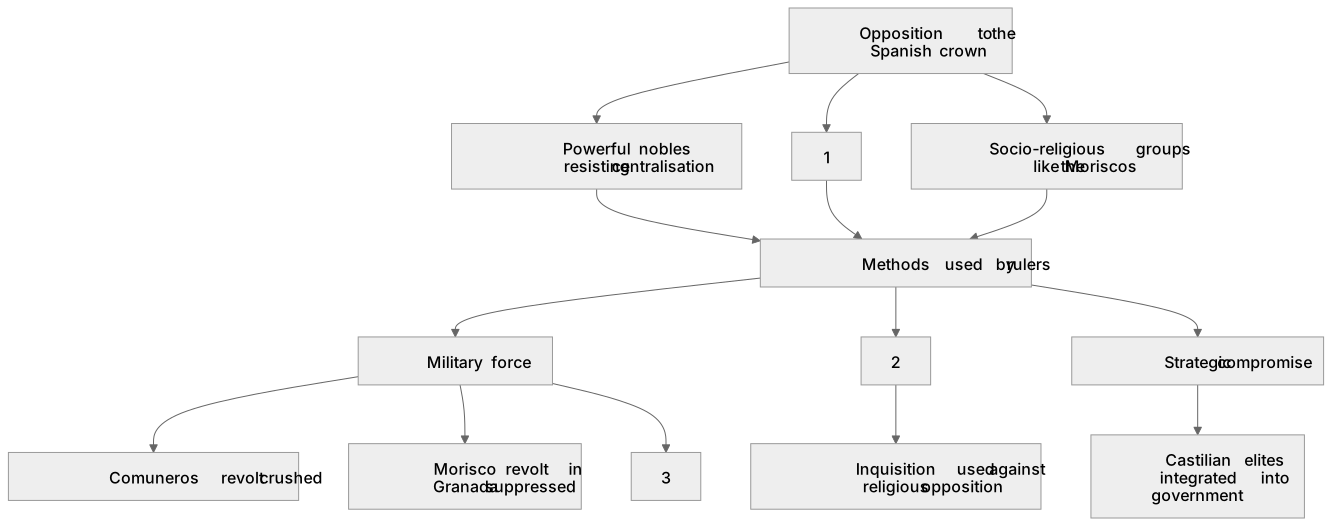
This topic examines the origins of opposition to the Spanish crown and evaluates the methods used by monarchs to manage it. Opposition stemmed from diverse sources: powerful nobles resisting centralisation, regional factions defending traditional privileges (fueros), and socio-religious groups like the Moriscos. Rulers dealt with these threats using military force, institutional repression, and strategic compromise. For example, Charles I crushed the Comuneros revolt militarily but subsequently integrated Castilian elites into his government. Philip II used the Inquisition to root out religious opposition and deployed royal troops to suppress the Morisco revolt in Granada and the Aragonese revolt, demonstrating a harsher approach to dissent.
What earns the marks
- Identify the varied sources of opposition, including the high nobility, regional assemblies (Cortes), and religious minorities.
- Analyse the causes and suppression of major uprisings, such as the Revolt of the Comuneros and the Germania under Charles I.
- Evaluate the use of the Spanish Inquisition as a political and religious tool to deal with opposition from Conversos, Moriscos, and Protestants.
- Assess Philip II's handling of the Morisco Revolt (1568–1571) and the Perez affair leading to the Aragonese Revolt (1591).
- Compare the effectiveness of different methods of dealing with opposition, such as military suppression versus political co-optation.
Common mistakes and how to put them right
Viewing all opposition as religiously motivated.
Put it right: Distinguish between religious dissent (e.g., Protestants) and political/economic opposition (e.g., the Comuneros defending urban privileges).
Assuming the Inquisition was solely a religious institution.
Put it right: Explain how the Crown used the Inquisition as a political weapon to bypass regional fueros and suppress political opponents.
Stating that opposition was entirely eradicated by 1598.
Put it right: Acknowledge that while major revolts were crushed, underlying regional tensions and resentment towards Castilian dominance remained unresolved.
Exam tips
- Categorise opposition into political, economic, and religious strands to structure your essays effectively.
- Compare how different monarchs dealt with opposition; for instance, contrast Charles I's eventual conciliation of Castilian nobles with Philip II's military suppression in Aragon.
- Use specific terminology like 'fueros' (regional laws) and 'letrados' (university-trained lawyers) when explaining why regions opposed centralising monarchs.
Try the lesson
The start of the 1B Spain in the Age of Discovery, 1469–1598 (A-level only) – consequence in this period through the following key questions:: Where did opposition come from and how was it dealt with? lesson, made from checked teaching notes for this specification point.
Have a go first
Where did the primary opposition originate during the Revolt of the Alpujarras (1568–1571), and how did Philip II ultimately deal with it?
Listen
This topic examines the origins of opposition to the Spanish crown and evaluates the methods used by monarchs to manage it. Opposition stemmed from diverse sources: powerful nobles resisting centralisation, regional factions defending traditional privileges (fueros), and socio-religious groups like the Moriscos. Rulers dealt with these threats using military force, institutional repression, and strategic compromise. For example, Charles I crushed the Comuneros revolt militarily but subsequently integrated Castilian elites into his government. Philip II used the Inquisition to root out religious opposition and deployed royal troops to suppress the Morisco revolt in Granada and the Aragonese revolt, demonstrating a harsher approach to dissent. A strong answer earns marks for these points. Identify the varied sources of opposition, including the high nobility, regional assemblies (Cortes), and religious minorities. Analyse the causes and suppression of major uprisings, such as the Revolt of the Comuneros and the Germania under Charles I. Evaluate the use of the Spanish Inquisition as a political and religious tool to deal with opposition from Conversos, Moriscos, and Protestants. Assess Philip II's handling of the Morisco Revolt (1568–1571) and the Perez affair leading to the Aragonese Revolt (1591). A common slip: Viewing all opposition as religiously motivated. Instead, distinguish between religious dissent (e.g., Protestants) and political/economic opposition (e.g., the Comuneros defending urban privileges). Exam tip: Categorise opposition into political, economic, and religious strands to structure your essays effectively.
See it
Key words
Say what each word means before you turn the card.
Regionalism vs. Centralisation
Try answering aloud or in your head before turning the card.
Religious Uniformity
Try answering aloud or in your head before turning the card.
Methods of Repression
Try answering aloud or in your head before turning the card.
Rebellion and Dissent
Try answering aloud or in your head before turning the card.
See every definition
- Regionalism vs. Centralisation
- Powerful nobles resisting centralisation and regional factions defending traditional privileges (fueros) were sources of opposition to the Spanish crown.
- Religious Uniformity
- Philip II used the Inquisition to root out religious opposition from Conversos, Moriscos, and Protestants.
- Methods of Repression
- Rulers dealt with threats using military force, institutional repression, and strategic compromise, including the Inquisition and royal troops.
- Rebellion and Dissent
- Major uprisings such as the Revolt of the Comuneros and the Germania under Charles I were suppressed, though underlying regional tensions remained unresolved.
Label the diagram
Some boxes have lost their names. Pick the right name for each number.
1Box 1
2Box 2
3Box 3
There is more to this lesson
The full lesson goes on to check your understanding and help you earn the marks. Create a free account to carry on, with your progress saved.
A week of Premium from your first lesson · Then the free plan continues · No card, no charge
Test your understanding of 1B Spain in the Age of Discovery, 1469–1598 (A-level only) – consequence in this period through the following key questions:: Where did opposition come from and how was it dealt with?
Active recall beats re-reading. Take an instant quiz now to test what you’ve learned and lock it into long-term memory.
A week of Premium from your first lesson · Then the free plan continues · No card, no charge