AQA · A-Level · History
Course version: 7042 · Version from Sept 2017
The 'Great Power', 1556–1598 (A-level only): Philip’s inheritance and…
Full specification wording
1B Spain in the Age of Discovery, 1469–1598 (A-level only) – Spain: The 'Great Power', 1556–1598 (A-level only): Philip’s inheritance and ambitions; ideas and pressures; the Spanish army and navy
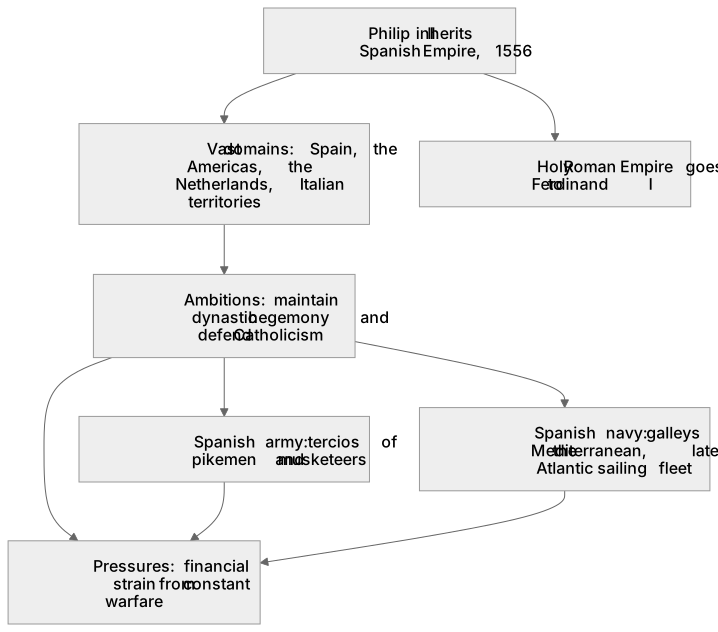
When Philip II inherited the Spanish Empire from Charles V in 1556, his vast domains included Spain, the Americas, the Netherlands, and Italian territories.
Checked against the AQA 7042 specification (opens in a new tab) on .
- Point 1 of 6
- 4 key terms
Study notes
From the checked teaching notes for this specification point.
The idea
When Philip II inherited the Spanish Empire from Charles V in 1556, his vast domains included Spain, the Americas, the Netherlands, and Italian territories. His primary ambitions were to maintain this dynastic hegemony and defend Catholicism against rising Protestantism and the Ottoman Empire. These ideas created immense pressures, particularly financial strain, as defending such dispersed territories required constant warfare. To project power, Philip relied heavily on the Spanish army, renowned for its formidable tercios—highly disciplined professional infantry units combining pikemen and musketeers. Simultaneously, the Spanish navy was crucial for protecting transatlantic silver fleets and countering Ottoman naval dominance in the Mediterranean using oared galleys, before later expanding into a heavy Atlantic sailing fleet to confront England and Dutch rebels.
What earns the marks
- Identify the geographical extent of Philip II's inheritance in 1556, including the division of the Habsburg empire that left him without the Holy Roman Empire.
- Evaluate how Philip's ideological commitment to the Counter-Reformation shaped his foreign policy ambitions.
- Analyse the financial and logistical pressures caused by defending a global empire, leading to multiple state bankruptcies.
- Assess the tactical superiority and organisational structure of the Spanish army, specifically the tercios.
- Explain the dual role of the Spanish navy in securing Mediterranean dominance and protecting the Atlantic convoy system.
Common mistakes and how to put them right
Assuming Philip II inherited the Holy Roman Empire from Charles V.
Put it right: State that the Holy Roman Empire went to Philip's uncle, Ferdinand I, while Philip inherited Spain, the Netherlands, the Americas, and Italian states.
Treating the Spanish navy as solely an Atlantic force.
Put it right: Emphasise that for much of his reign, Philip's naval focus was on Mediterranean galleys fighting the Ottomans, only shifting heavily to the Atlantic later.
Claiming Philip's ambitions were purely expansionist.
Put it right: Recognise that his ambitions were largely defensive, aiming to preserve his inherited territories and protect the Catholic faith.
Exam tips
- Link Philip's financial pressures directly to the immense cost of maintaining the army and navy across multiple fronts simultaneously.
- Use the Battle of Lepanto (1571) as a concrete example of the Spanish navy's effectiveness and Philip's ambition to curb Ottoman pressure.
- When discussing the army, specifically mention the tercios to demonstrate precise knowledge of Spanish military organisation.
Try the lesson
The start of the 1B Spain in the Age of Discovery, 1469–1598 (A-level only) – Spain: The 'Great Power', 1556–1598 (A-level only): Philip’s inheritance and ambitions; ideas and pressures; the Spanish army and navy lesson, made from checked teaching notes for this specification point.
Have a go first
Which of the following territories was excluded from the inheritance Philip II received following the abdication of his father, Charles V?
Listen
When Philip II inherited the Spanish Empire from Charles V in 1556, his vast domains included Spain, the Americas, the Netherlands, and Italian territories. His primary ambitions were to maintain this dynastic hegemony and defend Catholicism against rising Protestantism and the Ottoman Empire. These ideas created immense pressures, particularly financial strain, as defending such dispersed territories required constant warfare. To project power, Philip relied heavily on the Spanish army, renowned for its formidable tercios—highly disciplined professional infantry units combining pikemen and musketeers. Simultaneously, the Spanish navy was crucial for protecting transatlantic silver fleets and countering Ottoman naval dominance in the Mediterranean using oared galleys, before later expanding into a heavy Atlantic sailing fleet to confront England and Dutch rebels. A strong answer earns marks for these points. Identify the geographical extent of Philip II's inheritance in 1556, including the division of the Habsburg empire that left him without the Holy Roman Empire. Evaluate how Philip's ideological commitment to the Counter-Reformation shaped his foreign policy ambitions. Analyse the financial and logistical pressures caused by defending a global empire, leading to multiple state bankruptcies. Assess the tactical superiority and organisational structure of the Spanish army, specifically the tercios. A common slip: Assuming Philip II inherited the Holy Roman Empire from Charles V. Instead, State that the Holy Roman Empire went to Philip's uncle, Ferdinand I, while Philip inherited Spain, the Netherlands, the Americas, and Italian states. Exam tip: Link Philip's financial pressures directly to the immense cost of maintaining the army and navy across multiple fronts simultaneously.
See it
Key words
Say what each word means before you turn the card.
Dynastic inheritance and empire
Try answering aloud or in your head before turning the card.
Religion and the Counter-Reformation
Try answering aloud or in your head before turning the card.
Military and naval power
Try answering aloud or in your head before turning the card.
Economic and logistical overstretch
Try answering aloud or in your head before turning the card.
See every definition
- Dynastic inheritance and empire
- Philip II's vast domains, inherited from Charles V in 1556, included Spain, the Americas, the Netherlands and Italian territories.
- Religion and the Counter-Reformation
- Philip's primary ambition to defend Catholicism against rising Protestantism and the Ottoman Empire, shaping his foreign policy.
- Military and naval power
- Reliance on the Spanish army, renowned for its disciplined tercios of pikemen and musketeers, and on the navy for protecting silver fleets and countering Ottoman dominance.
- Economic and logistical overstretch
- Immense financial strain caused by defending dispersed territories, which required constant warfare.
Label the diagram
Some boxes have lost their names. Pick the right name for each number.
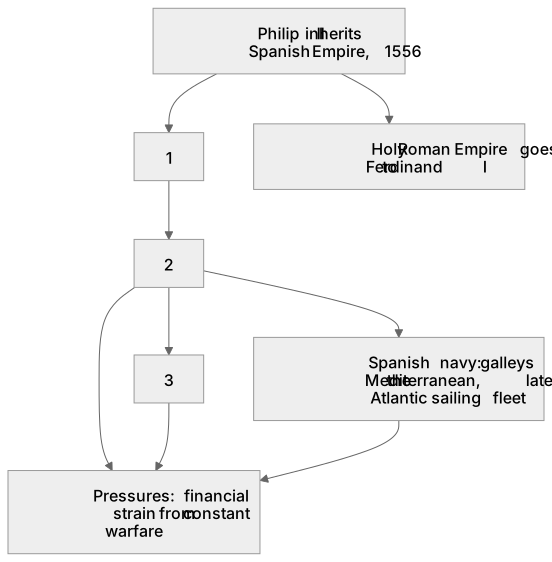
1Box 1
2Box 2
3Box 3
There is more to this lesson
The full lesson goes on to check your understanding and help you earn the marks. Create a free account to carry on, with your progress saved.
A week of Premium from your first lesson · Then the free plan continues · No card, no charge
Test your understanding of 1B Spain in the Age of Discovery, 1469–1598 (A-level only) – Spain: The 'Great Power', 1556–1598 (A-level only): Philip’s inheritance and ambitions; ideas and pressures; the Spanish army and navy
Active recall beats re-reading. Take an instant quiz now to test what you’ve learned and lock it into long-term memory.
A week of Premium from your first lesson · Then the free plan continues · No card, no charge