AQA · A-Level · History
Course version: 7042 · Version from Sept 2017
The 'Great Power', 1556–1598 (A-level only): Spain in the New World:…
Full specification wording
1B Spain in the Age of Discovery, 1469–1598 (A-level only) – Spain: The 'Great Power', 1556–1598 (A-level only): Spain in the New World: expansion, settlement and trade; the impact of empire
Under Philip II, Spain's New World empire saw significant expansion, notably into the Philippines (1565) and further into the Americas.
Checked against the AQA 7042 specification (opens in a new tab) on .
- Point 5 of 6
Study notes
From the checked teaching notes for this specification point.
The idea
Under Philip II, Spain's New World empire saw significant expansion, notably into the Philippines (1565) and further into the Americas. Settlement was consolidated through the establishment of viceroyalties and the encomienda system, which exploited indigenous labour while attempting to spread Catholicism. Trade was strictly monopolised through the Casa de Contratación in Seville, with the annual silver fleets from Potosí and Zacatecas becoming vital to the Spanish economy. The impact of the empire was profound: while bullion funded Philip's European wars, it also triggered severe inflation (the Price Revolution) and stifled domestic industrial development, creating a dangerous reliance on colonial wealth that masked underlying economic weaknesses.
What earns the marks
- Detail the mechanisms of expansion and settlement, such as the role of viceroys in New Spain and Peru.
- Explain the structure of colonial trade, specifically the convoy system (flota) and the monopoly held by Seville.
- Assess the economic impact of the empire on Spain, including the influx of silver and its contribution to the Price Revolution.
- Evaluate the broader impact of the empire, including the demographic collapse of indigenous populations and the funding of Philip II's foreign policies.
Common mistakes and how to put them right
Assuming New World bullion made Spain permanently wealthy.
Put it right: Explain that the influx of silver caused crippling inflation and was quickly spent on foreign wars, leading to multiple bankruptcies.
Confusing the initial conquests of Cortés and Pizarro with Philip II's reign.
Put it right: Focus on the consolidation of settlement, administrative control, and later expansion like the Philippines during Philip II's era.
Ignoring the domestic impact of the empire.
Put it right: Ensure you discuss how reliance on colonial trade stifled domestic Spanish agriculture and manufacturing.
Exam tips
- Use specific examples of administrative control, such as the Council of the Indies, to demonstrate how settlement was managed.
- Link the economic impact of the New World directly to Philip II's ability to conduct his foreign policy in Europe.
- When discussing trade, explicitly mention the Casa de Contratación and the silver fleets to show precise knowledge of economic mechanisms.
Try the lesson
The start of the 1B Spain in the Age of Discovery, 1469–1598 (A-level only) – Spain: The 'Great Power', 1556–1598 (A-level only): Spain in the New World: expansion, settlement and trade; the impact of empire lesson, made from checked teaching notes for this specification point.
Have a go first
What was the primary economic impact of the New World empire on Spain during the reign of Philip II?
Listen
Under Philip II, Spain's New World empire saw significant expansion, notably into the Philippines (1565) and further into the Americas. Settlement was consolidated through the establishment of viceroyalties and the encomienda system, which exploited indigenous labour while attempting to spread Catholicism. Trade was strictly monopolised through the Casa de Contratación in Seville, with the annual silver fleets from Potosí and Zacatecas becoming vital to the Spanish economy. The impact of the empire was profound: while bullion funded Philip's European wars, it also triggered severe inflation (the Price Revolution) and stifled domestic industrial development, creating a dangerous reliance on colonial wealth that masked underlying economic weaknesses. A strong answer earns marks for these points. Detail the mechanisms of expansion and settlement, such as the role of viceroys in New Spain and Peru. Explain the structure of colonial trade, specifically the convoy system (flota) and the monopoly held by Seville. Assess the economic impact of the empire on Spain, including the influx of silver and its contribution to the Price Revolution. Evaluate the broader impact of the empire, including the demographic collapse of indigenous populations and the funding of Philip II's foreign policies. A common slip: Assuming New World bullion made Spain permanently wealthy. Instead, Explain that the influx of silver caused crippling inflation and was quickly spent on foreign wars, leading to multiple bankruptcies. Exam tip: Use specific examples of administrative control, such as the Council of the Indies, to demonstrate how settlement was managed.
See it
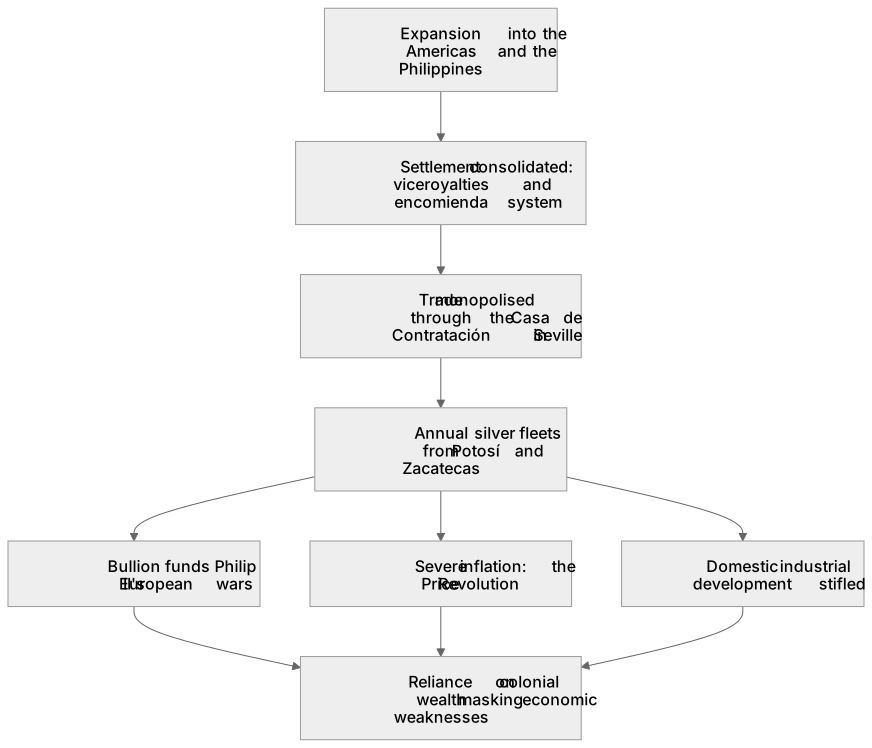
Label the diagram
Some boxes have lost their names. Pick the right name for each number.
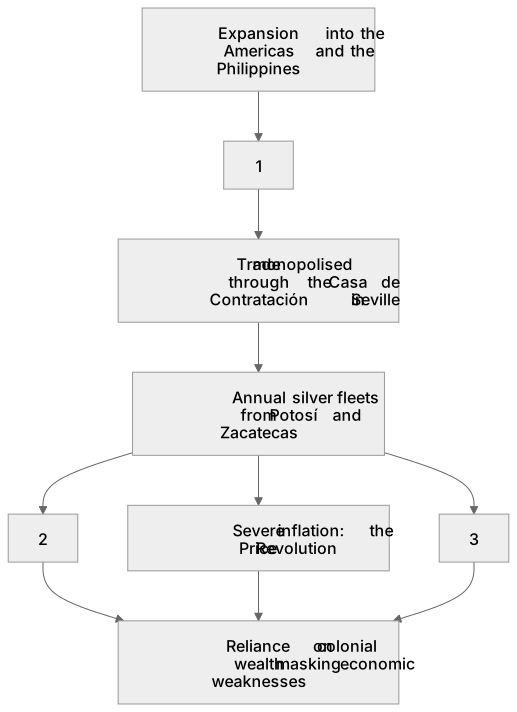
1Box 1
2Box 2
3Box 3
There is more to this lesson
The full lesson goes on to check your understanding and help you earn the marks. Create a free account to carry on, with your progress saved.
A week of Premium from your first lesson · Then the free plan continues · No card, no charge
Test your understanding of 1B Spain in the Age of Discovery, 1469–1598 (A-level only) – Spain: The 'Great Power', 1556–1598 (A-level only): Spain in the New World: expansion, settlement and trade; the impact of empire
Active recall beats re-reading. Take an instant quiz now to test what you’ve learned and lock it into long-term memory.
A week of Premium from your first lesson · Then the free plan continues · No card, no charge