AQA · A-Level · History
Course version: 7042 · Version from Sept 2017
The 'Great Power', 1556–1598 (A-level only): Spain’s international…
Full specification wording
1B Spain in the Age of Discovery, 1469–1598 (A-level only) – Spain: The 'Great Power', 1556–1598 (A-level only): Spain’s international position by 1598: the extent of Spain's power; illusion or reality
By Philip II's death in 1598, Spain's international position appeared formidable, boasting a vast global empire augmented by the 1580 annexation of Portugal.
Checked against the AQA 7042 specification (opens in a new tab) on .
- Point 6 of 6
Study notes
From the checked teaching notes for this specification point.
The idea
By Philip II's death in 1598, Spain's international position appeared formidable, boasting a vast global empire augmented by the 1580 annexation of Portugal. However, historians debate whether the extent of Spain's power was an illusion or reality. In reality, Spain possessed one of the largest empires in history, a formidable infantry (the tercios), and immense New World wealth. Yet, the illusion of absolute dominance was shattered by structural weaknesses: the failure of the 1588 Armada, the intractable Dutch Revolt, and four state bankruptcies (1557, 1560, 1575, 1596).
What earns the marks
- Assess the tangible realities of Spanish power by 1598, including the acquisition of the Portuguese Empire and New World wealth.
- Evaluate the limitations of Spain's military power, referencing the ongoing Dutch Revolt and naval defeats by England.
- Analyse the economic realities behind the illusion of wealth, focusing on the crown's massive debts and the four state bankruptcies (1557, 1560, 1575, 1596).
- Formulate a balanced judgement on whether Spain's hegemonic status in Europe was a genuine reality or a facade masking terminal decline.
Common mistakes and how to put them right
Arguing that the defeat of the Spanish Armada in 1588 completely destroyed Spanish power.
Put it right: Recognise that Spain quickly rebuilt its navy and remained a dominant global power long after 1588.
Treating Spain's economy as robust due to silver imports.
Put it right: Highlight that the crown's expenditure consistently outstripped its income, leading to crippling debt and bankruptcies.
Viewing Spain's international position in isolation.
Put it right: Compare Spain's overstretched resources with the rising, more concentrated power of rivals like France and England.
Exam tips
- Structure your essay around the concepts of 'illusion' and 'reality' to directly address the demands of the specification.
- Use the 1596 bankruptcy as a key piece of evidence to demonstrate the financial reality behind Spain's imperial facade.
- Acknowledge the significance of the Iberian Union (1580) when arguing for the reality of Spain's unprecedented global reach.
Try the lesson
The start of the 1B Spain in the Age of Discovery, 1469–1598 (A-level only) – Spain: The 'Great Power', 1556–1598 (A-level only): Spain’s international position by 1598: the extent of Spain's power; illusion or reality lesson, made from checked teaching notes for this specification point.
Have a go first
Which event in 1598 highlighted the limitations of Spain's international power and marked a shift in its foreign policy?
Listen
By Philip II's death in 1598, Spain's international position appeared formidable, boasting a vast global empire augmented by the 1580 annexation of Portugal. However, historians debate whether the extent of Spain's power was an illusion or reality. In reality, Spain possessed one of the largest empires in history, a formidable infantry (the tercios), and immense New World wealth. Yet, the illusion of absolute dominance was shattered by structural weaknesses: the failure of the 1588 Armada, the intractable Dutch Revolt, and four state bankruptcies (1557, 1560, 1575, 1596). A strong answer earns marks for these points. Assess the tangible realities of Spanish power by 1598, including the acquisition of the Portuguese Empire and New World wealth. Evaluate the limitations of Spain's military power, referencing the ongoing Dutch Revolt and naval defeats by England. Analyse the economic realities behind the illusion of wealth, focusing on the crown's massive debts and the four state bankruptcies (1557, 1560, 1575, 1596). Formulate a balanced judgement on whether Spain's hegemonic status in Europe was a genuine reality or a facade masking terminal decline. A common slip: Arguing that the defeat of the Spanish Armada in 1588 completely destroyed Spanish power. Instead, Recognise that Spain quickly rebuilt its navy and remained a dominant global power long after 1588. Exam tip: Structure your essay around the concepts of 'illusion' and 'reality' to directly address the demands of the specification.
See it
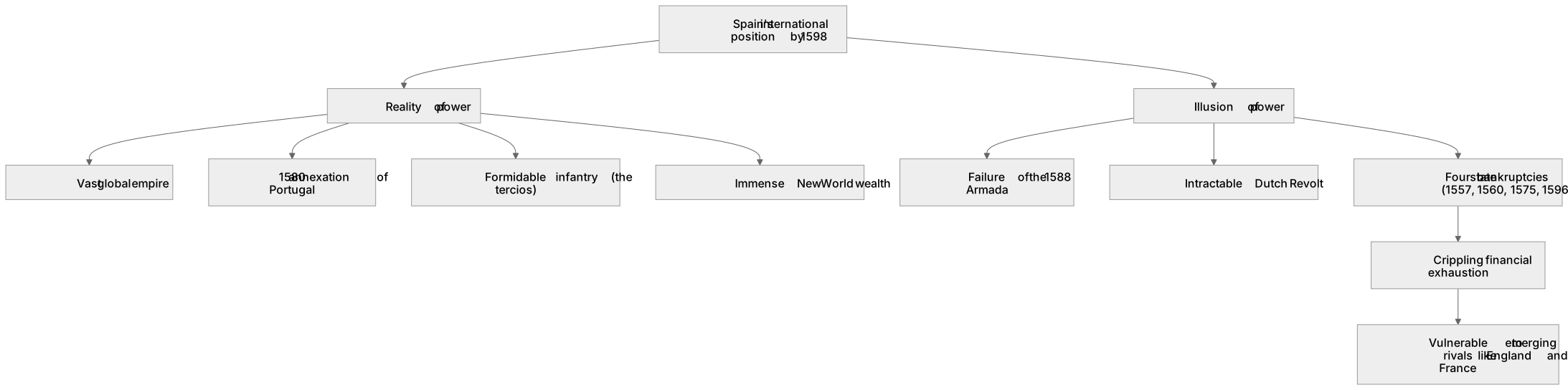
Label the diagram
Some boxes have lost their names. Pick the right name for each number.
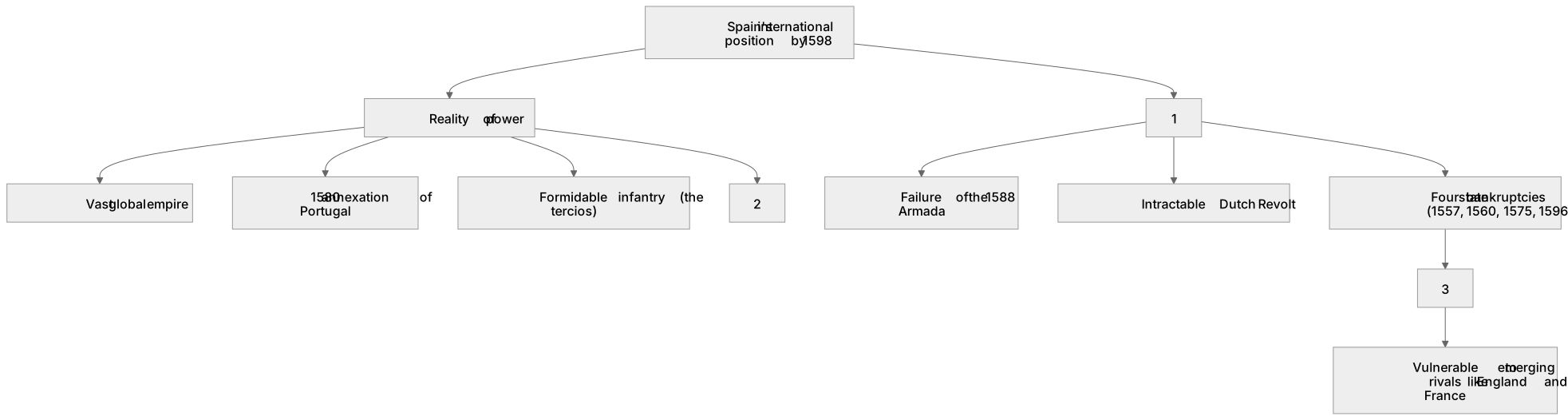
1Box 1
2Box 2
3Box 3
There is more to this lesson
The full lesson goes on to check your understanding and help you earn the marks. Create a free account to carry on, with your progress saved.
A week of Premium from your first lesson · Then the free plan continues · No card, no charge
Test your understanding of 1B Spain in the Age of Discovery, 1469–1598 (A-level only) – Spain: The 'Great Power', 1556–1598 (A-level only): Spain’s international position by 1598: the extent of Spain's power; illusion or reality
Active recall beats re-reading. Take an instant quiz now to test what you’ve learned and lock it into long-term memory.
A week of Premium from your first lesson · Then the free plan continues · No card, no charge