AQA · A-Level · History
Course version: 7042 · Version from Sept 2017
Religious policies and the Church in Spain
Full specification wording
1B Spain in the Age of Discovery, 1469–1598 (A-level only) – The drive to 'Great Power' status, 1516–1556: Religious policies and the Church in Spain
Charles I's religious policies aimed to maintain Catholic orthodoxy and unity within Spain while managing the institutional Church.
Checked against the AQA 7042 specification (opens in a new tab) on .
- Point 4 of 6
- 4 key terms
Study notes
From the checked teaching notes for this specification point.
The idea
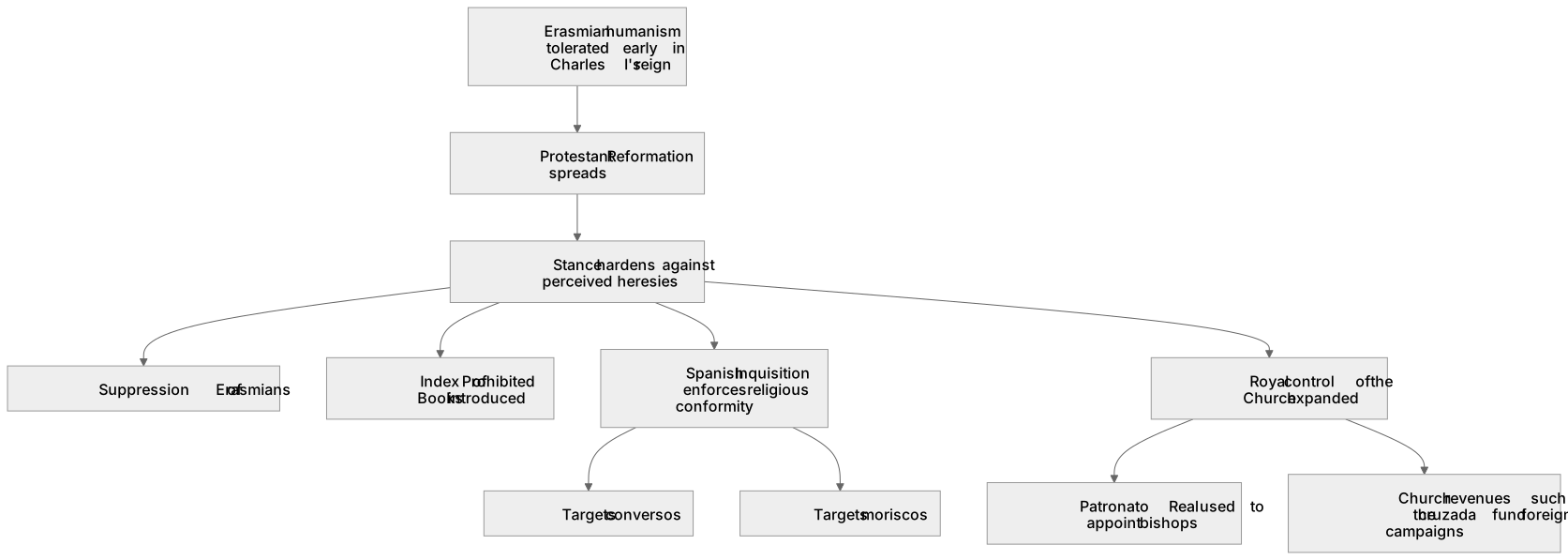
Charles I's religious policies aimed to maintain Catholic orthodoxy and unity within Spain while managing the institutional Church. Initially influenced by Erasmian humanism, Charles's stance hardened against perceived heresies as the Protestant Reformation spread, leading to the suppression of Erasmians and the introduction of the Index of Prohibited Books. The Spanish Inquisition remained a vital tool for enforcing religious conformity, particularly targeting conversos and moriscos. Regarding the Church in Spain, Charles successfully expanded royal control, utilising the Patronato Real to appoint bishops and secure substantial financial contributions from Church revenues, such as the cruzada, to fund his extensive foreign campaigns.
What earns the marks
- Analyse the shifting religious climate in Spain, from the early tolerance of Erasmianism to the strict suppression of Protestant ideas.
- Evaluate the role and effectiveness of the Spanish Inquisition in enforcing religious uniformity among conversos and moriscos.
- Assess the extent of royal control over the Spanish Church, focusing on the Patronato Real and the appointment of clergy.
- Examine the financial relationship between the Crown and the Church, including the extraction of revenues like the cruzada and subsidio.
Common mistakes and how to put them right
Assuming Spain was immediately hostile to all reformist ideas.
Put it right: Recognise that Erasmianism was popular and tolerated in the early years of Charles's reign before the Protestant threat escalated.
Treating the Spanish Church and the Papacy as identical interests.
Put it right: Highlight the tensions between Charles and the Pope, and Charles's efforts to secure independent royal control over the Spanish Church.
Overstating the immediate threat of Protestantism in Spain.
Put it right: Note that actual Protestant numbers in Spain were tiny, but the fear of heresy drove disproportionately harsh policies.
Exam tips
- Demonstrate how Charles used the Church not just for religious unity, but as a crucial source of state revenue to fund his wars.
- Contrast the treatment of different minority groups, such as the conversos and moriscos, to provide a nuanced view of the Inquisition's focus.
- Connect domestic religious policies to the wider European context of the Protestant Reformation to explain the hardening of attitudes in Spain.
Try the lesson
The start of the 1B Spain in the Age of Discovery, 1469–1598 (A-level only) – The drive to 'Great Power' status, 1516–1556: Religious policies and the Church in Spain lesson, made from checked teaching notes for this specification point.
Have a go first
Which religious group in Spain was targeted by the Inquisition during the 1520s for their mystical beliefs, which authorities feared bypassed the traditional Church hierarchy?
Listen
Charles I's religious policies aimed to maintain Catholic orthodoxy and unity within Spain while managing the institutional Church. Initially influenced by Erasmian humanism, Charles's stance hardened against perceived heresies as the Protestant Reformation spread, leading to the suppression of Erasmians and the introduction of the Index of Prohibited Books. The Spanish Inquisition remained a vital tool for enforcing religious conformity, particularly targeting conversos and moriscos. Regarding the Church in Spain, Charles successfully expanded royal control, utilising the Patronato Real to appoint bishops and secure substantial financial contributions from Church revenues, such as the cruzada, to fund his extensive foreign campaigns. A strong answer earns marks for these points. Analyse the shifting religious climate in Spain, from the early tolerance of Erasmianism to the strict suppression of Protestant ideas. Evaluate the role and effectiveness of the Spanish Inquisition in enforcing religious uniformity among conversos and moriscos. Assess the extent of royal control over the Spanish Church, focusing on the Patronato Real and the appointment of clergy. Examine the financial relationship between the Crown and the Church, including the extraction of revenues like the cruzada and subsidio. A common slip: Assuming Spain was immediately hostile to all reformist ideas. Instead, recognise that Erasmianism was popular and tolerated in the early years of Charles's reign before the Protestant threat escalated. Exam tip: Demonstrate how Charles used the Church not just for religious unity, but as a crucial source of state revenue to fund his wars.
See it
Key words
Say what each word means before you turn the card.
Religious uniformity
Try answering aloud or in your head before turning the card.
Royal patronage
Try answering aloud or in your head before turning the card.
The Inquisition
Try answering aloud or in your head before turning the card.
Erasmianism and reform
Try answering aloud or in your head before turning the card.
See every definition
- Religious uniformity
- Enforcing religious conformity among conversos and moriscos, with the Spanish Inquisition remaining a vital tool for this purpose.
- Royal patronage
- Expanding royal control over the Church in Spain by utilising the Patronato Real to appoint bishops.
- The Inquisition
- A vital tool for enforcing religious conformity, particularly targeting conversos and moriscos.
- Erasmianism and reform
- Initially popular and tolerated in the early years of Charles's reign before the Protestant threat escalated, later suppressed as his stance hardened against perceived heresies.
Label the diagram
Some boxes have lost their names. Pick the right name for each number.
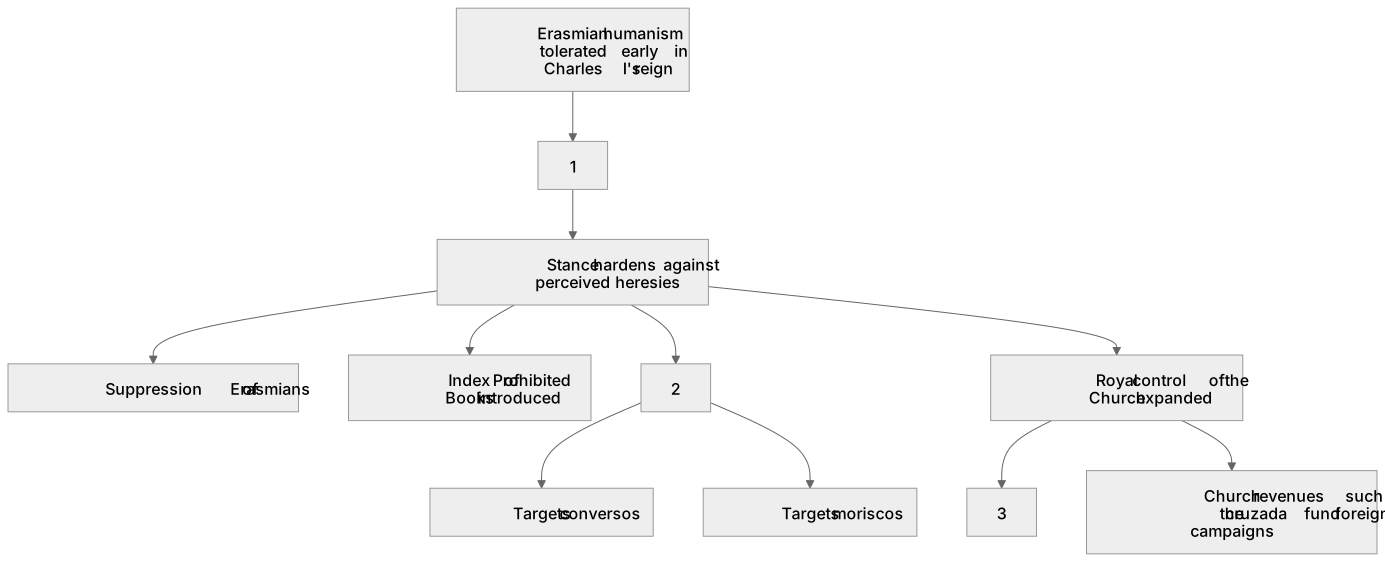
1Box 1
2Box 2
3Box 3
There is more to this lesson
The full lesson goes on to check your understanding and help you earn the marks. Create a free account to carry on, with your progress saved.
A week of Premium from your first lesson · Then the free plan continues · No card, no charge
Test your understanding of 1B Spain in the Age of Discovery, 1469–1598 (A-level only) – The drive to 'Great Power' status, 1516–1556: Religious policies and the Church in Spain
Active recall beats re-reading. Take an instant quiz now to test what you’ve learned and lock it into long-term memory.
A week of Premium from your first lesson · Then the free plan continues · No card, no charge