AQA · A-Level · History
Course version: 7042 · Version from Sept 2017
The expansion of Empire: the conquistadores; economic and social impact of…
Full specification wording
1B Spain in the Age of Discovery, 1469–1598 (A-level only) – The drive to 'Great Power' status, 1516–1556: The expansion of Empire: the conquistadores; economic and social impact of the New World on Spain
The expansion of the Spanish Empire under Charles I (V) was driven by the conquistadores, notably Hernán Cortés in Mexico (1519–1521) and Francisco Pizarro in Peru (1532).
Checked against the AQA 7042 specification (opens in a new tab) on .
- Point 5 of 6
- 2 key terms
Study notes
From the checked teaching notes for this specification point.
The idea
The expansion of the Spanish Empire under Charles I (V) was driven by the conquistadores, notably Hernán Cortés in Mexico (1519–1521) and Francisco Pizarro in Peru (1532). These campaigns vastly expanded Spanish territories, bringing immense wealth. The economic impact on Spain was profound but complex; the influx of silver from mines like Potosí funded Charles's European wars but also triggered severe inflation, known as the Price Revolution, which damaged domestic industries. Socially, the New World offered opportunities for social mobility, allowing impoverished nobles (hidalgos) to achieve wealth and status. However, it also led to emigration that drained Spain of skilled labour and exacerbated domestic poverty as living costs soared.
What earns the marks
- Identify the key conquistadores, such as Cortés and Pizarro, and their role in expanding the Spanish Empire in the Americas.
- Explain the economic consequences of bullion imports, specifically how silver funded imperial ambitions but caused the Price Revolution.
- Analyse the negative impact of New World wealth on domestic Spanish agriculture and manufacturing, which struggled to compete.
- Evaluate the social impact, including the emigration of hidalgos seeking upward mobility and the widening gap between rich and poor in Spain.
Common mistakes and how to put them right
Assuming New World wealth made Spain universally prosperous.
Put it right: In reality, it caused severe inflation that harmed the domestic economy and the poorest citizens.
Confusing the timeline of the conquistadores.
Put it right: Cortés conquered the Aztecs in the 1520s, whereas Pizarro conquered the Incas in the 1530s.
Stating that all bullion remained in Spain.
Put it right: Much of it immediately left the country to pay foreign bankers for Charles V's European wars.
Exam tips
- Use specific examples of conquistadores and their conquests to illustrate the rapid pace of imperial expansion.
- Link the influx of New World silver directly to Charles V's ability to sustain his costly foreign policies in Europe.
- When discussing social impact, contrast the opportunities for individual hidalgos with the broader demographic drain on Castile.
Try the lesson
The start of the 1B Spain in the Age of Discovery, 1469–1598 (A-level only) – The drive to 'Great Power' status, 1516–1556: The expansion of Empire: the conquistadores; economic and social impact of the New World on Spain lesson, made from checked teaching notes for this specification point.
Have a go first
Which conquistador led the expedition that resulted in the fall of the Aztec Empire during the reign of Charles I?
Listen
The expansion of the Spanish Empire under Charles I (V) was driven by the conquistadores, notably Hernán Cortés in Mexico (1519–1521) and Francisco Pizarro in Peru (1532). These campaigns vastly expanded Spanish territories, bringing immense wealth. The economic impact on Spain was profound but complex; the influx of silver from mines like Potosí funded Charles's European wars but also triggered severe inflation, known as the Price Revolution, which damaged domestic industries. Socially, the New World offered opportunities for social mobility, allowing impoverished nobles (hidalgos) to achieve wealth and status. However, it also led to emigration that drained Spain of skilled labour and exacerbated domestic poverty as living costs soared. A strong answer earns marks for these points. Identify the key conquistadores, such as Cortés and Pizarro, and their role in expanding the Spanish Empire in the Americas. Explain the economic consequences of bullion imports, specifically how silver funded imperial ambitions but caused the Price Revolution. Analyse the negative impact of New World wealth on domestic Spanish agriculture and manufacturing, which struggled to compete. Evaluate the social impact, including the emigration of hidalgos seeking upward mobility and the widening gap between rich and poor in Spain. Exam tip: Use specific examples of conquistadores and their conquests to illustrate the rapid pace of imperial expansion.
See it
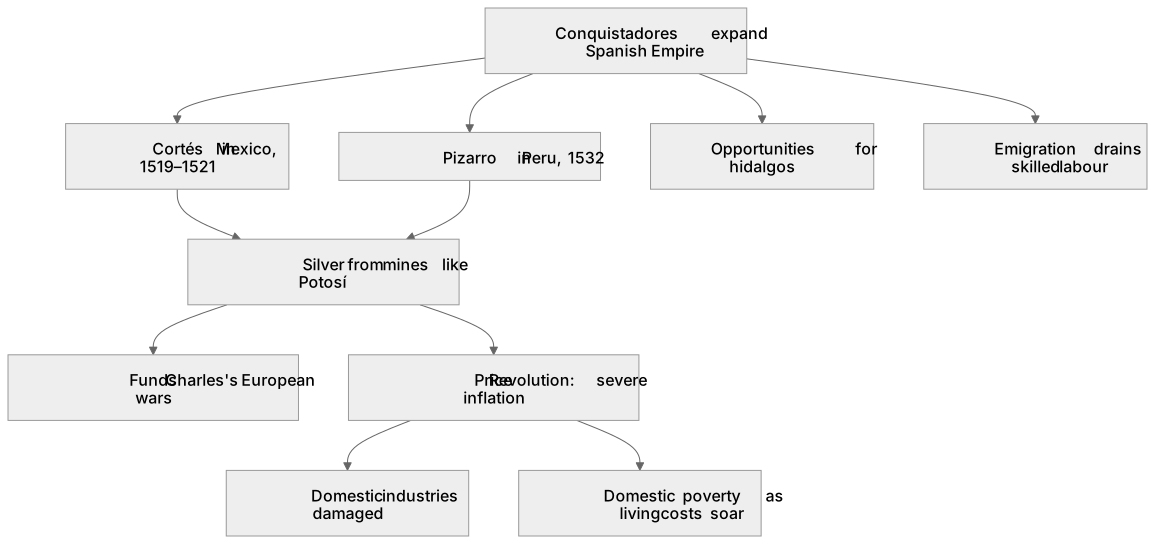
Key words
Say what each word means before you turn the card.
Conquistadores
Try answering aloud or in your head before turning the card.
Price Revolution
Try answering aloud or in your head before turning the card.
See every definition
- Conquistadores
- The men who drove the expansion of the Spanish Empire, notably Hernán Cortés in Mexico and Francisco Pizarro in Peru.
- Price Revolution
- Severe inflation triggered by the influx of silver from mines like Potosí, which damaged domestic industries.
Label the diagram
Some boxes have lost their names. Pick the right name for each number.
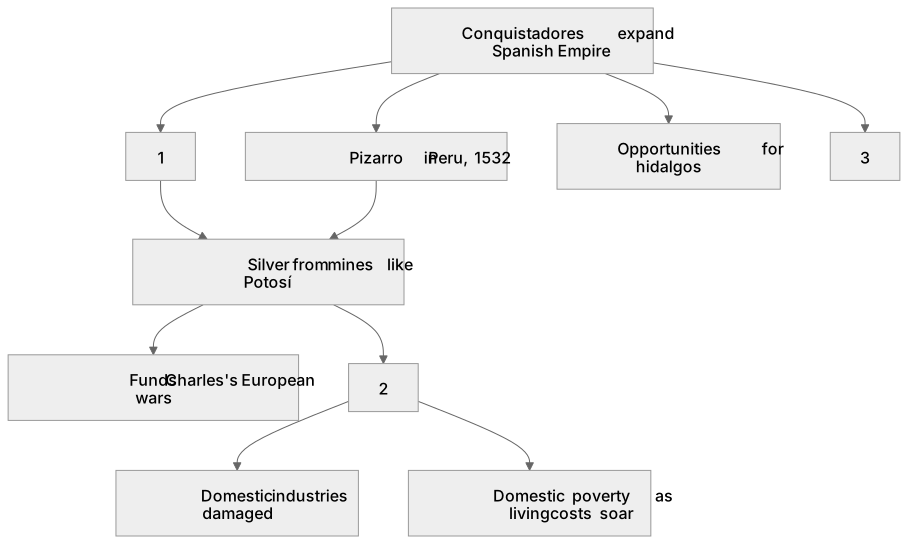
1Box 1
2Box 2
3Box 3
There is more to this lesson
The full lesson goes on to check your understanding and help you earn the marks. Create a free account to carry on, with your progress saved.
A week of Premium from your first lesson · Then the free plan continues · No card, no charge
Test your understanding of 1B Spain in the Age of Discovery, 1469–1598 (A-level only) – The drive to 'Great Power' status, 1516–1556: The expansion of Empire: the conquistadores; economic and social impact of the New World on Spain
Active recall beats re-reading. Take an instant quiz now to test what you’ve learned and lock it into long-term memory.
A week of Premium from your first lesson · Then the free plan continues · No card, no charge