AQA · A-Level · History
Course version: 7042 · Version from Sept 2017
Muslims/Moriscos; the Reconquista; Jews/conversos and anti-Semitism
Full specification wording
1B Spain in the Age of Discovery, 1469–1598 (A-level only) – The forging of a new state, 1469–1516: Muslims/Moriscos; the Reconquista; Jews/conversos and anti-Semitism
The drive for religious uniformity profoundly shaped the new Spanish state.
Checked against the AQA 7042 specification (opens in a new tab) on .
- Point 4 of 6
- 4 key terms
Study notes
From the checked teaching notes for this specification point.
The idea
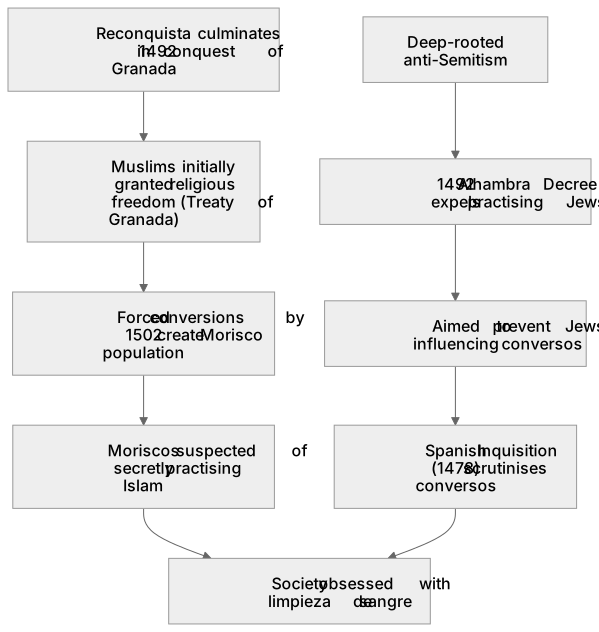
The drive for religious uniformity profoundly shaped the new Spanish state. The Reconquista culminated in the 1492 conquest of Granada, ending Islamic rule. Initially granted religious freedom, Muslims faced forced conversions by 1502, creating a marginalised Morisco population suspected of secretly practising Islam. Concurrently, deep-rooted anti-Semitism led to the 1492 Alhambra Decree, expelling all practising Jews. This policy aimed to prevent them from influencing conversos (Jewish converts to Christianity). Conversos faced intense scrutiny from the Spanish Inquisition, established in 1478, which investigated claims of false conversion. These policies created a society obsessed with limpieza de sangre (purity of blood).
What earns the marks
- Analyse the motivations behind the completion of the Reconquista and its impact on the Muslim population of Granada.
- Evaluate the transition of royal policy from the initial toleration of Muslims (Treaty of Granada) to forced conversions and the creation of the Morisco problem.
- Assess the role of anti-Semitism and the desire for religious uniformity in the decision to expel the Jews in 1492.
- Examine the establishment and function of the Spanish Inquisition in targeting conversos suspected of secretly practising Judaism.
Common mistakes and how to put them right
Using 'Muslims' and 'Moriscos' interchangeably.
Put it right: Use 'Muslims' for the period before forced conversion and 'Moriscos' for those who converted to Christianity (often nominally) after 1502.
Stating the Inquisition was established to persecute practising Jews.
Put it right: Clarify that the Inquisition only had jurisdiction over baptised Christians, specifically targeting conversos suspected of heresy.
Viewing the Reconquista solely as a religious crusade.
Put it right: Acknowledge the political and economic motivations, such as acquiring land and consolidating royal power, alongside the religious rhetoric.
Exam tips
- Link the expulsion of the Jews and the forced conversion of Muslims to the broader theme of Ferdinand and Isabella's state-building and the pursuit of religious unity.
- Use the concept of limpieza de sangre (purity of blood) to explain the long-term social marginalisation of both conversos and Moriscos.
- When evaluating the impact of the 1492 expulsions, consider the economic consequences of losing skilled Jewish administrators, merchants, and artisans.
Try the lesson
The start of the 1B Spain in the Age of Discovery, 1469–1598 (A-level only) – The forging of a new state, 1469–1516: Muslims/Moriscos; the Reconquista; Jews/conversos and anti-Semitism lesson, made from checked teaching notes for this specification point.
Have a go first
Which event in 1492 marked the successful conclusion of the Reconquista by Ferdinand and Isabella?
Listen
The drive for religious uniformity profoundly shaped the new Spanish state. The Reconquista culminated in the 1492 conquest of Granada, ending Islamic rule. Initially granted religious freedom, Muslims faced forced conversions by 1502, creating a marginalised Morisco population suspected of secretly practising Islam. Concurrently, deep-rooted anti-Semitism led to the 1492 Alhambra Decree, expelling all practising Jews. This policy aimed to prevent them from influencing conversos (Jewish converts to Christianity). Conversos faced intense scrutiny from the Spanish Inquisition, established in 1478, which investigated claims of false conversion. These policies created a society obsessed with limpieza de sangre (purity of blood). A strong answer earns marks for these points. Analyse the motivations behind the completion of the Reconquista and its impact on the Muslim population of Granada. Evaluate the transition of royal policy from the initial toleration of Muslims (Treaty of Granada) to forced conversions and the creation of the Morisco problem. Assess the role of anti-Semitism and the desire for religious uniformity in the decision to expel the Jews in 1492. Examine the establishment and function of the Spanish Inquisition in targeting conversos suspected of secretly practising Judaism. A common slip: Using 'Muslims' and 'Moriscos' interchangeably. Instead, use 'Muslims' for the period before forced conversion and 'Moriscos' for those who converted to Christianity (often nominally) after 1502. Exam tip: Link the expulsion of the Jews and the forced conversion of Muslims to the broader theme of Ferdinand and Isabella's state-building and the pursuit of religious unity.
See it
Put the events in order
Put these events in the order they happened, earliest first.
- 1. The Spanish Inquisition was established
- 2. Muslims faced forced conversions
- 3. The conquest of Granada ended Islamic rule
Key words
Say what each word means before you turn the card.
Religious uniformity and intolerance
Try answering aloud or in your head before turning the card.
State-building and the Reconquista
Try answering aloud or in your head before turning the card.
Social marginalisation and persecution
Try answering aloud or in your head before turning the card.
The role of the Inquisition
Try answering aloud or in your head before turning the card.
See every definition
- Religious uniformity and intolerance
- A drive that profoundly shaped the new Spanish state, seen in forced conversions, expulsions and scrutiny of converts.
- State-building and the Reconquista
- The Reconquista culminated in the 1492 conquest of Granada, ending Islamic rule, alongside political and economic motivations such as acquiring land and consolidating royal power.
- Social marginalisation and persecution
- Muslims faced forced conversions by 1502, creating a marginalised Morisco population, while conversos faced intense scrutiny from the Spanish Inquisition.
- The role of the Inquisition
- Established in 1478, it investigated claims of false conversion, targeting conversos suspected of heresy.
Label the diagram
Some boxes have lost their names. Pick the right name for each number.
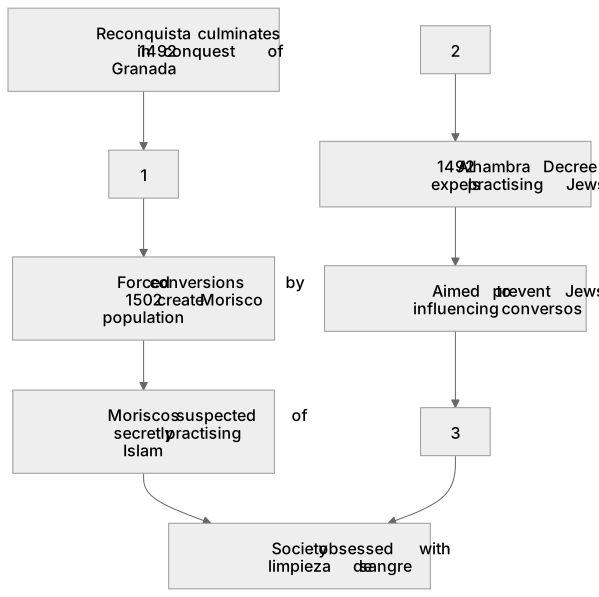
1Box 1
2Box 2
3Box 3
There is more to this lesson
The full lesson goes on to check your understanding and help you earn the marks. Create a free account to carry on, with your progress saved.
A week of Premium from your first lesson · Then the free plan continues · No card, no charge
Test your understanding of 1B Spain in the Age of Discovery, 1469–1598 (A-level only) – The forging of a new state, 1469–1516: Muslims/Moriscos; the Reconquista; Jews/conversos and anti-Semitism
Active recall beats re-reading. Take an instant quiz now to test what you’ve learned and lock it into long-term memory.
A week of Premium from your first lesson · Then the free plan continues · No card, no charge