AQA · A-Level · History
Course version: 7042 · Version from Sept 2017
Economic stagnation and change: trade and exploration in Europe and North…
Full specification wording
1B Spain in the Age of Discovery, 1469–1598 (A-level only) – The forging of a new state, 1469–1516: Economic stagnation and change: trade and exploration in Europe and North Africa; discovery and first settlements in the New World
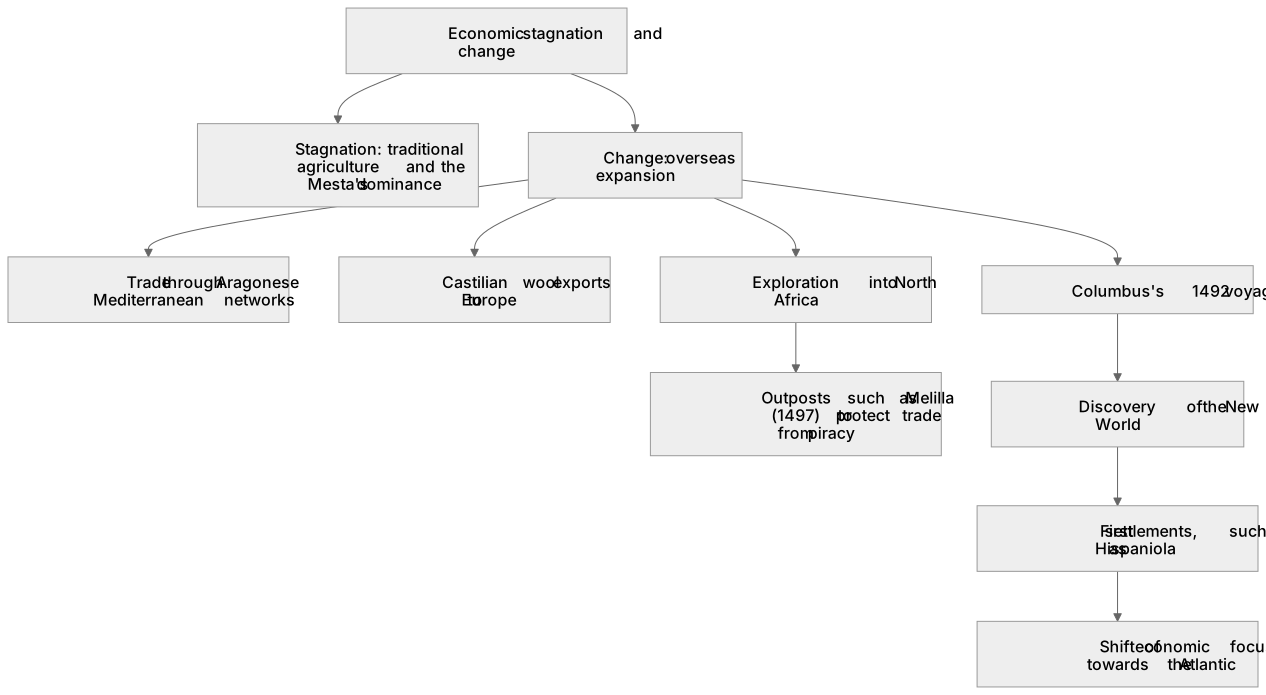
Under Ferdinand and Isabella, Spain's economy saw both stagnation, rooted in traditional agriculture and the Mesta's dominance, and dynamic change via overseas expansion.
Checked against the AQA 7042 specification (opens in a new tab) on .
- Point 5 of 6
Study notes
From the checked teaching notes for this specification point.
The idea
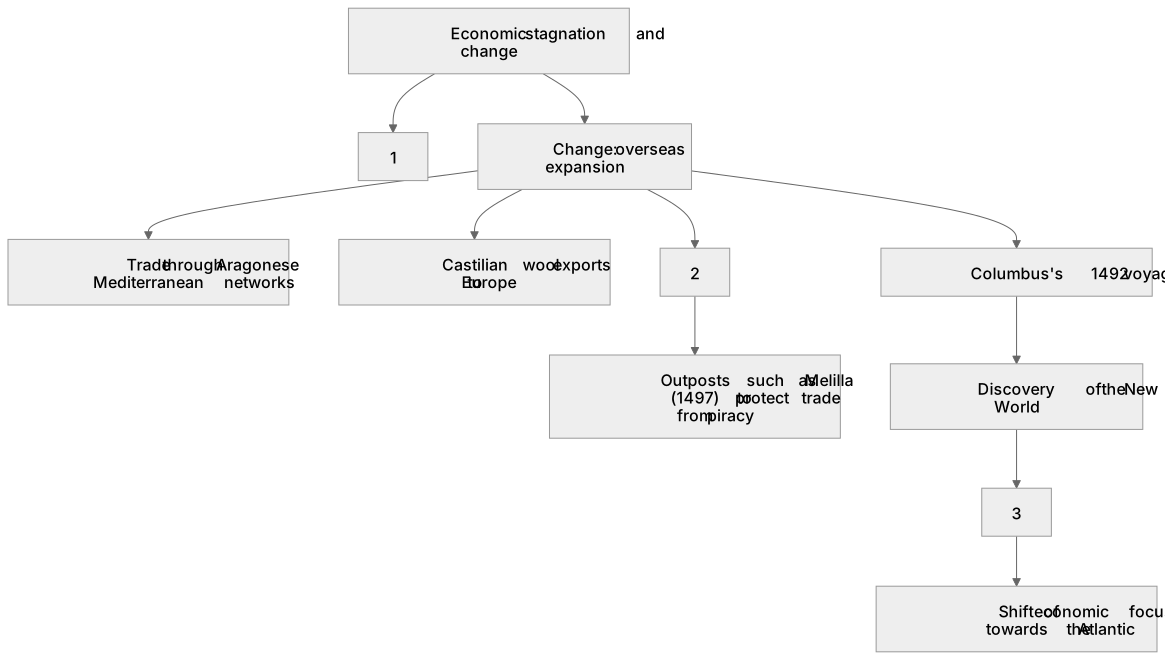
Under Ferdinand and Isabella, Spain's economy saw both stagnation, rooted in traditional agriculture and the Mesta's dominance, and dynamic change via overseas expansion. While domestic industries struggled, trade flourished through Aragonese Mediterranean networks and Castilian wool exports to Europe. Exploration expanded into North Africa, securing outposts like Melilla (1497) to protect trade from piracy. Simultaneously, Columbus's 1492 voyage initiated the discovery of the New World. The establishment of the first settlements, such as Hispaniola, shifted Spain's economic focus towards the Atlantic. This laid the foundations for a global empire and future wealth extraction, despite initial economic returns being modest before 1516.
What earns the marks
- Assess the impact of the Mesta on domestic agricultural stagnation versus the profitability of the wool trade with Flanders.
- Evaluate the strategic and economic motives for North African exploration, including the capture of Melilla and Oran to secure Mediterranean trade routes.
- Analyze the significance of Columbus's voyages and the Treaty of Tordesillas (1494) in establishing a Spanish monopoly in the New World.
- Examine the economic realities of the first New World settlements, noting that early returns from Hispaniola were limited compared to later bullion imports.
Common mistakes and how to put them right
Assuming the New World provided massive wealth immediately after 1492.
Put it right: Note that significant bullion imports did not begin until after 1516; early settlements were economically precarious.
Ignoring Spanish activity in North Africa.
Put it right: Include the conquest of North African outposts like Melilla as crucial for protecting Mediterranean trade and continuing the Reconquista.
Treating the Spanish economy as entirely transformed by 1516.
Put it right: Emphasise the ongoing economic stagnation in domestic agriculture and manufacturing, which remained underdeveloped.
Exam tips
- Contrast the traditional, stagnant domestic economy with the dynamic, expanding overseas trade networks to build a nuanced argument.
- Use specific examples of North African outposts, such as Melilla or Tripoli, to demonstrate knowledge of Mediterranean exploration.
- When discussing the New World, distinguish between the initial discovery phase and the later establishment of permanent administrative settlements.
Try the lesson
The start of the 1B Spain in the Age of Discovery, 1469–1598 (A-level only) – The forging of a new state, 1469–1516: Economic stagnation and change: trade and exploration in Europe and North Africa; discovery and first settlements in the New World lesson, made from checked teaching notes for this specification point.
Have a go first
Which of the following best describes the initial Spanish settlements established in the New World by 1516?
Listen
Under Ferdinand and Isabella, Spain's economy saw both stagnation, rooted in traditional agriculture and the Mesta's dominance, and dynamic change via overseas expansion. While domestic industries struggled, trade flourished through Aragonese Mediterranean networks and Castilian wool exports to Europe. Exploration expanded into North Africa, securing outposts like Melilla (1497) to protect trade from piracy. Simultaneously, Columbus's 1492 voyage initiated the discovery of the New World. The establishment of the first settlements, such as Hispaniola, shifted Spain's economic focus towards the Atlantic. This laid the foundations for a global empire and future wealth extraction, despite initial economic returns being modest before 1516. A strong answer earns marks for these points. Assess the impact of the Mesta on domestic agricultural stagnation versus the profitability of the wool trade with Flanders. Evaluate the strategic and economic motives for North African exploration, including the capture of Melilla and Oran to secure Mediterranean trade routes. Analyze the significance of Columbus's voyages and the Treaty of Tordesillas (1494) in establishing a Spanish monopoly in the New World. Examine the economic realities of the first New World settlements, noting that early returns from Hispaniola were limited compared to later bullion imports. A common slip: Assuming the New World provided massive wealth immediately after 1492. Instead, Note that significant bullion imports did not begin until after 1516; early settlements were economically precarious. Exam tip: Contrast the traditional, stagnant domestic economy with the dynamic, expanding overseas trade networks to build a nuanced argument.
See it
Put the events in order
Put these events in the order they happened, earliest first.
- 1. Columbus's voyage initiated the discovery of the New World
- 2. Capture of Melilla secured Mediterranean trade routes
- 3. Treaty of Tordesillas established a Spanish monopoly in the New World
Label the diagram
Some boxes have lost their names. Pick the right name for each number.
1Box 1
2Box 2
3Box 3
There is more to this lesson
The full lesson goes on to check your understanding and help you earn the marks. Create a free account to carry on, with your progress saved.
A week of Premium from your first lesson · Then the free plan continues · No card, no charge
Test your understanding of 1B Spain in the Age of Discovery, 1469–1598 (A-level only) – The forging of a new state, 1469–1516: Economic stagnation and change: trade and exploration in Europe and North Africa; discovery and first settlements in the New World
Active recall beats re-reading. Take an instant quiz now to test what you’ve learned and lock it into long-term memory.
A week of Premium from your first lesson · Then the free plan continues · No card, no charge