AQA · A-Level · History
Course version: 7042 · Version from Sept 2017
The degree of political unity and social and economic change by 1516
Full specification wording
1B Spain in the Age of Discovery, 1469–1598 (A-level only) – The forging of a new state, 1469–1516: The degree of political unity and social and economic change by 1516
By 1516, Spain remained a dynastic union rather than a fully unified nation.
Checked against the AQA 7042 specification (opens in a new tab) on .
- Point 6 of 6
- 4 key terms
Study notes
From the checked teaching notes for this specification point.
The idea
By 1516, Spain remained a dynastic union rather than a fully unified nation. Political unity was limited; Castile and Aragon retained distinct laws, cortes, and taxation, though the monarchy centralised power via the Santa Hermandad and royal councils. Social change was driven by religious uniformity, notably the 1492 expulsion of the Jews and forced conversion of Muslims, creating a society obsessed with 'purity of blood'. Economic change was mixed; while overseas trade and the wool industry expanded, domestic agriculture stagnated under the Mesta's privileges. The state forged by the Catholic Monarchs achieved significant religious authority, but lacked deep structural integration across its kingdoms.
What earns the marks
- Evaluate the extent of political unity, contrasting the shared monarchical authority with the survival of distinct regional laws and institutions (fueros).
- Analyse the social impact of religious policies, including the Inquisition and the expulsion of minorities, on the demographic and cultural landscape.
- Assess the degree of economic change, weighing the growth of the Mesta and overseas trade against the stagnation of domestic agriculture and manufacturing.
- Synthesise the overall state of Spain in 1516, judging whether the Catholic Monarchs created a 'new state' or merely a personal union of crowns.
Common mistakes and how to put them right
Stating that Ferdinand and Isabella created a fully unified, modern nation-state.
Put it right: Emphasise that Spain remained a collection of separate kingdoms with their own distinct laws, customs, and institutions.
Overstating the economic transformation by 1516.
Put it right: Acknowledge that while trade expanded, the fundamental economic structure remained agrarian and heavily reliant on raw wool exports.
Ignoring the social consequences of religious policy.
Put it right: Explicitly link the drive for religious unity (Inquisition, expulsions) to significant social changes, such as the loss of the conversos' economic expertise.
Exam tips
- Use the concept of a 'dynastic union' to accurately describe the political relationship between Castile and Aragon.
- When evaluating change, always establish a baseline (the situation in 1469) to measure the extent of progress by 1516.
- Link social and economic changes together, for example, by discussing how the expulsion of the Jews impacted Spain's financial and mercantile sectors.
Try the lesson
The start of the 1B Spain in the Age of Discovery, 1469–1598 (A-level only) – The forging of a new state, 1469–1516: The degree of political unity and social and economic change by 1516 lesson, made from checked teaching notes for this specification point.
Have a go first
Which of the following best characterises the political unity of Spain at the time of Ferdinand's death in 1516?
Listen
By 1516, Spain remained a dynastic union rather than a fully unified nation. Political unity was limited; Castile and Aragon retained distinct laws, cortes, and taxation, though the monarchy centralised power via the Santa Hermandad and royal councils. Social change was driven by religious uniformity, notably the 1492 expulsion of the Jews and forced conversion of Muslims, creating a society obsessed with 'purity of blood'. Economic change was mixed; while overseas trade and the wool industry expanded, domestic agriculture stagnated under the Mesta's privileges. The state forged by the Catholic Monarchs achieved significant religious authority, but lacked deep structural integration across its kingdoms. A strong answer earns marks for these points. Evaluate the extent of political unity, contrasting the shared monarchical authority with the survival of distinct regional laws and institutions (fueros). Analyse the social impact of religious policies, including the Inquisition and the expulsion of minorities, on the demographic and cultural landscape. Assess the degree of economic change, weighing the growth of the Mesta and overseas trade against the stagnation of domestic agriculture and manufacturing. Synthesise the overall state of Spain in 1516, judging whether the Catholic Monarchs created a 'new state' or merely a personal union of crowns. A common slip: Stating that Ferdinand and Isabella created a fully unified, modern nation-state. Instead, Emphasise that Spain remained a collection of separate kingdoms with their own distinct laws, customs, and institutions. Exam tip: Use the concept of a 'dynastic union' to accurately describe the political relationship between Castile and Aragon.
See it
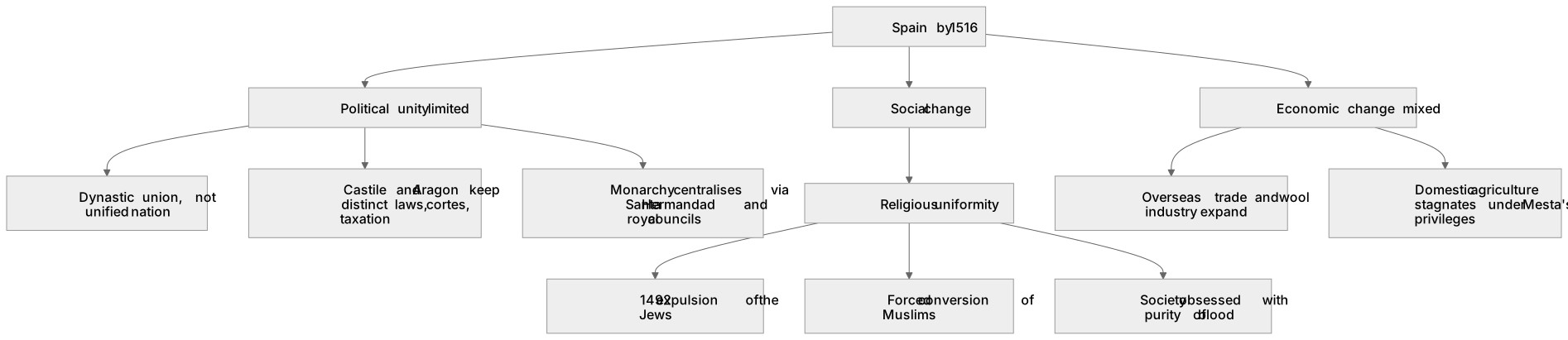
Key words
Say what each word means before you turn the card.
State-building
Try answering aloud or in your head before turning the card.
Centralisation
Try answering aloud or in your head before turning the card.
Religious uniformity
Try answering aloud or in your head before turning the card.
Economic development
Try answering aloud or in your head before turning the card.
See every definition
- State-building
- The forging of a new state by 1516 through monarchical authority, royal councils and the Santa Hermadad, while Castile and Aragon retained distinct laws, cortes and taxation.
- Centralisation
- The monarchy centralised power via the Santa Hermadad and royal councils, though Castile and Aragon kept distinct laws, cortes and taxation.
- Religious uniformity
- A drive creating a society obsessed with 'purity of blood', notably through the 1492 expulsion of the Jews and forced conversion of Muslims.
- Economic development
- Mixed change in which overseas trade and the wool industry expanded, but domestic agriculture stagnated under the Mesta's privileges.
Label the diagram
Some boxes have lost their names. Pick the right name for each number.
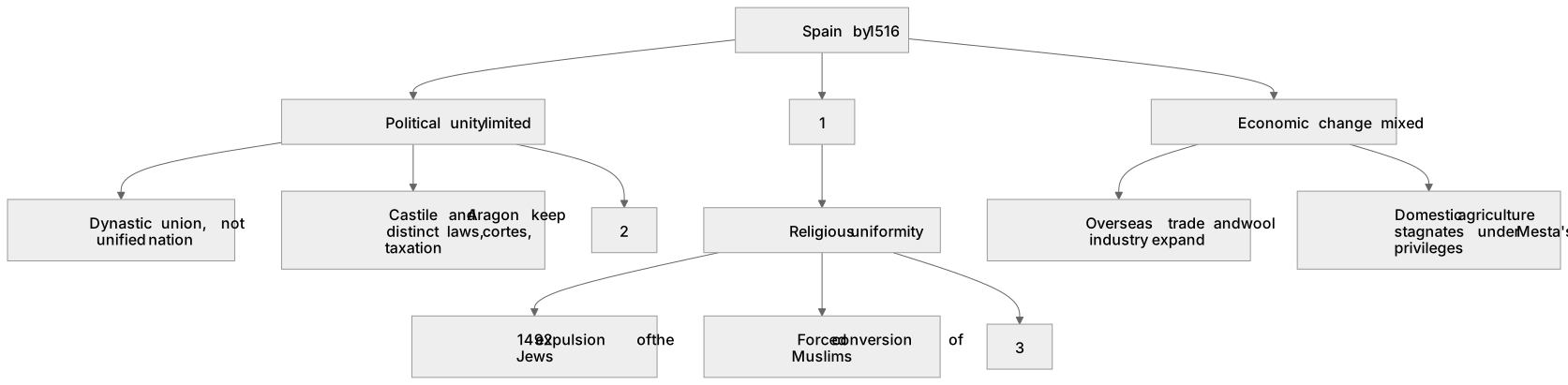
1Box 1
2Box 2
3Box 3
There is more to this lesson
The full lesson goes on to check your understanding and help you earn the marks. Create a free account to carry on, with your progress saved.
A week of Premium from your first lesson · Then the free plan continues · No card, no charge
Test your understanding of 1B Spain in the Age of Discovery, 1469–1598 (A-level only) – The forging of a new state, 1469–1516: The degree of political unity and social and economic change by 1516
Active recall beats re-reading. Take an instant quiz now to test what you’ve learned and lock it into long-term memory.
A week of Premium from your first lesson · Then the free plan continues · No card, no charge