AQA · A-Level · History
Course version: 7042 · Version from Sept 2017
Philip II as ruler: character; inheritance; change and continuity in…
Full specification wording
1B Spain in the Age of Discovery, 1469–1598 (A-level only) – The 'Golden Age', 1556–1598 (A-level only): Philip II as ruler: character; inheritance; change and continuity in government; administration and policy
Philip II’s character as the 'Prudent King' profoundly shaped his rule; his meticulous, often slow micro-management of state affairs contrasted with his father's peripatetic style.
Checked against the AQA 7042 specification (opens in a new tab) on .
- Point 1 of 6
Study notes
From the checked teaching notes for this specification point.
The idea
Philip II’s character as the 'Prudent King' profoundly shaped his rule; his meticulous, often slow micro-management of state affairs contrasted with his father's peripatetic style. Inheriting a vast, disparate empire and crippling debt from Charles V in 1556, Philip established a permanent capital in Madrid. He maintained continuity by utilising the conciliar system (polysynody) but enacted change by increasingly relying on small juntas and secretaries (letrados) rather than grandees to streamline administration. His domestic policy focused on centralising power, enforcing religious orthodoxy through the Inquisition, and managing the immense logistical challenges of governing a global empire via extensive written correspondence.
What earns the marks
- Evaluate how Philip's cautious character and reliance on written documents led to severe administrative bottlenecks.
- Assess the impact of his inheritance from Charles V, specifically the division of the Habsburg lands and the immediate burden of royal bankruptcy in 1557.
- Analyse the continuity of the conciliar system alongside the change towards using specialised juntas and personal secretaries like Mateo Vázquez.
- Examine Philip's administrative policies, including the Castilianisation of the empire and the establishment of Madrid as the permanent court in 1561.
Common mistakes and how to put them right
Claiming Philip II inherited the Holy Roman Empire.
Put it right: Charles V divided his lands; Philip inherited Spain, the Netherlands, Naples, and the Americas, while the imperial title went to Ferdinand.
Stating Philip completely abolished the conciliar system.
Put it right: He retained the councils but bypassed them for sensitive matters by using smaller, informal juntas and personal secretaries.
Assuming Philip's government was highly efficient due to his hard work.
Put it right: His micromanagement and insistence on reading all dispatches often paralysed decision-making.
Exam tips
- Use the establishment of Madrid in 1561 as concrete evidence of Philip's shift towards a centralised, sedentary administration.
- Contrast Philip's reliance on university-educated letrados with the traditional political power of the high nobility to demonstrate administrative change.
- When evaluating his inheritance, explicitly link the financial debts left by Charles V to Philip's subsequent domestic and foreign policy constraints.
Try the lesson
The start of the 1B Spain in the Age of Discovery, 1469–1598 (A-level only) – The 'Golden Age', 1556–1598 (A-level only): Philip II as ruler: character; inheritance; change and continuity in government; administration and policy lesson, made from checked teaching notes for this specification point.
Have a go first
Which of the following best describes Philip II's personal approach to government and administration in Spain?
Listen
Philip II’s character as the 'Prudent King' profoundly shaped his rule; his meticulous, often slow micro-management of state affairs contrasted with his father's peripatetic style. Inheriting a vast, disparate empire and crippling debt from Charles V in 1556, Philip established a permanent capital in Madrid. He maintained continuity by utilising the conciliar system (polysynody) but enacted change by increasingly relying on small juntas and secretaries (letrados) rather than grandees to streamline administration. His domestic policy focused on centralising power, enforcing religious orthodoxy through the Inquisition, and managing the immense logistical challenges of governing a global empire via extensive written correspondence. A strong answer earns marks for these points. Evaluate how Philip's cautious character and reliance on written documents led to severe administrative bottlenecks. Assess the impact of his inheritance from Charles V, specifically the division of the Habsburg lands and the immediate burden of royal bankruptcy in 1557. Analyse the continuity of the conciliar system alongside the change towards using specialised juntas and personal secretaries like Mateo Vázquez. Examine Philip's administrative policies, including the Castilianisation of the empire and the establishment of Madrid as the permanent court in 1561. A common slip: Claiming Philip II inherited the Holy Roman Empire. Instead, Charles V divided his lands; Philip inherited Spain, the Netherlands, Naples, and the Americas, while the imperial title went to Ferdinand. Exam tip: Use the establishment of Madrid in 1561 as concrete evidence of Philip's shift towards a centralised, sedentary administration.
See it
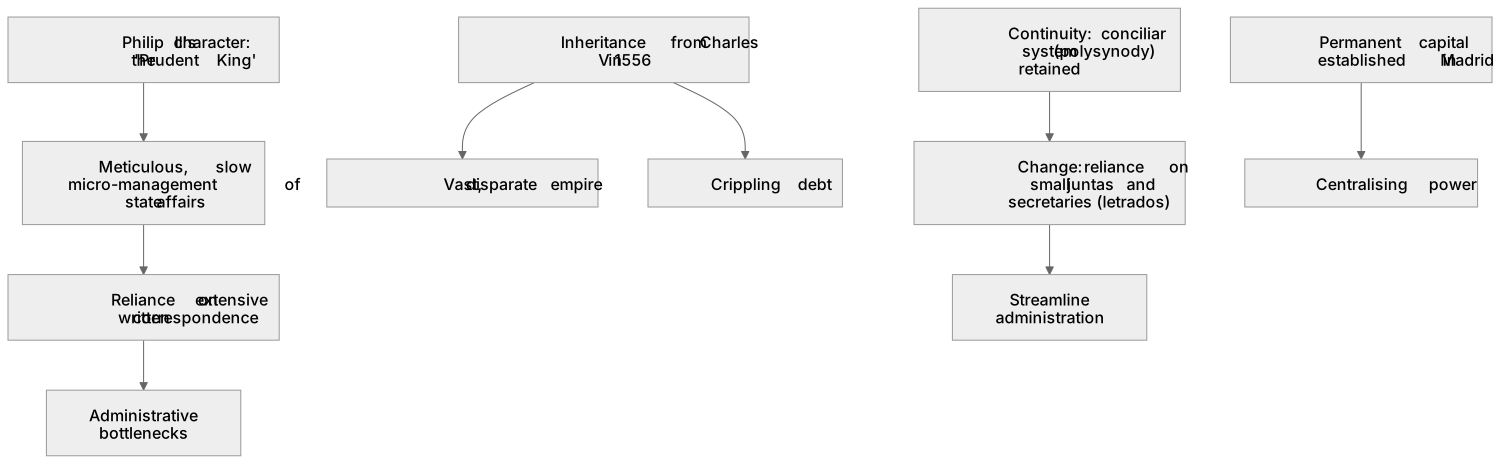
Label the diagram
Some boxes have lost their names. Pick the right name for each number.
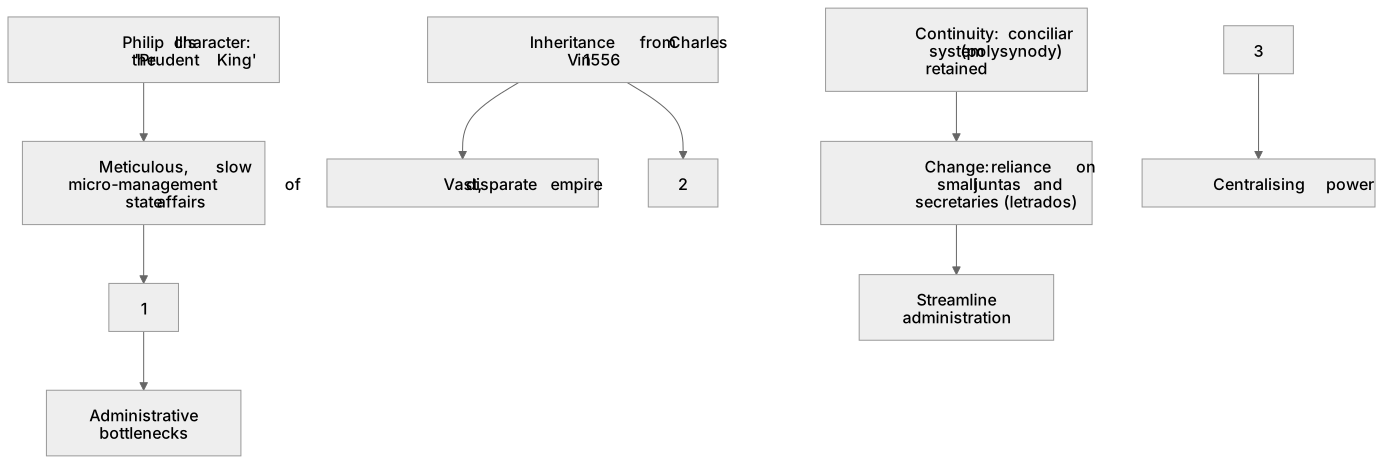
1Box 1
2Box 2
3Box 3
There is more to this lesson
The full lesson goes on to check your understanding and help you earn the marks. Create a free account to carry on, with your progress saved.
A week of Premium from your first lesson · Then the free plan continues · No card, no charge
Test your understanding of 1B Spain in the Age of Discovery, 1469–1598 (A-level only) – The 'Golden Age', 1556–1598 (A-level only): Philip II as ruler: character; inheritance; change and continuity in government; administration and policy
Active recall beats re-reading. Take an instant quiz now to test what you’ve learned and lock it into long-term memory.
A week of Premium from your first lesson · Then the free plan continues · No card, no charge